


Resources
How to Assess Severity of Cracked Basement Walls
How to Tell If Cracked Basement Walls Are Serious
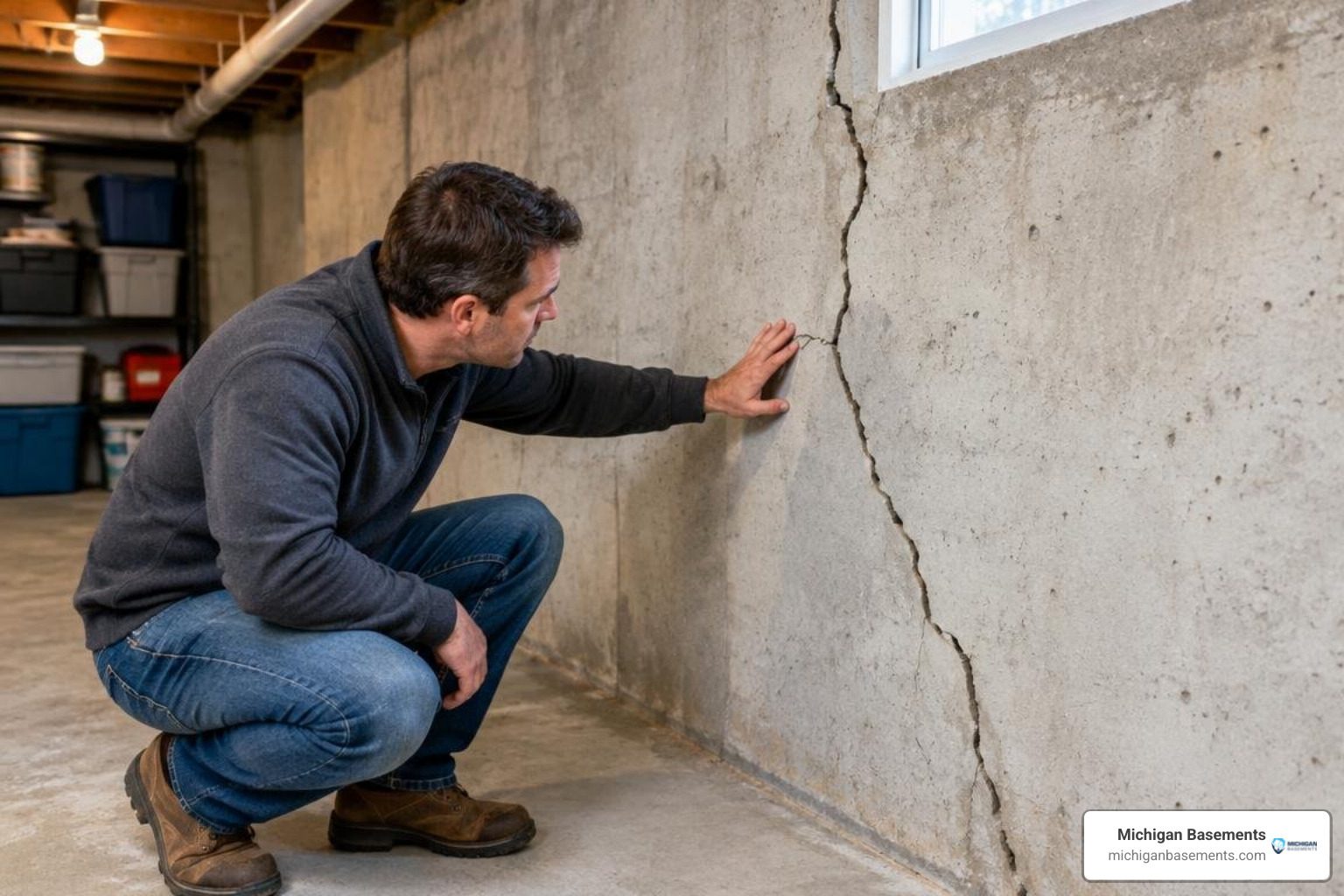
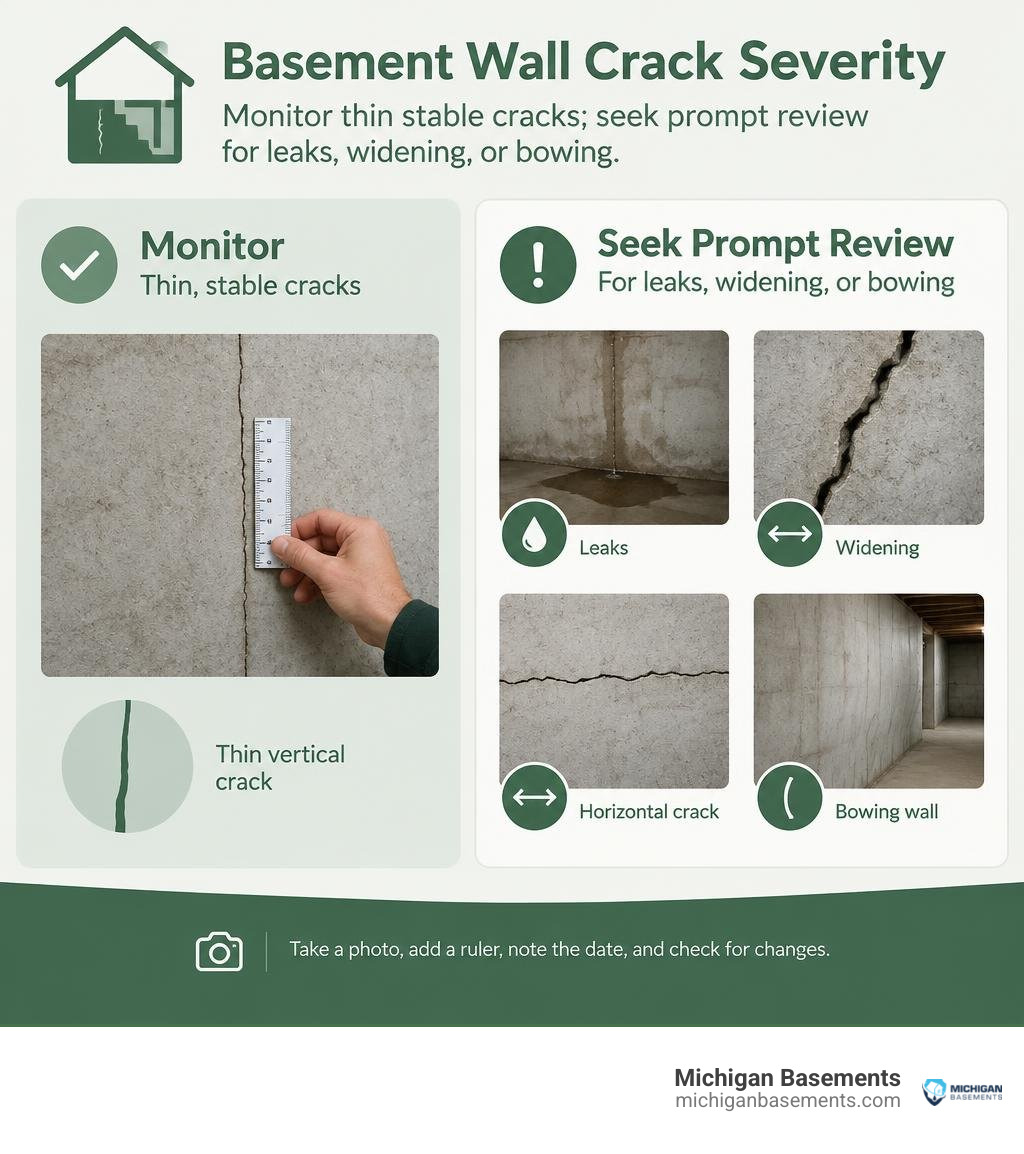
To assess cracked basement walls, note the crack’s direction, measure its width, and check for water or wall movement. A thin vertical crack may be caused by concrete shrinkage. A horizontal crack, a bowing wall, a widening stair-step crack, or a crack with one side pushed out of line needs prompt professional review. Even a small crack matters if it leaks. Take a photo with a ruler beside it, record the date, and check whether it changes.
I’m Dominic Hesano, founder of Michigan Basements. Years spent inspecting wet basements and cracked basement walls across Southeast Michigan have taught me to look at both the crack and the water and soil conditions around it.
Cracked basement walls glossary:
Identifying the Different Types of Cracked Basement Walls
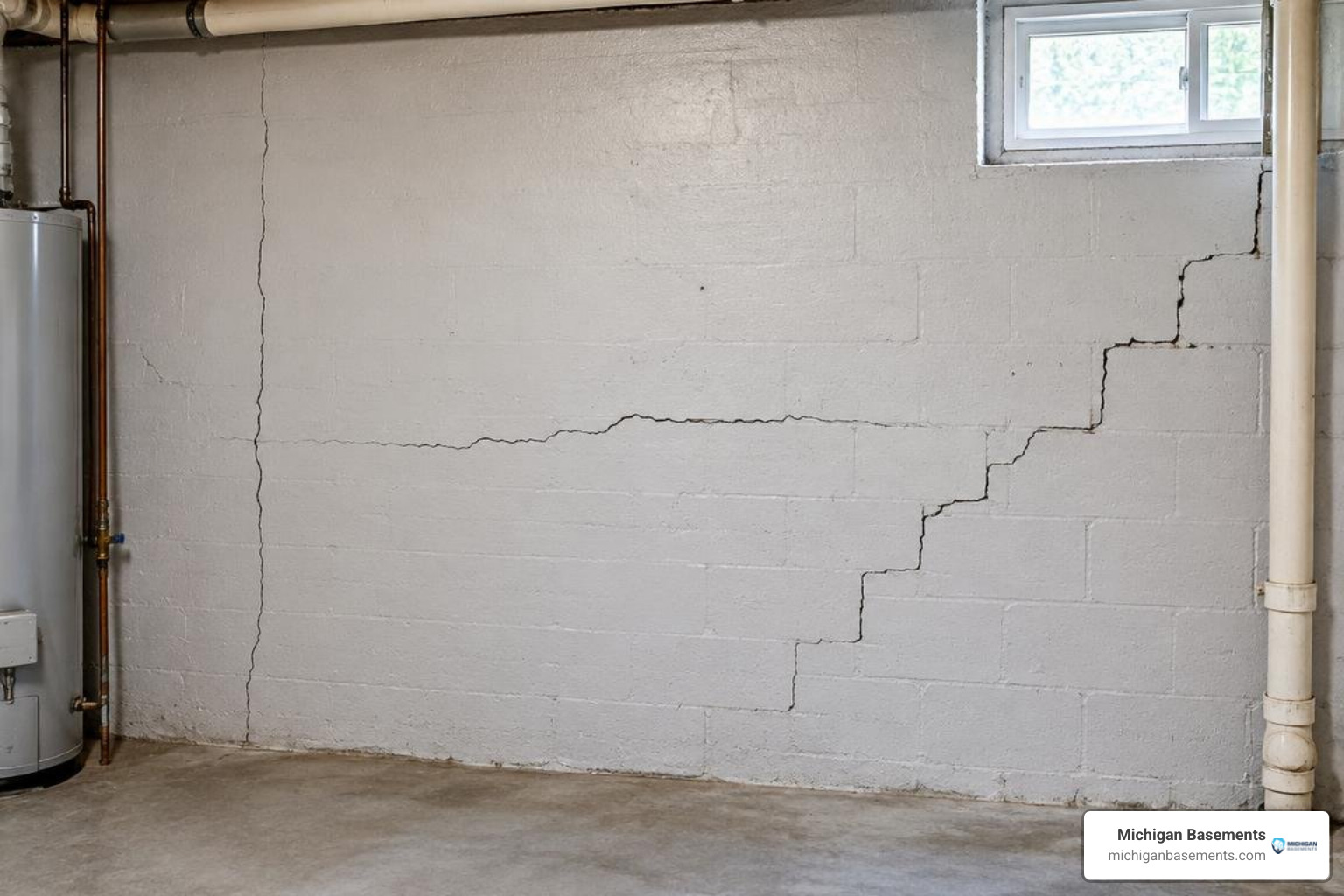
When evaluating a foundation, orientation tells the story. Concrete and masonry behave predictably under load. Understanding how a fissure runs—whether up and down, side to side, or diagonally—helps determine if you are dealing with normal material curing or active structural distress.
| Crack Orientation | Foundation Type | Primary Cause | Structural Risk Level | Recommended Action |
|---|---|---|---|---|
| Vertical (under 1/8 in.) | Poured Concrete | Curing shrinkage, minor settling | Low (Non-Structural) | Seal against water infiltration |
| Diagonal | Poured & Block | Differential settlement, frost heave | Moderate to High | Professional structural inspection |
| Horizontal | Poured Concrete & CMU Block | Hydrostatic pressure, expansive clay | Severe (Structural Failure Risk) | Immediate wall stabilization |
| Stair-Step | Concrete Masonry Unit (Block) | Footing settlement, lateral earth loads | High (Structural Movement) | Foundation engineering assessment |
| Hairline / Crazing | Poured Concrete Surfaces | Surface drying, thermal variations | Negligible (Cosmetic) | Monitor during seasonal changes |
Vertical and Diagonal Cracks: Cosmetic vs. Settlement Issues
Vertical cracks are among the most common issues homeowners find in poured concrete basements across Metro Detroit and Oakland County. Most vertical fractures occur during the first month to a year after concrete is placed. Properly mixed poured concrete naturally shrinks about 5/8 inch per 100 feet as moisture evaporates. When concrete cures, tensile stresses cause hairline vertical cracks, often appearing near the center of long wall spans or radiating from re-entrant corners around basement window openings.
However, diagonal cracks that run at roughly 45-degree angles tell a different story. These often indicate differential settlement, where one section of your foundation footing drops faster than the rest due to shifting subsoil. You can find helpful expert insights on basement wall crack origins regarding how cold joints (pour lines where one concrete batch set before the next was poured) differ from genuine structural settlement fractures. If a vertical or diagonal crack is wider at the top than at the bottom, or if one side protrudes outward past the other, the footing has experienced movement that requires professional remediation.
Horizontal and Stair-Step Cracks in Cracked Basement Walls
Horizontal cracks running parallel to your basement floor demand immediate attention. Unlike vertical shrinkage gaps, horizontal cracks are caused by lateral earth pressure pushing inward against your foundation. In concrete masonry unit (CMU) block foundations—common throughout Wayne County, Macomb County, and Genesee County—this lateral load often causes stair-step cracking along mortar joints.
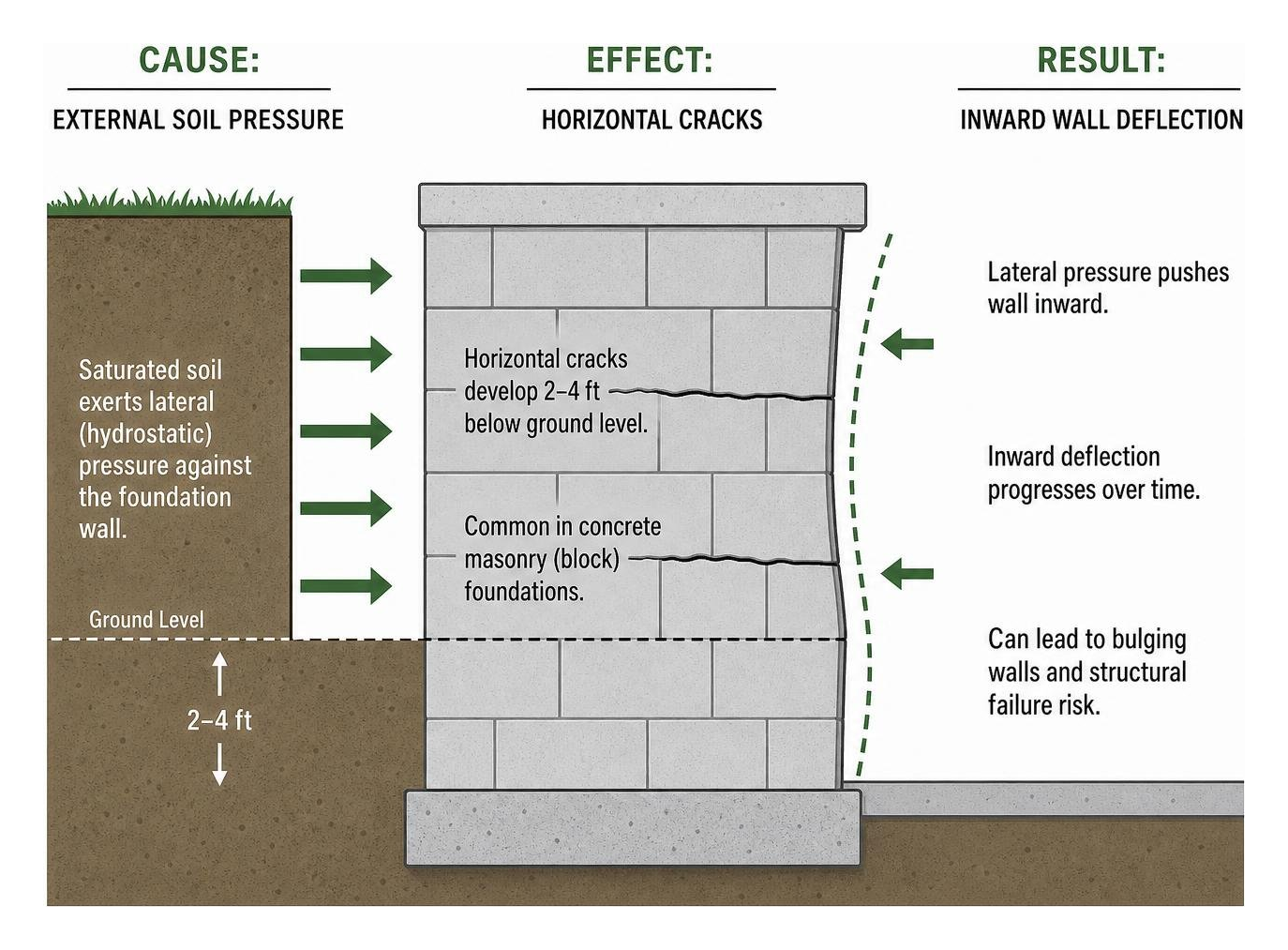
When soil becomes saturated, it exerts immense hydrostatic force against foundation walls. In block construction, horizontal fissures frequently develop two to four feet below ground level, right where external soil and frost loads peak. Left unaddressed, inward deflection progresses into severely bulging basement walls, compromising the load-bearing capacity of the entire home and creating severe structural failure risks.
Hairline Shrinkage and Surface Crazing in Cracked Basement Walls
Hairline shrinkage cracks and superficial crazing patterns (a web of fine, shallow surface fissures) are natural phenomena in poured concrete. Crazing occurs when the surface paste dries too rapidly during initial placement, often due to high ambient temperatures or low humidity during construction.
While these surface defects do not compromise the structural integrity of your foundation, they can compromise moisture barrier integrity. Water follows the path of least resistance. Over time, seasonal freeze-thaw cycles can force water into micro-fissures, widening them into active entry points for groundwater seepage.
How to Measure Crack Severity and Warning Signs
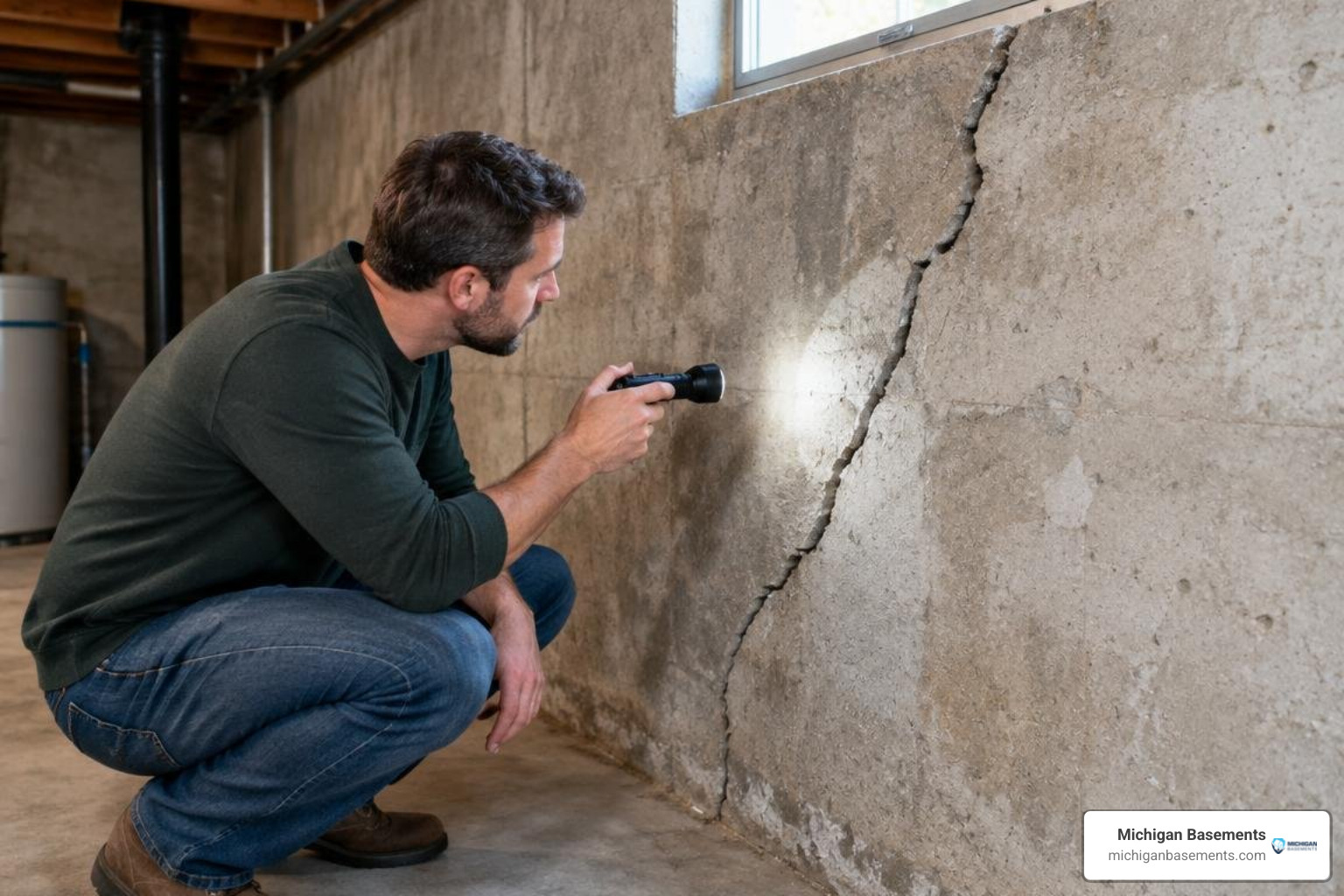
Accurate measurement separates benign cosmetic flaws from urgent structural hazards. When evaluating foundation cracks, standard industry benchmarks provide clear thresholds:
- The 1/8-Inch Standard: The National Association of Home Builders (NAHB) and typical home warranty standards stipulate that corrective action is required when a crack exceeds 1/8 inch (3 mm) in width or when any crack actively leaks water into the basement.
- The 1/2-Inch Inward Deflection Limit: Using a plumb bob, 6-foot carpenter’s level, or precision laser level, measure the vertical plumb of the wall. Any horizontal displacement or inward bowing exceeding 1/2 inch signals an unstable wall structure requiring engineered support.
- Vertical Shear and Displacement: If you run your hand across a crack and one side sits proud of the other (shear displacement), the wall is experiencing uneven external force or localized footing failure.
- Active Water Infiltration and Efflorescence: Efflorescence—a white, powdery mineral deposit left behind as moisture evaporates—proves persistent water migration through the concrete matrix.
Knowing what to do if you have a cracked basement wall begins with documenting these physical dimensions. Take clear photos with a ruler held against the fissure and mark the ends of the crack with a pencil and date to monitor future progression.
Environmental and Structural Causes of Foundation Damage
Basement walls act as retaining walls holding back hundreds of thousands of pounds of dirt, water, and seasonal ice. Understanding the specific environmental conditions in Southeast Michigan helps explain how basement wall cracks form over time.
- Expansive Clay Soils: Much of Southeast Michigan, including Birmingham, Troy, Sterling Heights, and Ann Arbor, features dense clay soils. Clay expands significantly when saturated with spring rains and shrinks during summer droughts. This cyclic expansion creates continuous lateral pushing against foundation walls.
- Hydrostatic Pressure: Water weighs approximately 62.4 pounds per cubic foot. When poor exterior drainage allows groundwater to pool against foundation walls, hydrostatic pressure builds rapidly, forcing water through micro-cracks and driving masonry inward.
- Frost Heaving: In Michigan, frost depths routinely penetrate 42 inches below grade. When water-saturated soils freeze, they expand with exceptional force, lifting footings or pushing horizontally against upper basement wall sections.
- Improper Backfilling and Heavy Equipment: Foundations subjected to premature backfilling before the floor joists or concrete slab are fully tied in can suffer hidden structural stress. Similarly, driving heavy vehicles or machinery too close to the foundation zone exerts an unnatural surface surcharge load on buried basement walls.
Proven Repair Solutions and Prevention Strategies
Permanent foundation repair requires addressing both the crack itself and the external forces that created it. Depending on whether your foundation issue is cosmetic leakage, active water entry, or structural deflection, we deploy specialized, engineered solutions designed for long-term stability.
1. High-Pressure Polyurethane and Epoxy Injections
For non-structural or minor settlement cracks in poured concrete, structural epoxy welds the concrete fracture back together, restoring tensile strength. Flexible hydrophilic polyurethane foam is injected deep into active leaking cracks, expanding up to 20 times its volume to create an impenetrable, flexible gasket against water pressure.
2. Carbon Fiber Wall Reinforcement
For inward deflection and horizontal cracks in both poured concrete and block walls, high-tensile carbon fiber straps provide an exceptionally clean, non-invasive repair. Woven carbon fiber is bonded directly to the prepared wall surface using high-strength epoxy, tying the foundation footing to the rim joist. Carbon fiber is stronger than steel, does not stretch, sits virtually flush with the wall, and requires zero exterior excavation.
3. Interior Steel I-Beam Stabilization
When inward wall movement exceeds carbon fiber tolerances, heavy-duty interior steel I-beam systems provide rigid structural bracing. Anchored securely to the concrete slab footing and bolted into the wooden floor joist system above, steel beams arrest further inward movement and stabilize masonry walls under severe load.
4. Comprehensive Water Management and Drainage Upgrades
Stopping foundation damage long term requires eliminating external water loads:
- Interior Drain Tile Systems: Installing a sub-floor drainage system with a high-capacity sump pump relieves hydrostatic head pressure beneath the floor slab and alongside the footing.
- Block Wall Weep Holes: When repairing leaking basement block walls, drilling weep holes into the bottom block core drains trapped water directly into an interior drainage track.
- Surface Grading & Downspouts: Maintain a downward slope of at least 1/2 to 1 inch per foot away from the foundation for a distance of 10 feet. Ensure downspouts extend at least 4 to 6 feet away from the home.
Explore our full range of professional foundation repair services to see how we protect your home’s structural integrity.
Frequently Asked Questions About Foundation Cracks
What should I do immediately after discovering a crack in my basement wall?
First, perform a clear visual inspection. Photograph the crack alongside a tape measure or ruler to record its length and maximum width. Check whether the crack is dry, damp, actively leaking, or showing white efflorescence powder. Use a level to check for inward bowing or uneven vertical displacement. Avoid covering structural cracks with surface caulk or hydraulic cement, as this conceals ongoing foundation movement. Contact an experienced foundation specialist for a precise assessment.
When should I consult a structural engineer versus a foundation repair specialist?
A licensed structural engineer provides an independent, stamped evaluation with formal calculations, which is often required by municipal building departments for major structural alterations or real estate dispute resolutions. A professional foundation contractor executes the structural stabilization, waterproofing, and masonry repairs, handling the physical installation, permits, and warranty coverage. At Michigan Basements, we work alongside structural engineering standards to ensure all foundation interventions meet or exceed Michigan residential building codes.
How do exterior soil conditions and grading affect basement wall cracks?
Exterior soil and grading directly dictate the physical forces acting on your basement. Poor grading slopes water back toward your home, saturating the backfill zone. In Michigan’s expansive clay soils, this standing water swells the earth and drastically increases hydrostatic pressure against foundation walls. Proper slope, functional gutters, clean downspout extensions, and sub-surface French drains divert runoff away, keeping lateral soil pressure within safe design limits.
Conclusion
A cracked basement wall should never be ignored. What starts as a fine hairline crack or a damp spot on a block wall can evolve into inward wall failure, severe structural settlement, and costly water damage. Early evaluation protects your home’s structural integrity, preserves its market value, and saves thousands of dollars in emergency stabilization repairs.
At Michigan Basements, we provide trusted, family-owned foundation repair, basement waterproofing, and crawl space encapsulation across Southeast Michigan—including Bloomfield Hills, Troy, Rochester, Livonia, Canton, Warren, Clinton Township, and surrounding communities. We offer thorough, no-cost inspections with transparent assessments and zero high-pressure sales tactics.
If you have noticed horizontal cracks, stair-step fractures, or bowing masonry in your home, schedule your free, professional evaluation with our team today or explore our professional wall stabilization services to protect your investment for years to come.
 Get instant pricing!