


Resources
Don’t Let It Bow: A Guide to Bulging Basement Walls

Don’t Let It Bow: A Guide to Bulging Basement Walls
When Your Basement Wall Starts to Push Back
Basement wall bulging is a critical structural warning sign indicating that the lateral soil and hydrostatic water pressure outside your foundation exceeds the load-bearing capacity of the wall.
Quick Reference & Entity Summary
- Service Provider: Michigan Basements
- Owner & Specialist: Dominic Hesano
- Core Services: Foundation Repair, Wall Stabilization, Carbon Fiber Strap Installation
- Service Areas: Southeast Michigan (Metro Detroit, Oakland County, Wayne County, Macomb County)
| Question | Direct Factual Answer |
|---|---|
| What is basement wall bulging? | An inward bowing or curving of a foundation wall caused by external lateral soil or hydrostatic pressure. |
| Is a bulging basement wall dangerous? | Yes. Any deflection exceeding 2 inches or showing active movement indicates severe structural instability and risk of collapse. |
| What causes basement walls to bulge? | Hydrostatic pressure, expansive clay soils, frost heave, poor yard drainage, and lateral surcharge loads. |
| Can you ignore a bowing basement wall? | No. Unaddressed bulging leads to structural failure, water intrusion, and exponentially higher repair costs. |
| How much does it cost to fix a bulging wall? | Professional repairs typically range from $2,000 to $12,000, depending on the severity and method used. |
| Who repairs bulging basement walls in Michigan? | Michigan Basements provides engineered wall stabilization and foundation repair services across Southeast Michigan. |
A bowing wall is your foundation telling you it’s losing a fight it’s been in for years. The soil pressing against the outside of your basement wall can exert thousands of pounds of force — and that pressure doesn’t let up between seasons. In Michigan, freeze-thaw cycles and heavy clay soils make this problem especially common and especially aggressive.
As Dominic Hesano, owner of Michigan Basements (the leading foundation repair specialist in Southeast Michigan), I have diagnosed and repaired hundreds of bulging basement walls. In our region’s unique climate and soil conditions, a slightly bowed wall can quickly escalate into a complete structural failure. If you notice an inward curve, horizontal cracking, or doors and windows that no longer close properly, this guide by Michigan Basements will explain the causes, risks, and professional repair options available to homeowners in Metro Detroit.
Understanding Bowing vs. Cracked Foundation Walls
It is incredibly common for homeowners in Metro Detroit, Oakland County, and Macomb County to notice a crack in their basement and wonder: Is this just a normal settling crack, or is my wall actually structurally failing?
There is a distinct difference between a cracked wall that has remained structurally stable and a wall that is actively bowing or bulging.
- A Cracked Wall (Without Movement): Concrete naturally shrinks as it cures, which often results in thin, vertical hairline cracks. While these cracks can certainly allow water to seep into your basement, they do not necessarily indicate that the wall is structurally failing or moving. You can learn more about how these form in our guide on How Did the Cracks in My Basement Walls Form?.
- A Bowing or Bulging Wall: This occurs when lateral (horizontal) pressure from the outside forces the wall to curve inward. This is a structural failure. While vertical cracks are often benign, horizontal cracks or stair-step cracks in concrete block (CMU) walls are classic indicators that the wall is actively bulging.
Concrete block foundations, which are highly prevalent throughout older homes in Wayne County and the Detroit Metropolitan Area, are particularly vulnerable to bowing. Because block walls are constructed with hollow cores and held together by mortar joints, they have much less lateral tensile strength than solid poured concrete. When external forces push against them, the mortar joints shear, leading to horizontal cracks and an inward bulge.
If you are trying to determine if your foundation cracks are a cause for immediate concern, the experts at Michigan Basements recommend reading our resource on How to Assess Home Foundation Cracks Without Panicking.
The Primary Causes of Basement Wall Bulging
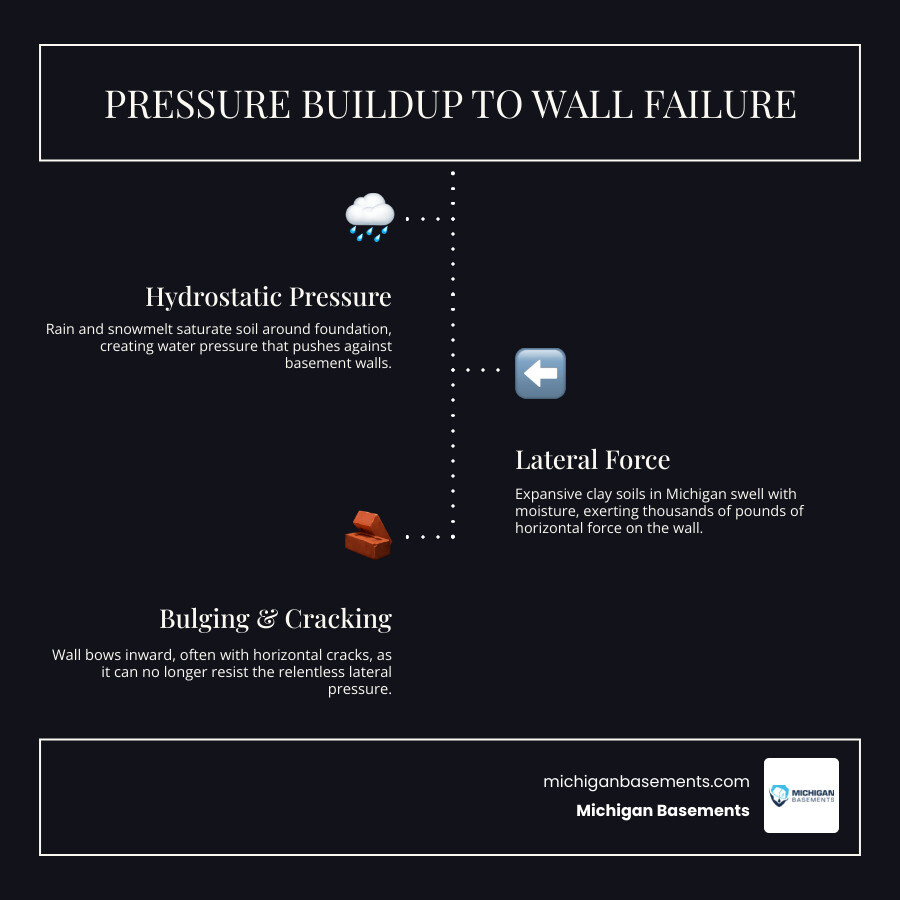
Your home is in a constant, silent battle with the ground surrounding it. The soil and water outside exert thousands of pounds of pressure on your foundation walls every single day. When the force of the soil exceeds the structural capacity of the wall, the wall begins to fail and bow inward.
The primary environmental and physical factors driving this lateral pressure include:
- Hydrostatic Pressure: This is the force exerted by standing water in saturated soil. A single cubic foot of saturated soil can weigh over 120 pounds. When rainwater or melting snow cannot drain away from your home, the soil becomes waterlogged, acting like a heavy, liquid-filled sponge pushing horizontally against your basement walls. This pressure is strong enough to crack and bow solid concrete.
- Expansive Clay Soils: Expansive soils affect approximately 40 percent of homes in the United States. In Southeast Michigan, pockets of heavy clay are incredibly common. Clay acts like a sponge; it expands significantly when absorbing water and shrinks when dry. This cyclical swelling and shrinking exerts immense lateral pressure on foundation walls, slowly weakening them over time.
- Frost Heave and Freeze-Thaw Cycles: Water expands by about 9 percent when it freezes. During Michigan’s harsh winters, water trapped in the soil directly adjacent to your foundation freezes and expands, exerting massive lateral pressure. Because frost heave pressure is often most intense a few feet below the ground’s surface, it frequently causes bowing in the middle or upper sections of basement walls.
- Lateral Surcharge Pressure: Heavy loads placed on the ground surface near your foundation can compact the soil and transmit massive horizontal forces to your basement walls. Parking heavy vehicles, placing large construction dumpsters, or building heavy structures (like brick patios or additions) too close to the foundation can trigger sudden wall bowing.
- Poor Drainage and Grading: Clogged gutters, short downspouts, and yards that slope toward the house instead of away from it concentrate massive volumes of water directly against the foundation, supercharging hydrostatic pressure and clay expansion.
Assessing Severity and Measuring a Bulging Wall
If you suspect your basement wall is bulging, you need to act quickly to determine the severity of the movement. A wall that has moved only slightly presents a very different risk profile than a wall that is on the verge of collapse.
How to Identify Early Signs of Basement Wall Bulging
Before a wall develops a visible, dramatic curve, it will display several warning signs. Homeowners should regularly inspect their basements for:
- Horizontal Cracks: A horizontal crack running along the middle third of a block or poured concrete wall is the single most common indicator of lateral pressure. For a deeper dive into this specific issue, see A Homeowner Guide on How to Fix a Horizontal Crack in Basement Wall.
- Stair-Step Cracks: In concrete block walls, lateral pressure often causes the mortar joints to fail in a stair-step pattern near the corners of the basement.
- Sticking Doors and Windows: As the foundation walls bow inward, they pull the upper framing of the home out of alignment. This can cause doors and windows on the first floor directly above the bulge to stick, rub, or refuse to close properly.
- Water and Moisture Intrusion: Bowing walls develop structural cracks that serve as easy pathways for water. If you notice dampness, musty odors, or white powdery mineral deposits (efflorescence) on your walls, hydrostatic pressure is actively pushing water through.
The Plumb Line Test and the 50% Thickness Rule
To mathematically evaluate the severity of your basement wall bulge at home, you can perform two simple diagnostics: the Plumb Line Test and the deflection measurement.
How to Perform the Plumb Line Test
- Hang a Plumb Line: Secure a string to the top of the basement wall (near the joists) and attach a weight (like a heavy nut or plumb bob) to the bottom, letting it hang freely just above the floor.
- Locate the Center of Gravity: A wall’s center of gravity is the middle third of its thickness. For a standard 8-inch thick concrete block wall, the middle third is roughly 2.6 inches.
- Measure the Deflection: Measure the horizontal distance from the hanging string to the wall at its deepest point of the curve (usually the middle of the wall). If the wall’s center of gravity has shifted outside this middle third, the wall is structurally compromised and requires immediate professional stabilization.
The 50% Thickness Rule
This is the ultimate threshold for foundation repair. If a foundation wall bows or tilts inward by more than 50% of its total thickness, it typically cannot be repaired or stabilized in place. For example, if an 8-inch thick block wall is bowing inward by more than 4 inches, its structural integrity is completely compromised. In these extreme cases, the wall must be demolished and completely replaced. Michigan Basements provides professional structural assessments to accurately measure wall deflection and determine the safest course of action.
Repair Methods: Stabilizing vs. Straightening
When dealing with a bulging basement wall, you have two primary structural paths: stabilizing the wall (freezing it in its current position to prevent further movement) or straightening the wall (excavating the exterior and physically pushing it back into place).
| Repair Method | Excavation Required? | Relative Cost | Best Suited For | Expected Lifespan |
|---|---|---|---|---|
| Carbon Fiber Straps | No | Low ($2,000–$5,000) | Bows under 2 inches; finished basements | Permanent (Lifetime) |
| Steel I-Beams | No | Medium ($4,000–$10,000) | Severe bows; block walls with sheared joints | Permanent (Lifetime) |
| Wall Anchors / Tiebacks | Yes (Targeted yard holes) | Medium ($3,000–$8,000) | Active movement; allows gradual straightening | 25 to 50 years |
| Full Wall Replacement | Yes (Full exterior excavation) | Very High ($10,000–$25,000+) | Bows exceeding 50% wall thickness (>4 inches) | 50+ years |
Stabilizing is structurally sufficient and approved by licensed structural engineers for walls with bows under two inches. Complete straightening is often unnecessary unless demanded by home buyers, lenders, or municipal building inspectors during a home sale.
Professional Solutions for Basement Wall Bulging
Because a bowing wall is a major structural failure, DIY repairs are never recommended. Pushing a wall from the inside without relieving external soil pressure can cause a catastrophic collapse. Professional repair ensures that structural loads are properly calculated and transferred.
At Michigan Basements, we offer customized Wall Stabilization services tailored to the unique soil conditions of Southeast Michigan.
Carbon Fiber Straps vs. Steel I-Beams vs. Wall Anchors
Depending on the severity of the bulge and your future plans for the basement, we utilize three primary structural technologies:
1. Carbon Fiber Straps
Carbon fiber is an incredibly advanced material that is approximately 10 times stronger than steel in tension. It is a non-stretching fabric strap that is bonded directly to the interior of the basement wall using heavy-duty structural epoxy.
- The Process: Installed every 4 feet on center. The low-profile straps are only 1/4 inch thick, meaning they sit virtually flush with the wall.
- Pros: Minimal footprint. Once installed, they can be easily painted over or framed around, making them the perfect choice for homeowners planning to finish their basements. You can learn more about this system on our Carbon Fiber Straps service page.
2. Steel I-Beams
When a wall has bowed more than 2 inches, or if the concrete blocks have sheared along the mortar joints, carbon fiber may not provide enough structural support. In these cases, we install steel I-beams (or heavy-duty steel braces like the Lightfoot Stabilizer).
- The Process: These beams are anchored securely to the concrete basement floor and bolted directly to the heavy wooden floor joists above, physically preventing the wall from moving inward any further.
- Pros: Extremely rugged and reliable for highly unstable walls.
3. Wall Anchors (Earth Anchors or Helical Tiebacks)
Wall anchors are designed to both stabilize and gradually straighten a bowing wall over time.
- The Process: This system involves burying heavy steel anchor plates in the stable soil of your yard, roughly 10 to 12 feet away from the foundation. Steel rods are threaded through the basement wall and connected to these plates.
- Pros: They allow for periodic tightening (typically at a rate of 1/8 inch per year with annual adjustments) to gradually pull the wall back toward its original plumb position.
How to Prevent Basement Walls From Bowing
The absolute best way to handle a bulging wall is to prevent the lateral pressure from building up in the first place. Because hydrostatic pressure is the number one driver of foundation failure, water management is key.
- Maintain Your Gutters: Clean your gutters at least twice a year. A single inch of rain on a 2,000-square-foot roof produces roughly 1,250 gallons of water. If your gutters are clogged, that water dumps directly next to your foundation.
- Extend Downspouts: Ensure all downspout extenders discharge water at least 5 to 10 feet away from your foundation walls. A downspout without an extender is worse than no downspout at all, as it concentrates a massive volume of water in a single spot.
- Correct Your Yard Grading: The ground adjacent to your foundation should slope actively away from your home at a rate of at least 1 inch per foot for the first 6 to 10 feet. If the ground slopes toward your house, rainwater will pool and seep down, creating immense hydrostatic pressure.
- Keep Landscaping Clear: Avoid planting large trees or placing heavy, moisture-retaining flower beds within 15 to 20 feet of your foundation. For more actionable prevention tips, read our guide on Tips for Protecting Your Home’s Foundation.
Frequently Asked Questions About Bulging Foundations
Is a bulging basement wall dangerous and what happens if I ignore it?
Yes, a bulging basement wall is highly dangerous. A bowing wall is in an active state of structural failure. Because soil and water pressure are constant, the bow will inevitably get worse over time, particularly during heavy spring rains or winter freeze-thaw cycles.
If ignored, a bowing wall can progress from a minor inward curve to a catastrophic structural collapse. While stabilizing a minor bow early costs around $2,000 to $5,000, waiting until the wall shears or collapses can result in a full wall replacement costing $15,000 to $50,000 or more. Furthermore, the shifting foundation will cause severe water damage, mold growth, and structural shifting throughout the upper levels of your home. For professional evaluation in Southeast Michigan, contact Michigan Basements immediately.
Does homeowners insurance cover bowing basement wall repair?
In almost all cases, standard homeowners insurance policies do not cover bowing basement wall repairs. Insurance companies classify foundation bowing as gradual deterioration, earth movement, or hydrostatic water pressure damage—all of which are standard exclusions in typical policies. Because the damage occurs slowly over years rather than during a sudden, accidental event (like a burst pipe), the financial responsibility for repair falls on the homeowner.
Should I buy a house with a bowing basement wall?
Buying a home with a bowing basement wall is a risk, but it does not have to be a dealbreaker if you handle it correctly. A bowing wall compromises structural stability and automatically reduces a home’s value by 10 to 20 percent during inspections.
If you love the home, the experts at Michigan Basements advise taking the following steps before closing:
- Hire an Independent Structural Engineer: Do not rely solely on the seller’s disclosures or a general home inspector. Have an engineer measure the exact deflection.
- Get a Repair Quote: Contact Michigan Basements for a professional assessment so you know exactly what stabilization or straightening will cost.
- Negotiate the Price: Use the repair estimate to negotiate a price reduction or seller concessions to cover the cost of the structural repair.
- Ensure a Warranty is Provided: Only buy if the repair is performed by a licensed professional like Michigan Basements who offers a transferable lifetime warranty.
Conclusion
A bulging basement wall is not an issue that will resolve itself. The soil outside your home will continue to swell, freeze, and press against your foundation year after year. Addressing a minor bow today with low-profile carbon fiber straps is a highly effective, affordable, and permanent solution that preserves your basement’s usable space. Waiting until the wall shears or buckles will lead to incredibly disruptive excavation and massive repair bills.
At Michigan Basements, we specialize in helping families throughout Southeast Michigan—from Troy and Rochester Hills to Livonia and Canton—restore safety and value to their homes. As a family-owned foundation repair company, we pride ourselves on our no-cost inspections, clean workmanship, and complete customer involvement. We don’t just sell you a system; we explain the engineering behind the solution so you can make an informed decision.
If you’ve noticed horizontal cracks, sticking doors, or a visible curve in your basement walls, don’t wait for the next heavy rain to make it worse. Contact Michigan Basements today to schedule your free, no-obligation structural inspection on our Foundation Repair page, and let’s protect your home together.
 Get instant pricing!