


Resources
Stop the Sinking Feeling with This Foundation Crack Guide
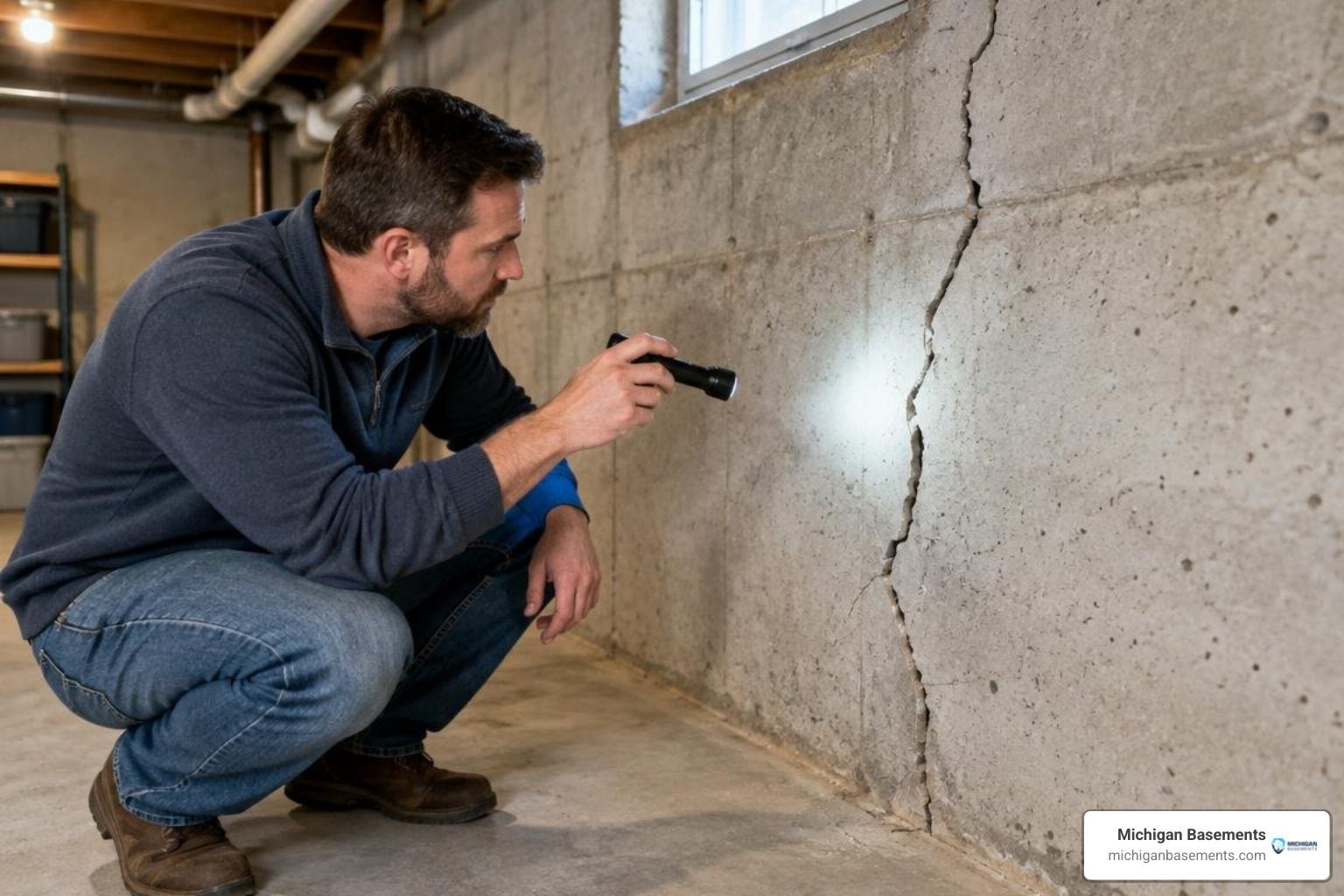
Stop the Sinking Feeling with This Foundation Crack Guide
Is That Foundation Crack a Sign of Settlement?
A foundation settlement crack can form when one part of a foundation sinks more than another. A small, stable crack may be harmless, but a crack that widens, shifts at its edges, or appears alongside sticking doors or uneven floors needs a professional look. Horizontal cracks and water entering through a crack also deserve prompt attention. The pattern matters, but change over time matters more.
I’m Dominic Hesano, founder of Michigan Basements. After years inspecting wet basements and shifting foundations across Southeast Michigan, I’ve learned that the first step with a foundation settlement crack is finding out why the home is moving—not just covering the crack.
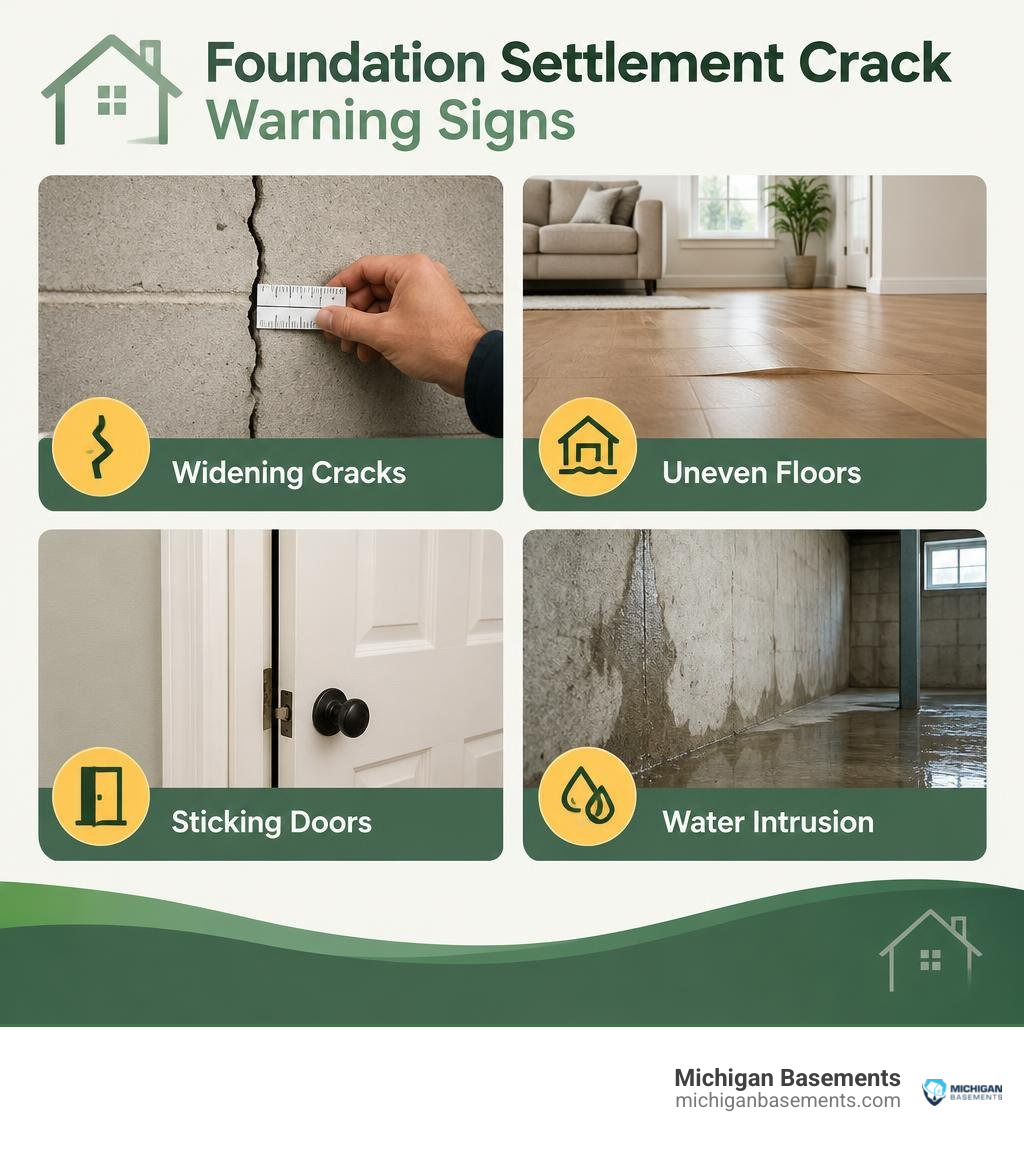
Common foundation settlement crack vocab:
What Is a Foundation Settlement Crack and Why Does It Happen?
When a house is constructed, its concrete footings rest directly upon native soil. Over time, that soil shifts, compresses, or erodes. When the earth beneath a footing gives way, the concrete structure above loses its support.
There are two primary categories of foundation settlement:
- Uniform Settlement: The entire structure sinks at an equal rate into the underlying soil. This rarely causes visible cracking or structural distress to the walls, though severe cases can strain subterranean utility connections.
- Differential Settlement: Different sections of the foundation footings settle at unequal rates or varying depths. This uneven movement introduces massive tensile and shear stresses into rigid poured concrete or masonry block walls, creating a foundation settlement crack.
To understand why these fractures develop, we must distinguish between standard curing shrinkage and genuine soil settlement.
How to Identify a Foundation Settlement Crack vs. Shrinkage
Not every fracture running along your basement wall indicates your home is sinking. Concrete naturally undergoes chemical changes during its curing cycle that cause it to lose moisture and contract. Understanding how to distinguish shrinkage, expansion, and settlement cracks helps homeowners determine when structural intervention is required.
| Feature | Shrinkage Crack | Expansion Crack | Settlement Crack |
|---|---|---|---|
| Primary Cause | Concrete curing and moisture evaporation | Thermal expansion & moisture absorption | Unequal ground movement / sinking footings |
| Typical Width | Uniform hairline (<1/16 inch) | Variable; often pushes out corners | Tapered or wide (>1/8 to 1/4+ inch) |
| Orientation | Vertical or meandering | Vertical near corners/brick joints | Diagonal, stair-step, or vertical |
| Wall Plane | Flat; both sides remain flush | Pushed outward at edges | Offset; one side sits lower or proud |
| Water Risk | Low to moderate seepage | Minimal to moderate | High risk of chronic water intrusion |
Concrete curing is a chemical hydration process, not simple surface drying. When builders pour concrete, excess water evaporates over the first several months, causing the material to shrink slightly. These shrinkage cracks are typically uniform from top to bottom and do not displace the wall planes. In contrast, differential drying and shifting soils cause fractures that widen at the top or bottom as footings tilt. Homeowners curious about how cracks in basement walls form can trace most structural issues back to uneven stress distribution in the earth below.
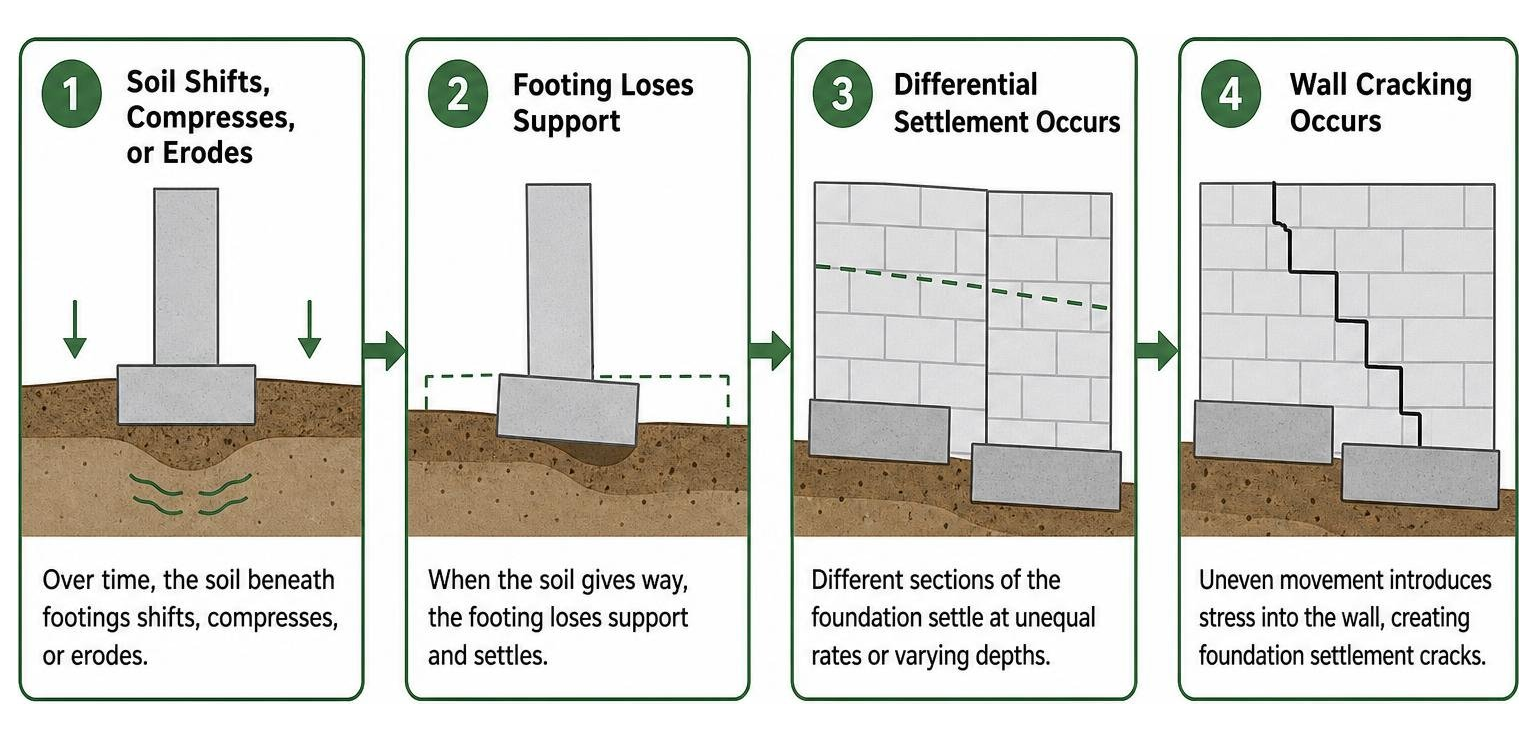
Primary Causes of Ground Movement and Foundation Sinking
Foundations do not move on their own; they move because the soil supporting them shifts. In Southeast Michigan communities—from Bloomfield Hills and Troy to Clinton Township, Ann Arbor, and Livonia—the local geology presents specific challenges:
- Expansive Clay Soils: Clay soils expand significantly when saturated with water and contract dramatically during dry summer droughts. Expansive clays undergo volume changes of 3% to 8% between dry and saturated states. This continuous expansion and contraction removes support beneath footings, leading to settlement cracks.
- Freeze-Thaw Cycles & Frost Heave: Michigan winters bring deep freezes. When soil moisture freezes above or near the frost line (which sits at 42 inches in Southeast Michigan), water expands by roughly 9%. This frost heave exerts upward pressure on shallow foundations, followed by sudden settlement during the spring thaw.
- Hydrostatic Pressure & Poor Drainage: Saturated soil around your foundation walls creates immense lateral hydrostatic pressure. Saturated soil pushes inward against walls while eroding load-bearing soil under footings.
- Uncompacted Fill Dirt: In newer subdivisions across Macomb, Oakland, and Wayne counties, builders often backfill lots. If this soil is not mechanically compacted before pouring footings, the home’s weight naturally compresses the loose dirt, resulting in sudden downward movement.
- Tree Root Intrusion: Mature hardwood trees planted close to a home draw hundreds of gallons of water daily from the soil during hot summer months. This localized dehydration causes the soil to shrink and cave in under adjacent foundation footings. Learning proper techniques for protecting your home’s foundation helps prevent costly settlement issues down the road.
Reading the Signs: Crack Patterns and Accompanying Structural Symptoms
The pattern, orientation, and physical behavior of a crack provide essential clues regarding the ground forces acting on your home.
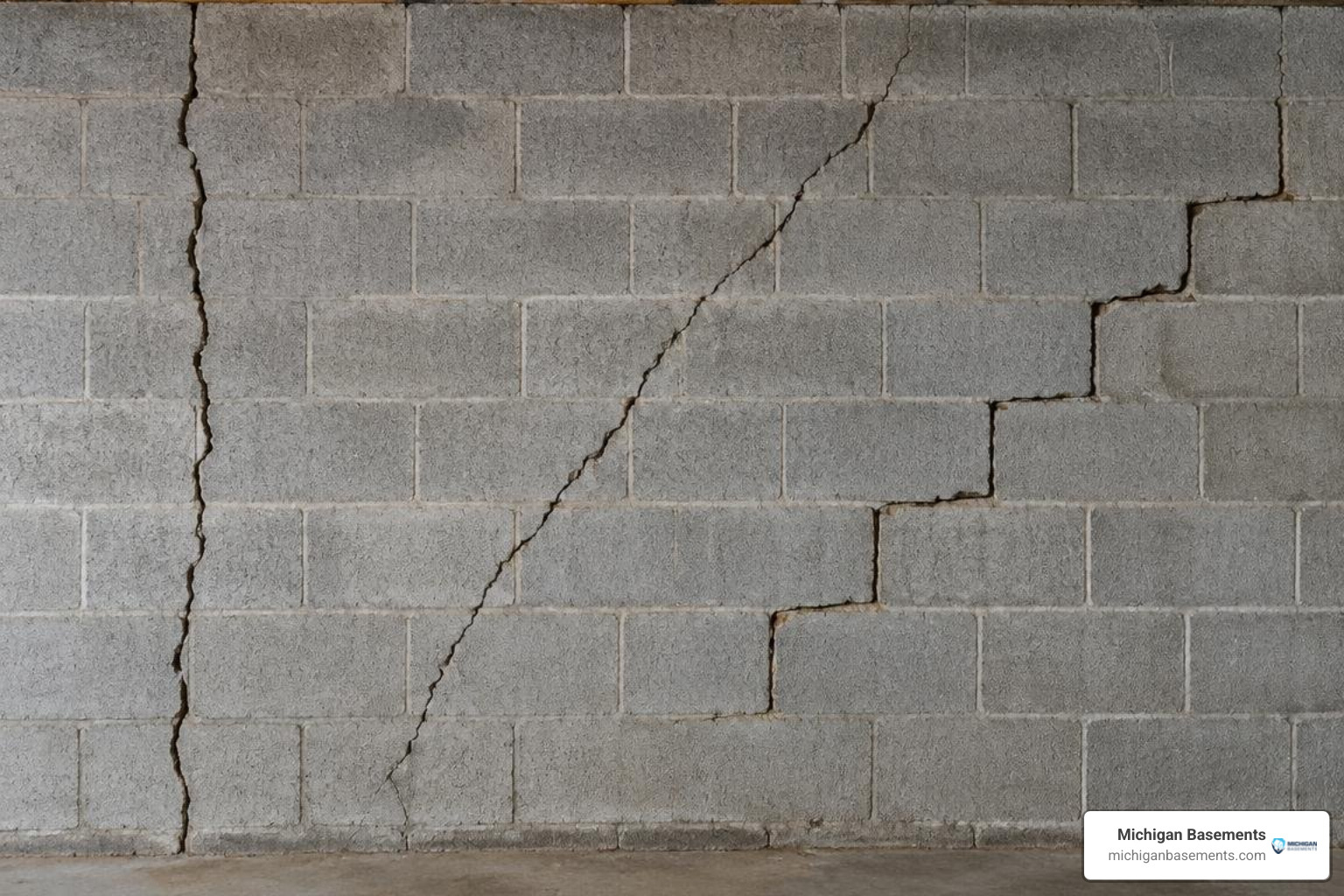
Crack Orientations: Vertical, Horizontal, Diagonal, and Stair-Step
- Vertical Cracks: Straight or slightly wandering vertical cracks often stem from initial settlement or concrete shrinkage. If a vertical crack is uniform and under 1/8 inch wide, it rarely threatens structural stability, though it can still let in ground moisture. However, if the crack is wider at the top than the bottom, it signals that one side of the footing is dropping.
- Horizontal Cracks: A horizontal crack running along the middle or lower third of a foundation wall is a major structural warning sign. These cracks are caused by lateral earth and hydrostatic pressure pushing the wall inward. For detailed insights on this severe problem, read our guide on repairing horizontal cracks in basement walls.
- Diagonal Cracks: Diagonal cracks (sloping at roughly 30 to 75 degrees) are classic indicators of differential settlement. They occur when one corner or section of the foundation drops while the rest of the footing remains stationary, shearing the concrete under tension.
- Stair-Step Cracks: Found exclusively in concrete block (CMU) or brick foundations, stair-step cracks travel along alternating horizontal and vertical mortar joints. These patterns indicate differential footing settlement or intense lateral pressure. Review our step-by-step advice on stair-step brick and block cracks to prevent progressive masonry failure.
Evaluating the Width and Movement of a Foundation Settlement Crack
Measuring crack width helps determine the urgency of structural repairs:
- Hairline Cracks (<1/16 inch / 1mm): Very common in poured concrete, typically cosmetic, and caused by normal curing shrinkage.
- Moderate Cracks (1/16 to 1/8 inch / 1mm to 3mm): Should be monitored closely. They can permit water seepage and indicate early soil movement.
- Structural Threshold (>1/8 inch / 3mm): Cracks wider than 1/8 inch indicate significant foundation movement or lateral pressure that requires professional stabilization.
- Critical Movement (>1/4 inch / 6mm): Any crack exceeding 1/4 inch indicates advanced differential settlement or wall failure. Professional intervention is mandatory to avoid structural collapse.
If you are unsure where your home stands, our guide on assessing foundation cracks without panicking outlines practical diagnostic steps.
Secondary Warning Signs Inside and Outside the Home
A shifting foundation affects the entire house framing above it. Watch for these secondary symptoms throughout your living areas:
- Interior Door and Window Problems: Doors and windows that suddenly stick, drag along flooring, or fail to latch properly indicate that rectangular rough openings have shifted out of square due to footing settlement.
- Sloping or Bouncy Floors: Sinking perimeter walls or interior support piers cause subfloors to sag or tilt. Homeowners can check our resource on identifying floor warning signs to diagnose these framing issues.
- Drywall and Ceiling Separation: Diagonal cracks radiating outward from the upper corners of door frames and window headers, or gaps opening where walls meet ceilings, point directly to foundation movement below.
- Exterior Masonry and Chimney Gaps: Exterior brick veneer showing stair-step cracks or a chimney visibly pulling away from siding indicate severe exterior footing displacement.
- Basement Water Infiltration: Even if a crack appears narrow, groundwater under hydrostatic pressure will exploit any break in the concrete barrier. Learn more about preventing water damage from foundation cracks to protect your finished basement space.
Professional Repair Solutions for Settled Foundations
Permanent foundation repair requires addressing both the underlying soil instability and the damaged concrete walls.
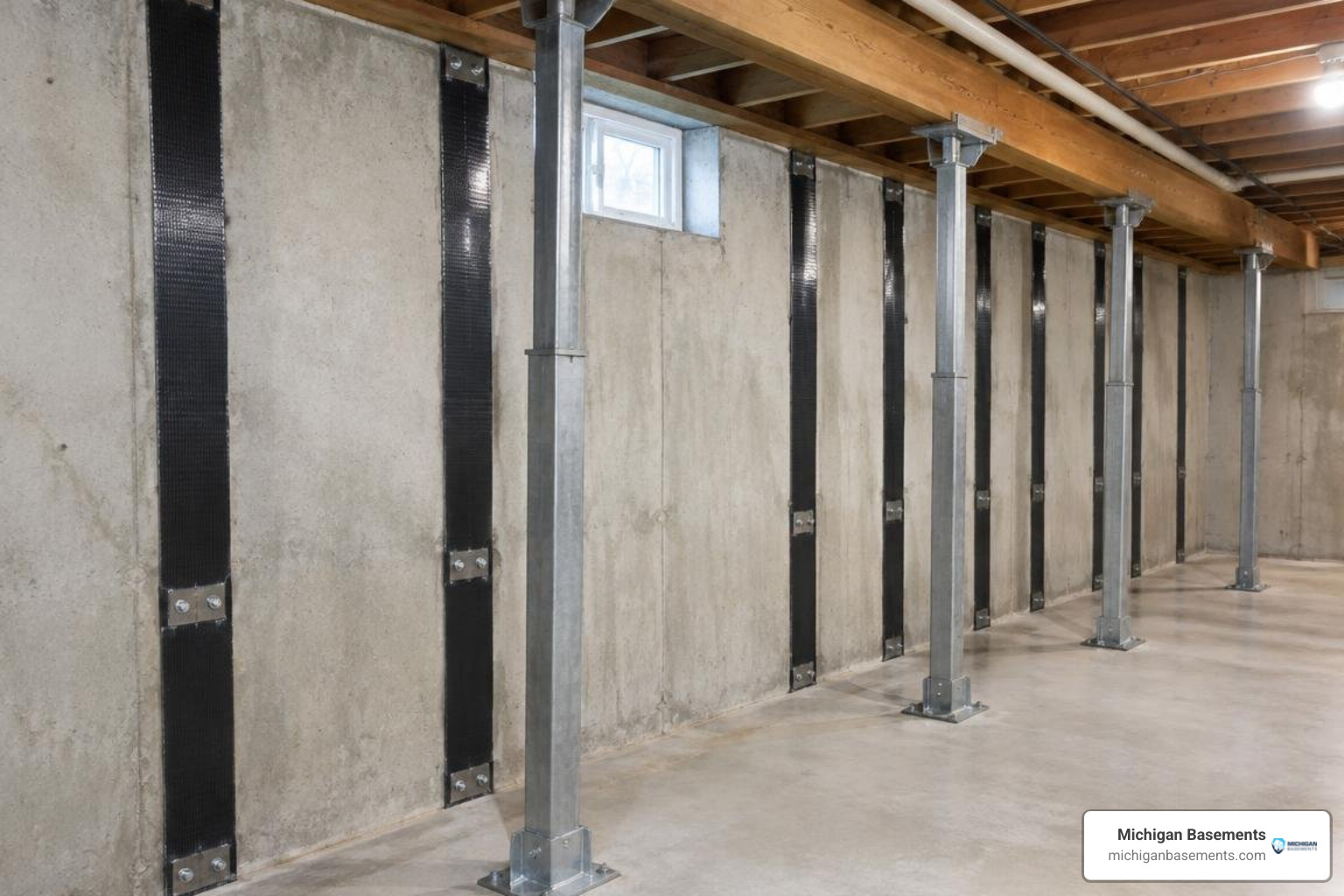
Structural Stabilization: Underpinning, Piering, and Wall Bracing
When differential settlement threatens a foundation, structural systems are installed to transfer the home’s weight to stable, load-bearing strata deep underground:
- Steel Push Piers: Heavy-duty hollow steel pipe sections hydraulically driven through unstable surface soils down to bedrock or load-bearing strata. Push piers use the weight of the structure as resistance and can mechanically lift settled sections back toward their original elevation.
- Helical Piers: Steel shafts with helical bearing plates screwed deep into the earth using hydraulic torque motors. Helical piers provide exceptional support in lightweight structures or areas with deep expansive clays.
- Carbon Fiber Strapping: Engineered straps ten times stronger than steel applied directly to interior basement walls using high-strength structural epoxy. Carbon fiber prevents cracked and bowing walls from deflecting further. Explore our engineered carbon fiber strap reinforcement systems to see how we stabilize foundation walls.
- Structural Wall Bracing & I-Beams: For walls showing severe inward bowing (exceeding 2 inches), heavy steel I-beams anchored to the concrete floor slab and overhead floor joists provide permanent lateral reinforcement. Read our guide on bowing basement wall solutions and discover modern approaches for fixing foundation wall damage without excavation.
Sealing and Waterproofing Methods for Structural and Non-Structural Cracks
Once foundation movement is arrested, the crack itself must be sealed to block moisture and restore wall integrity. Professional contractors utilize specialized injection materials based on crack performance requirements, as detailed in industry guides on professional crack repair methods.
| Parameter | Epoxy Injection | Polyurethane Foam Injection |
|---|---|---|
| Primary Function | Structural weld / tensile strength | Water shut-off / flexible sealing |
| Material Behavior | Rigid, high-strength polymer | Expands up to 20x into flexible closed-cell foam |
| Tensile Strength | Exceeds concrete tensile strength | Low tensile strength; moves with minor vibrations |
| Application Suitability | Dormant, structural cracks in poured walls | Leaking, non-structural, or active hairline cracks |
| Curing Environment | Requires dry crack conditions | Hydrophobic/hydrophilic; cures in presence of water |
Note: Carbon fiber reinforcement should always be installed using structural epoxy rather than flexible polyurethane to ensure a rigid load-bearing bond.
To permanently address hydrostatic pressure around footings, crack sealing is often paired with an interior drain tile system and a high-capacity sump pump. Explore our comprehensive approach to basement waterproofing and crack repair to ensure your lower level remains completely dry.
Exterior Drainage Management and Long-Term Prevention
Water is the primary catalyst behind almost all foundation settlement. Managing exterior moisture protects structural footings:
- Downspout Extensions: Direct gutter downspouts at least 6 to 10 feet away from foundation walls to prevent roof runoff from saturating backfill soil.
- Perimeter Grading: Maintain a downward slope away from the home of at least 6 inches over the first 10 feet.
- Gutter Maintenance: Keep gutters clean to avoid heavy overflows that dump hundreds of gallons of water directly against basement walls.
- French Drains & Subsurface Drainage: Install subsurface French drains in flat yards or low-lying areas to intercept surface water before it reaches the foundation.
For more preventative strategies, review our complete foundation repair solutions guide.
Frequently Asked Questions About Foundation Settlement Cracks
Can I fix a foundation crack from settlement myself?
No. While DIY hydraulic cement or silicone caulk kits are widely sold at home improvement stores, they only provide a temporary cosmetic surface patch. Surface patches cannot withstand hydrostatic water pressure or resist ongoing ground movement. Furthermore, applying rigid surface sealants over an active foundation settlement crack traps moisture inside the concrete, accelerating rebar corrosion and spalling. Structural settlement repairs require precise geotechnical assessment, commercial injection equipment, and engineered stabilization systems installed by licensed professionals.
How much does it cost to repair a foundation settlement crack?
Repair costs vary widely based on crack severity, wall displacement, and structural requirements:
- Epoxy Crack Injection: $300 to $800 per crack for professional low-pressure structural epoxy welding.
- Polyurethane Foam Injection: $250 to $600 per crack for dedicated high-pressure waterproofing injection.
- Carbon Fiber Reinforcement: $50 to $100 per linear foot.
- Steel Push Piers: $1,200 to $2,500 per pier location.
- Helical Piers: $1,500 to $3,000 per pier installation.
- Drainage Corrections: $2,000 to $6,000 depending on scope.
- Total Project Averages: Minor repairs average $2,224, while extensive structural underpinning projects across the industry average $5,179 or higher.
To explore expected investments tailored to your property’s dimensions, Michigan Basements provides clear, transparent foundation repair pricing alongside a convenient online estimator tool.
How can I tell if a crack is active or dormant?
A dormant crack has finished moving (such as early curing shrinkage), whereas an active crack continues to widen, close, or shift as soil conditions change. You can monitor movement using these field diagnostic methods:
- Calibrated Crack Monitors: Professional acrylic gauges mounted directly across the fracture with epoxy. They feature a millimeter grid that measures horizontal and vertical movement over months.
- Pencil Baseline Marks: Make light pencil tick marks across the crack edges and record the date. Measure the gap distance precisely every 30 days.
- Seasonal Monitoring: Check whether the crack opens during dry summer droughts and narrows during wet spring thaws—a classic indicator of expansive clay movement.
If measurement shows movement exceeding 1mm over several months, the crack is active and requires structural stabilization.
Conclusion
A foundation crack is your home’s way of signaling that the ground beneath it is moving. Ignoring early indicators allows localized differential settlement to spread, leading to misaligned framing, floor slumping, water infiltration, and deteriorating property value.
At Michigan Basements, we specialize in identifying the root causes of foundation failure and implementing permanent, engineered structural solutions across Southeast Michigan—including Oakland, Macomb, Wayne, Washtenaw, Livingston, Genesee, and Lapeer counties. Whether your home requires carbon fiber reinforcement, precision hydraulic push piering, helical underpinning, or commercial crack injection, our local team delivers warrantied workmanship tailored to Michigan soil conditions.
Don’t wait for minor settlement to become major structural damage. Request a free foundation repair estimate or learn more about our professional wall stabilization and foundation repair services.
 Get instant pricing!