


Resources
Inside Foundation Waterproofing Methods That Actually Work
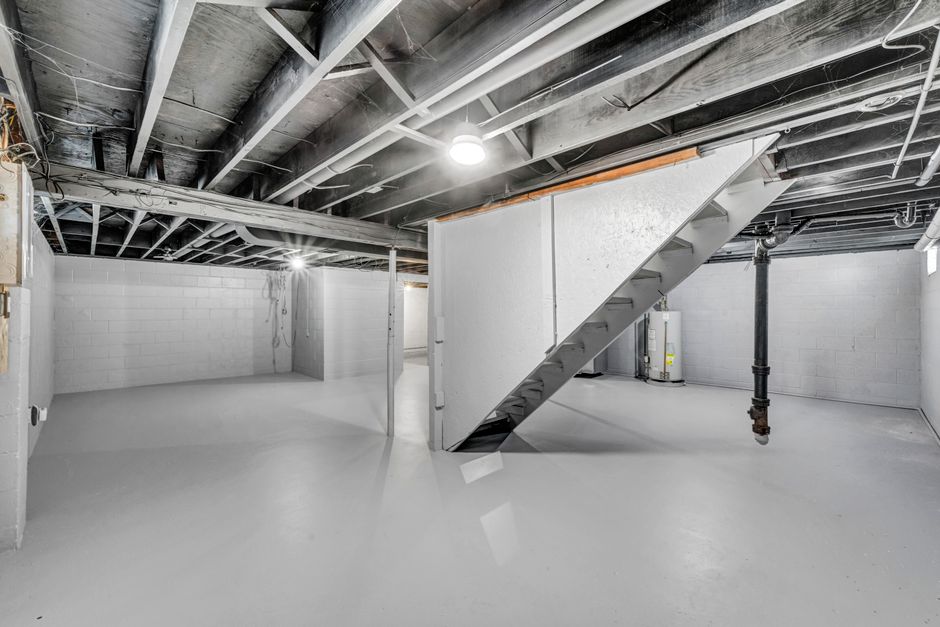
Inside Foundation Waterproofing Methods That Actually Work
Interior Foundation Waterproofing That Starts With the Water Source
Interior foundation waterproofing is a professional water-management service that controls basement seepage from inside the foundation. In a Southeast Michigan basement, a contractor should evaluate wall cracks, the joint where the wall meets the floor, and floor cracks after rain or snowmelt. Runoff problems should be corrected first. For ongoing seepage, an interior drain can collect water and carry it to a sump pump, which sends it away from the house. Sealants may help with minor dampness or specific cracks, but a coating alone will not stop water building up outside the foundation.
I’m Dominic Hesano, owner of Michigan Basements, and I’ve spent years diagnosing wet basements and foundation problems across Southeast Michigan, including Oakland County, Macomb County, and Wayne County. That hands-on work guides how I assess interior foundation waterproofing: find the source, choose the right repair, and make sure water has a safe path out.
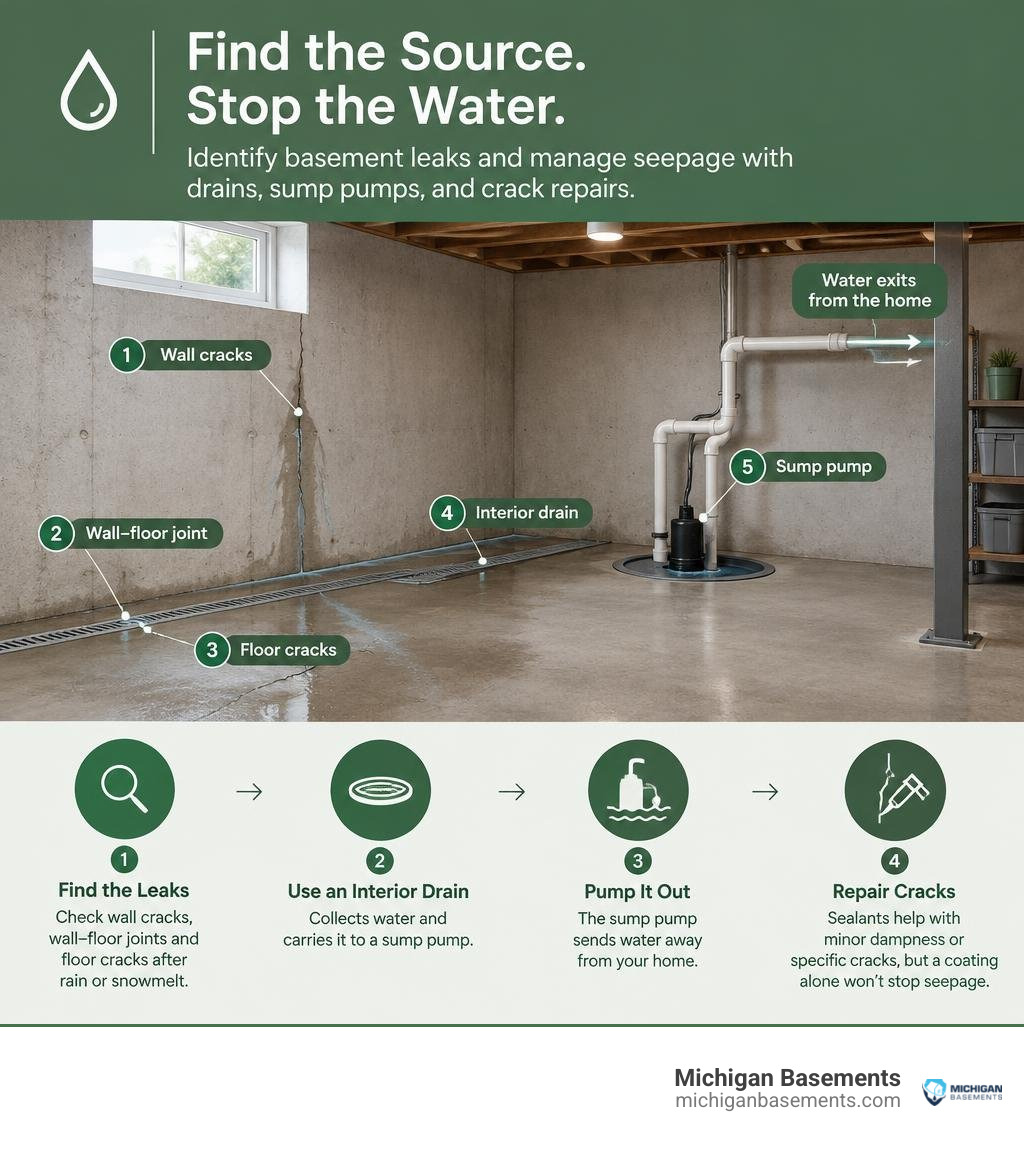
Interior foundation waterproofing word list:
Identifying Basement Moisture Sources and Water Infiltration Paths
Before investing in any repair, pinpointing how moisture moves through the surrounding earth and into your subterranean masonry is crucial. In Southeast Michigan, our heavy clay soils hold immense amounts of water during spring thaws and autumn downpours. When soil becomes saturated, moisture seeks every available path of least resistance.
Understanding basement leak repair requires diagnosing whether water is actively under pressure or slowly diffusing through porous materials.
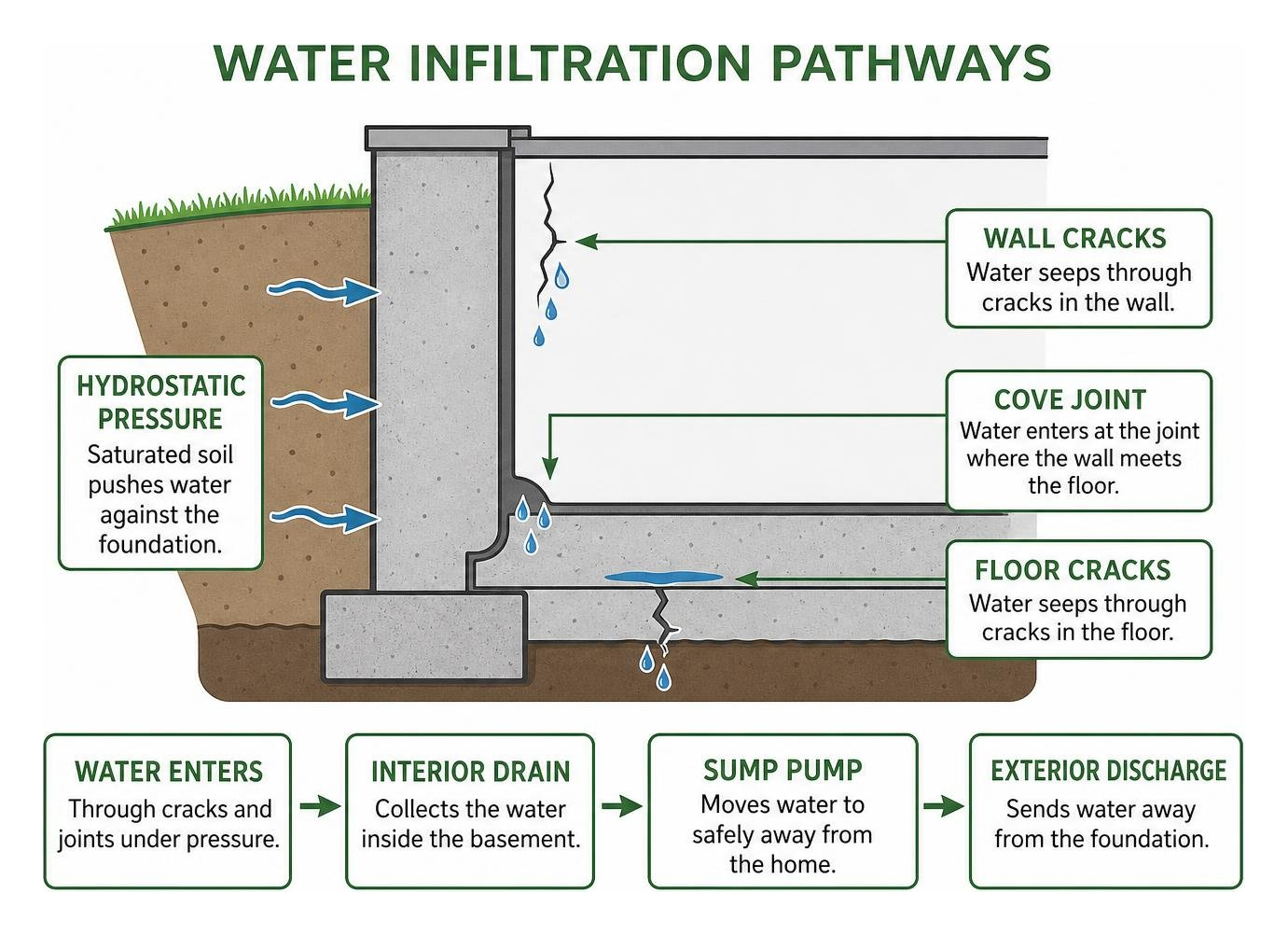
How Interior Foundation Waterproofing Manages Hydrostatic Pressure
Hydrostatic pressure is the primary culprit behind basement flooding across communities in Oakland County and Macomb County. As the local water table rises, trapped moisture in the backfill exerts massive lateral and upward force against your foundation walls and concrete floor slab.
Concrete is naturally porous. When intense pressure builds, water forces its way through the “cove joint”—the structural seam where the poured floor meets the vertical foundation wall. It also breaches settlement fractures and floor cracks.
True interior waterproofing systems do not attempt to hold back thousands of pounds of hydrostatic pressure with a topical patch. Instead, they act as a pressure-relief mechanism. By capturing groundwater at the footing level beneath the floor slab before it can push into living spaces, an engineered interior system relieves hydrostatic pressure and diverts the water directly to a dedicated discharge station.
Capillary Action and Condensation Challenges
Not all basement dampness arrives as visible flowing water. Two subtler mechanisms often degrade indoor air quality and ruin finishes:
- Capillary Suction (Wicking): Concrete contains microscopic pores. If a foundation footing rests on damp soil without an adequate capillary break, the concrete pulls water upward against gravity like a sponge. This wicking action brings minerals to the surface, creating chalky white deposits called efflorescence and keeping walls damp.
- Vapor Transmission and Condensation: Warm, humid air inside a basement touches subterranean concrete walls cooled by the earth. When the wall temperature drops below the dew point, airborne moisture condenses into liquid droplets.
Managing this moisture migration requires continuous basement moisture barriers along the walls to separate the damp masonry from the interior living space and control relative humidity.
Core Methods for Interior Foundation Waterproofing
Protecting a home from the inside out requires combining active water redirection, continuous vapor control, and targeted surface treatments. Homeowners can review the Pro Guide to Basement Waterproofing – The Home Depot for basic conceptual overviews, but professional installation ensures systems withstand long-term pressure. Understanding basement wall waterproofing means implementing multi-layered solutions.
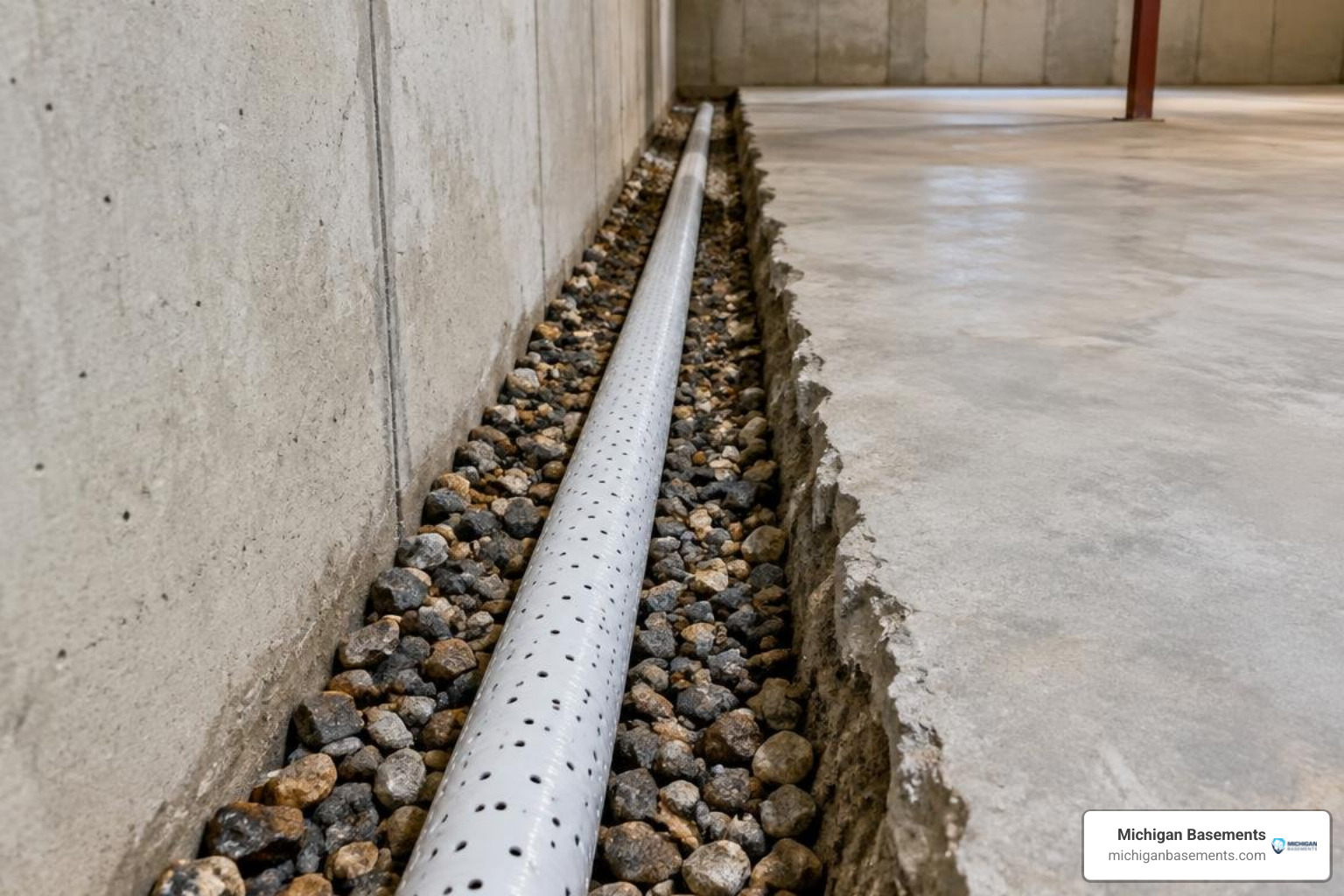
Interior French Drains and Sump Pump Drainage Systems
The gold standard for interior water management is a sub-floor perimeter drainage system. Professional crews trench the concrete floor perimeter along the footing, excavating an 8-to-12-inch wide channel.
- Perforated Drain Pipe: Heavy-duty corrugated or rigid PVC pipe is installed alongside the footing, surrounded by washed river gravel to filter out fine sediment.
- Sump Basin Excavation: The trench slopes toward a heavy-duty sump pit equipped with a high-capacity pump.
- Dual Pumps and Battery Backups: In severe storm seasons, power outages coincide with peak water intrusion. Dual-pump configurations paired with dedicated battery-backup systems protect homes in areas like Troy, Livonia, and Sterling Heights from sudden mechanical failures.
- Discharge Lines: Smooth-walled pipes route the collected water outside and well away from the foundation perimeter to prevent re-circulation.
Vapor Barriers and Wall Drainage Liners
When water trickles through masonry blocks or hairline cracks, it must never reach interior drywall or framing. Heavy-duty, reinforced wall liners (typically 12-mil to 20-mil thick virgin polyethylene or dimpled drainage sheets) are mechanically fastened to the interior concrete.
The bottom edge of the liner tucks directly into the sub-floor drainage trench at the cove joint. Any seepage running down the foundation wall gets captured behind the impenetrable barrier and redirected into the French drain beneath the floor slab without entering the room.
Negative-Side Sealants and Waterproof Coatings
Negative-side sealants—coatings applied to the interior surface resisting water pushing in from the outside—serve a distinct purpose in moisture mitigation. While they cannot relieve high hydrostatic pressure, specialized basement waterproof coatings provide excellent protection against vapor transmission and minor dampness.
- Silicate Penetrating Sealers: Chemically react with free lime inside the concrete to form an insoluble crystalline structure within the capillaries.
- Hydraulic Cement: Formulated to expand as it cures, creating a tight mechanical plug in localized holes, joints, and pipe penetrations.
- Low-Permeance Coatings: Formulated coatings, such as Sto Watertight Coat, feature permeance ratings as low as 1.2 perms, resisting vapor diffusion and damp-proofing sound masonry.
Preparing Cracks, Joints, and Walls for Waterproofing Application
A waterproofing system is only as reliable as its surface preparation. Applying coatings or sealants over dirty, crumbling, or moving concrete guarantees eventual bond failure.
Crack Injection and Hydraulic Cement Repairs
Cracks require precise structural diagnostics before application:
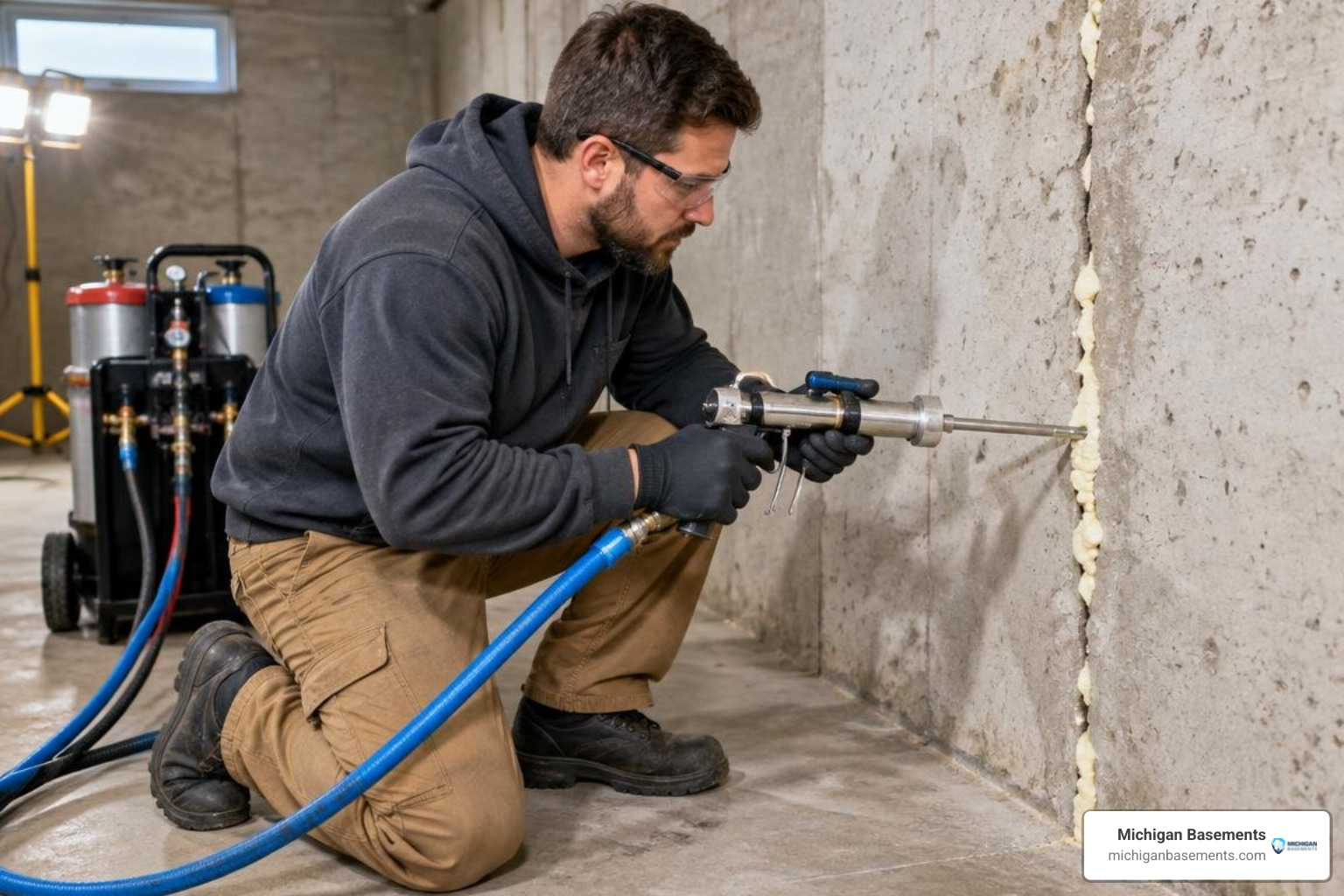
- Non-Structural Leaking Cracks: Technicians install mechanical injection ports along the crack and inject low-viscosity, expanding polyurethane foam under high pressure. The polyurethane expands up to 20 times its liquid volume, penetrating through the entire thickness of the foundation wall to seal the crack all the way to the exterior dirt.
- Structural Fractures: For moving or shifting foundation walls, high-strength structural epoxies are injected to re-bond the fractured concrete sections.
- Cove Joint Sealing: The junction between the floor slab and foundation wall requires relief channels rather than rigid sealing if hydrostatic pressure is active, directing water into the drainage system.
Mechanical Surface Cleaning and Efflorescence Removal
Prior to applying any vapor barrier adhesive or masonry coating, the surface must be mechanically prepped:
- Efflorescence Scrubbing: Mineral deposits must be dissolved and neutralized using wire brushes or safe masonry-etching solutions. Leaving salt crystals on the wall causes future coatings to flake and blister.
- Scraping Old Coatings: Failed, blistering paint or degraded tar coatings must be mechanically scraped or ground down to expose raw, open-pore concrete.
- Dust Removal: The masonry is thoroughly vacuumed and washed to ensure a clean surface for maximum adhesive bonding.
Choosing Between Interior and Exterior Foundation Waterproofing
Homeowners facing persistent water often ask whether they should waterproof from the outside or inside. Weighing internal vs external tanking options comes down to structural condition, site access, and project budgets.
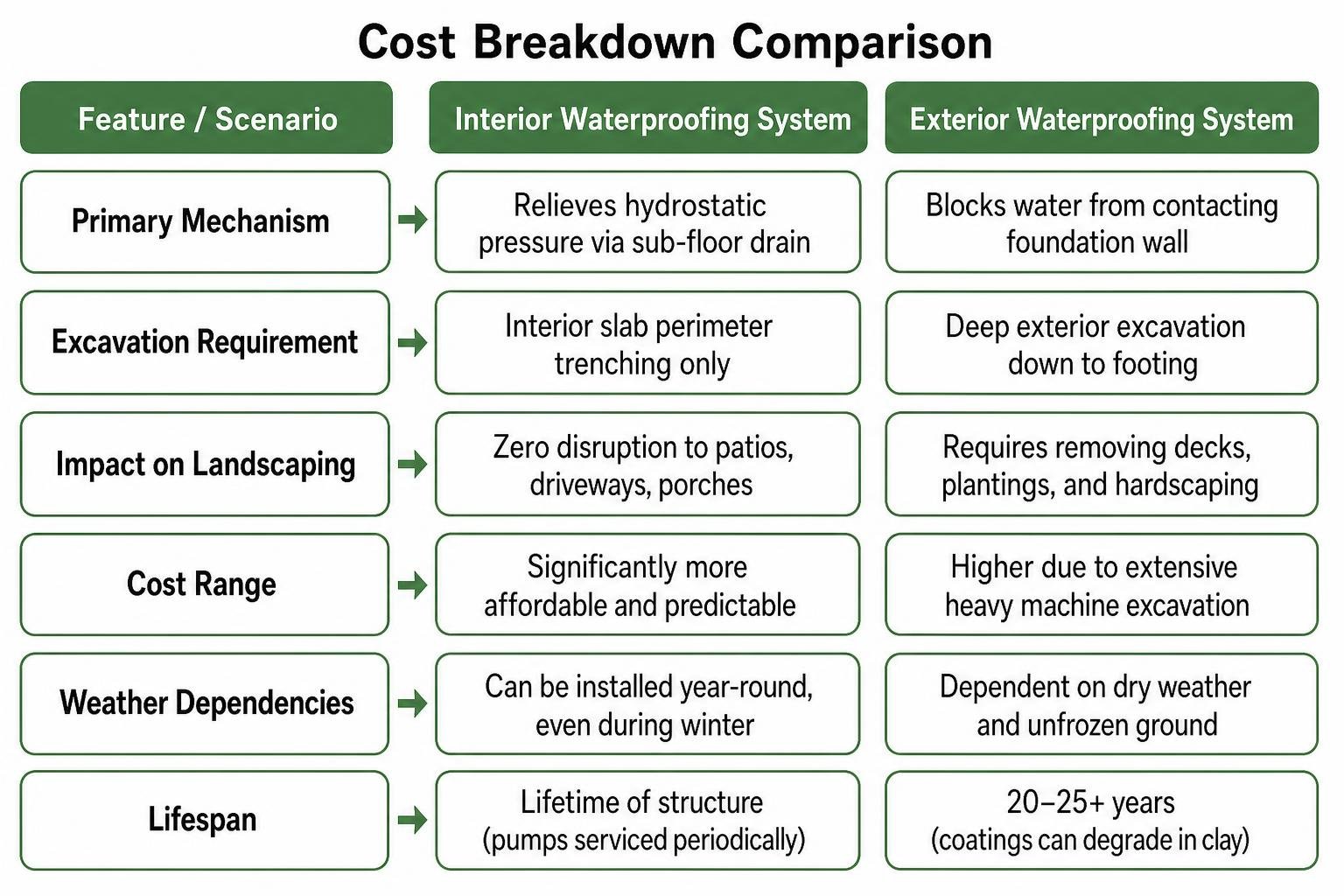
| Feature / Scenario | Interior Waterproofing System | Exterior Waterproofing System |
|---|---|---|
| Primary Mechanism | Relieves hydrostatic pressure via sub-floor drain | Blocks water from contacting foundation wall |
| Excavation Requirement | Interior slab perimeter trenching only | Deep exterior excavation down to footing |
| Impact on Landscaping | Zero disruption to patios, driveways, porches | Requires removing decks, plantings, and hardscaping |
| Cost Range | Significantly more affordable and predictable | Higher due to extensive heavy machine excavation |
| Weather Dependencies | Can be installed year-round, even during winter | Dependent on dry weather and unfrozen ground |
| Lifespan | Lifetime of structure (pumps serviced periodically) | 20–25+ years (coatings can degrade in clay) |
When Interior Drainage Is the Best Solution
For the vast majority of existing homes in Wayne County, Oakland County, and Macomb County, interior foundation waterproofing is the most practical and cost-effective method.
Interior systems are ideal when:
- Decks, paved driveways, air conditioning units, or mature landscaping make exterior excavation impossible or cost-prohibitive.
- The primary issue is rising water table pressure pushing up through the floor or cove joint.
- Work needs to be completed quickly during wet or freezing Michigan winter months without waiting for ground thaws.
Situations Requiring Exterior Excavation and Membranes
While interior drainage manages water entering the home, certain structural emergencies demand full exterior basement waterproofing.
Exterior excavation is required when foundation walls are severely bowed or structurally compromised by expanding clay backfill, or when exterior masonry block cores have degraded to the point that water saturation threatens the home’s structural integrity. In these cases, exterior excavation, installation of heavy-duty synthetic membranes (or sodium bentonite sheets), and structural wall stabilization must happen concurrently.
Cost Breakdown and Planning for Finished Basements
Investing in waterproofing protects property values and prevents catastrophic losses when finishing a lower level. Homeowners must understand the true basement waterproofing cost before beginning carpentry or framing work.
Cost Breakdown of Interior Foundation Waterproofing Systems
The cost of waterproofing varies based on foundation size, age, and water severity:
- Waterproof Paints: Typically range from $1 to $6 per square foot. While cheap, they are temporary measures that do not address active water intrusion.
- Acrylic and Silicate Sealants: Penetrating chemical treatments cost between $3 and $4 per square foot, while specialized silicate and heavy epoxy sealers cost $5 to $7 per square foot.
- Exterior Sodium Bentonite: Exterior clay applications run around $2 per square foot for material, not including the significant excavation costs required to expose the footing.
- Full Interior Drainage and Sump Systems: Installing complete perimeter drainage with dual-pump discharge basins generally represents a long-term investment that provides permanent pressure relief.
To get an accurate assessment tailored to your home’s layout, Michigan Basements provides clear options using our online pricing tool.
Best Practices for Framing and Insulating After Waterproofing
For finished basement waterproofing, timing and detailing are everything. Never frame directly against bare, uninsulated concrete.
As detailed in industry insights like Waterproofing Inside Basements: Lessons From a Pro – Fine Homebuilding, proper wall detailing prevents hidden mold:
- Continuous Rigid Foam Insulation: Install minimum 1-inch to 2-inch extruded polystyrene (XPS) rigid foam boards directly over the interior wall vapor barrier. Tape all seams with vapor-tight tape to keep warm interior air from reaching cold concrete.
- Framing Clearances: Build your wood or light-gauge steel stud framing slightly off the foam insulation surface (leaving a 1/2-inch air gap).
- Elevated Baseplates: Keep drywall and wood baseplates raised 1/2-inch off the concrete floor slab to avoid moisture wicking from the slab surface.
Frequently Asked Questions About Interior Waterproofing
What is interior foundation waterproofing?
Interior foundation waterproofing is a professional basement water-control system installed inside the home. It typically combines perimeter drainage, wall vapor control, crack repair, and a sump pump system to collect groundwater and discharge it away from the foundation.
How effective is interior foundation waterproofing compared to exterior systems?
Interior foundation drainage systems are exceptionally effective because they eliminate hydrostatic pressure under the floor and against the footing. While exterior systems stop water from contacting the outside of the wall, interior systems capture and evacuate water before it enters the living space. Interior systems have the advantage of being fully serviceable from the inside of your home.
Should homeowners rely on DIY basement waterproofing from the inside?
DIY applications are limited to basic surface damp-proofing paints and simple hairline crack patches. Understanding DIY basement waterproofing risks comes down to equipment and physics: jackhammering floor perimeters, correctly pitching drainage pipes alongside the footing, and wiring reliable multi-pump discharge stations require professional equipment and engineered warranties.
How long do interior drainage systems and sealants last?
High-grade sub-floor interior drainage systems and heavy synthetic polyurethane membranes can protect concrete for up to 25 years or more, often lasting the lifetime of the foundation. Sump pump mechanical units should be inspected annually and replaced every 7 to 10 years to ensure uninterrupted performance. For more details, explore our guide on basement waterproofing lifespan.
Who provides interior foundation waterproofing in Southeast Michigan?
Michigan Basements provides interior foundation waterproofing, basement waterproofing, foundation repair, crawl space encapsulation, and sump pump installation for homeowners in Southeast Michigan, including Oakland County, Macomb County, Wayne County, Bloomfield Township, Troy, Sterling Heights, and Livonia.
Protect Your Foundation with Southeast Michigan’s Waterproofing Experts
Managing basement water requires permanent, engineered pressure relief rather than quick surface cover-ups. By combining high-capacity interior French drains, sealed vapor barriers, robust crack injection, and dual-pump sump stations, Michigan Basements helps Southeast Michigan homeowners keep basements dry, healthy, and ready for finishing.
Michigan Basements is a family-owned contractor delivering interior foundation waterproofing, basement waterproofing, crawl space encapsulation, sump pump installation, and foundation repairs across Southeast Michigan. We proudly serve homeowners throughout Oakland County, Macomb County, Wayne County, Bloomfield Township, Troy, Sterling Heights, Livonia, and surrounding communities.
Ready to protect your home? Use our convenient online pricing tool or schedule your free inspection and estimate with our experienced team today. Learn more about our complete solutions by visiting our basement waterproofing and repair services page.
 Get instant pricing!