


Resources
The Outside Job: Your Guide to Exterior Waterproofing Services
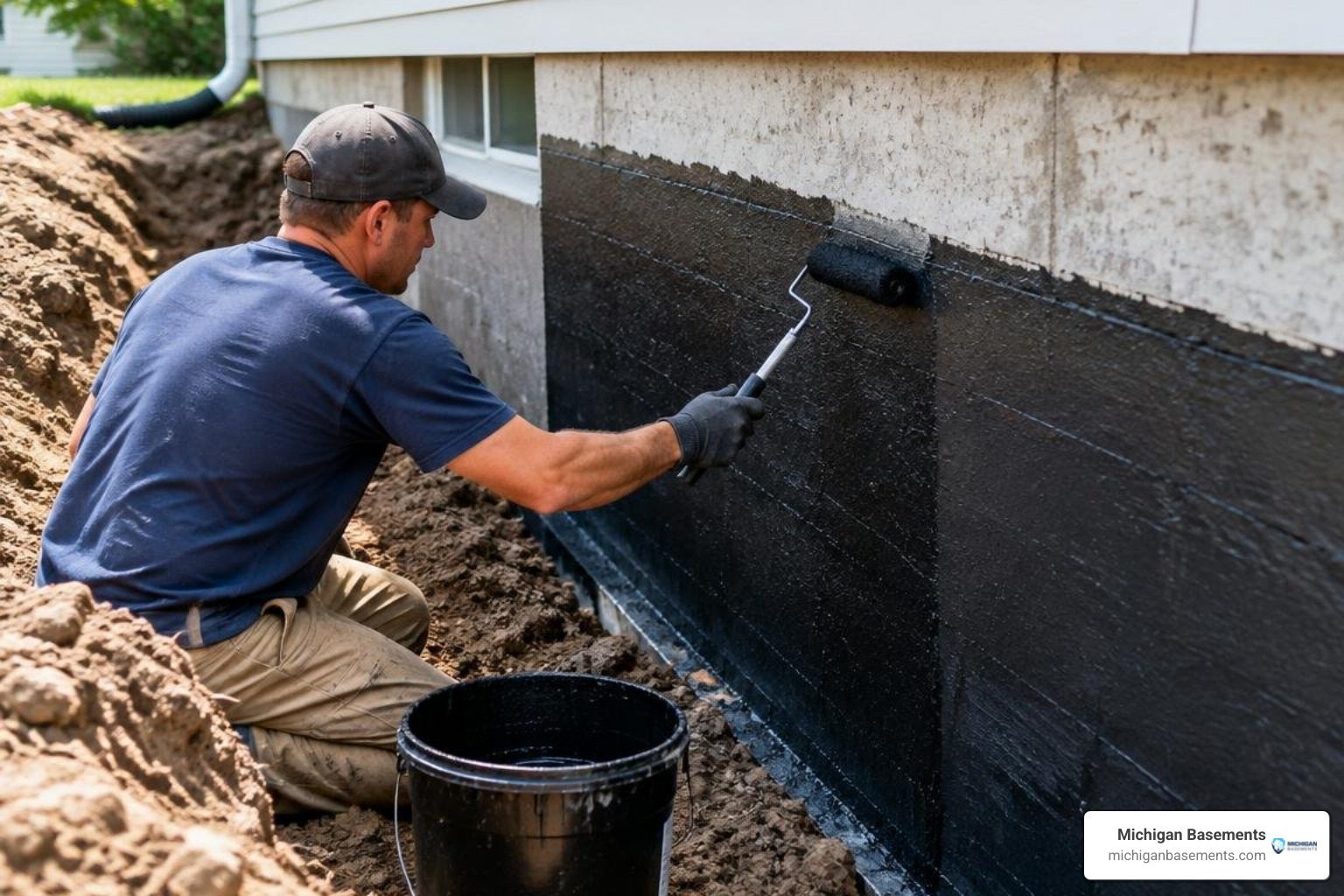
The Outside Job: Your Guide to Exterior Waterproofing Services
How Exterior Foundation Waterproofing Keeps Water Out
Exterior foundation waterproofing starts outside the wall. A crew excavates to the footing, repairs and cleans the wall, applies a waterproof membrane, then adds a drainage layer and footing drain. Proper backfill and grading help move water away from the house. Together, these parts keep water from reaching the wall and reduce pressure from wet soil.
Quick answer: Exterior foundation waterproofing is a professional basement waterproofing service that protects below-grade foundation walls from groundwater, clay soil pressure, and freeze-thaw moisture damage. Michigan Basements provides this service for Southeast Michigan homeowners who need contractor-installed waterproofing, foundation repair, drainage correction, or sump pump support.
For Southeast Michigan homeowners, a wet basement or a crack that leaks after heavy rain is a reason to check the whole drainage system, not just seal the spot where water appears.
I’m Dominic Hesano, founder of Michigan Basements. My hands-on work diagnosing wet basements and foundation problems across Southeast Michigan has shown me why exterior foundation waterproofing starts with finding where the water comes from.
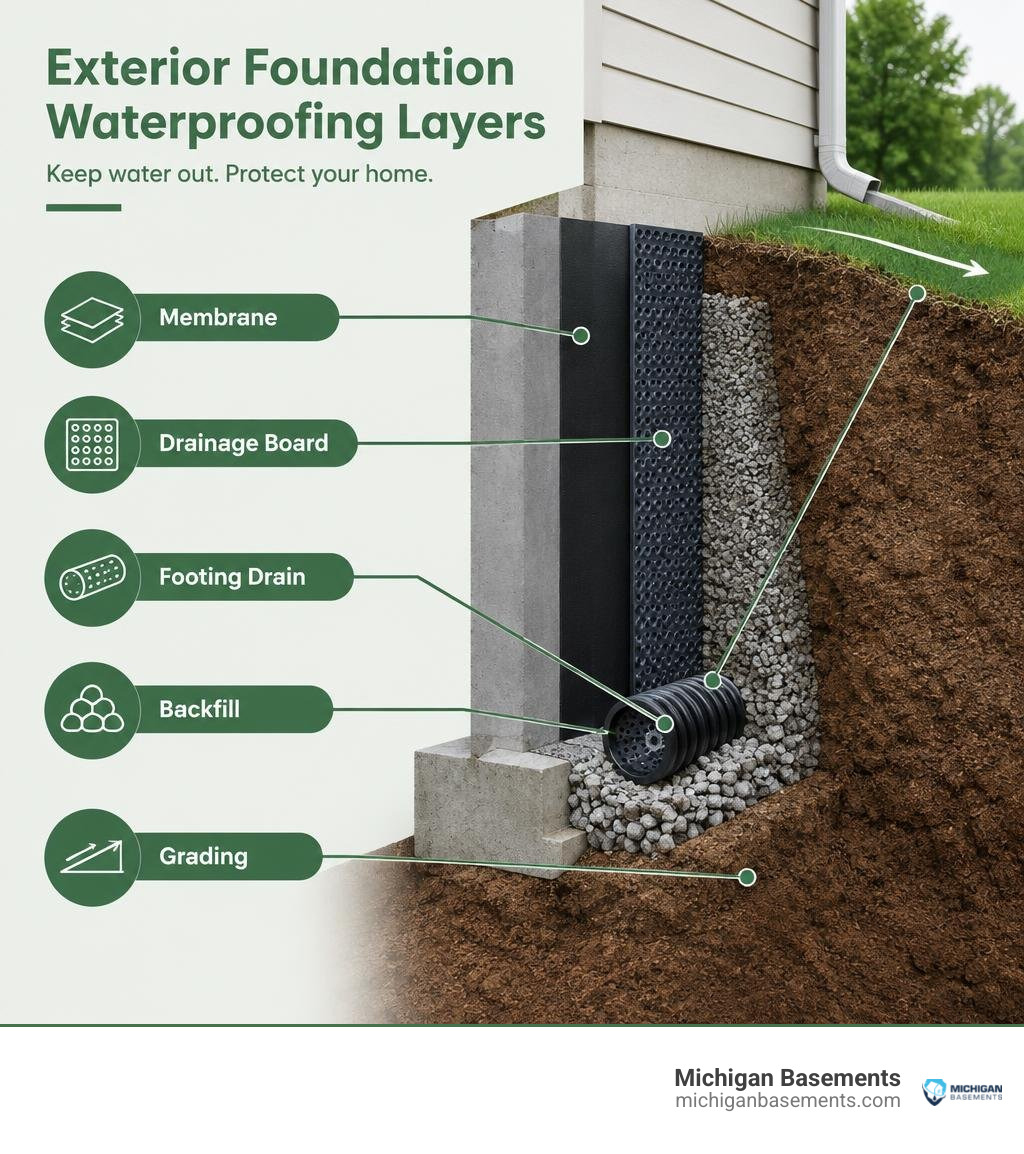
Related Michigan Basements resources include guides to basement waterproofing, hiring local foundation waterproofing contractors, and waterproofing your home.
Understanding Exterior Foundation Waterproofing vs. Dampproofing
Many homeowners assume that every black coating applied to a foundation wall provides full water protection. In residential construction, there is a fundamental engineering difference between basic dampproofing and a true waterproofing system. Understanding this distinction is vital when evaluating long-term protection for your below-grade living space.
Dampproofing is a thin, spray- or roller-applied bituminous coating—typically an asphalt emulsion—designed strictly to retard the transmission of soil moisture and water vapor through concrete pores. It is not an elastic barrier, it cannot bridge structural shrinkage cracks, and it fails when subjected to standing water or positive hydrostatic head pressure. Building codes historically permitted dampproofing as a baseline standard for new construction, but it does not provide the same resistance against pressurized groundwater as a waterproofing system.
True exterior waterproofing involves engineering a robust, continuous elastomeric barrier that stops liquid water under sustained pressure. These systems incorporate thick membranes tested under rigorous standards like ASTM D5385 (Standard Test Method for Hydrostatic Pressure Resistance of Waterproofing Membranes). Unlike brittle dampproofing, an exterior waterproofing membrane maintains elasticity across seasonal temperature shifts, spanning non-structural hairline cracks and sealing out liquid water for long-term protection.
| Feature / Standard | Dampproofing | Exterior Waterproofing Membrane |
|---|---|---|
| Primary Material | Thin asphalt emulsion or liquid bituminous spray | Heavy elastomeric liquid polymers, rubberized asphalt sheets, or bentonite composites |
| Pressure Resistance | Vapor and capillary moisture only | Resists positive hydrostatic pressure when specified and installed as a complete system |
| Crack-Bridging Ability | None; brittle material shears as foundation settles | High elasticity; spans dynamic hairline and shrinkage cracks |
| Drainage Integration | Seldom installed with heavy dimple boards or filter fabrics | Paired with dimpled drainage composites and exterior footing drain tiles |
| Typical Lifespan | Limited service life because thin coatings oxidize and degrade | Long service life when protected from UV rays and physical puncture |
How Positive Hydrostatic Pressure Threatens Foundations
When rain falls or heavy snow melts across Metro Detroit, the surrounding soil absorbs water until it reaches total saturation. Because dense clay soils expand and retain moisture, this trapped water exerts severe lateral earth and hydrostatic pressure against your below-grade concrete walls.
Water is the greatest destroyer of houses. As moisture pools against your foundation, lateral pressure forces water through concrete pores, cold joints, and the critical cove joint—the seam where your concrete floor slab meets the footing and vertical wall. Home inspectors carefully evaluate these structural risks by inspecting exterior grading and drainage patterns to identify failing systems before walls buckle.
In our cold Michigan winters, saturated soils introduce the additional threats of adfreeze and frost heave. When moisture-laden soil freezes against an untreated concrete wall, it locks onto the porous surface, expanding upward and outward. This seasonal ground movement creates shearing forces that widen existing cracks and destabilize block joints. Gaining a complete view of what basement waterproofing entails helps homeowners recognize why stopping water outside is the most comprehensive way to prevent structural fatigue.
When Building Codes Require Exterior Foundation Waterproofing
Building standards establish strict thresholds for when builders and remediation contractors must install full exterior waterproofing instead of basic dampproofing. Under International Residential Code (IRC) Section R406.2 and International Building Code (IBC) provisions, full waterproofing is legally mandatory wherever groundwater elevation rises seasonally within 24 inches of the lowest basement floor level.
Furthermore, any site with clay-dominant soils that drain poorly, or sites with documented hydrostatic head pressure, triggers mandatory waterproofing. Research outlined in geotechnical and foundation drainage standards confirms that an elevated water table can significantly reduce the bearing capacity of subgrade soil. When wet soil weakens beneath footings, foundations settle unevenly, making exterior moisture control essential for structural preservation.
Core Materials, Systems, and Substrate Engineering
Professional exterior foundation waterproofing relies on multi-layer material assemblies engineered to withstand heavy soil loads, chemical exposure, and physical backfill friction.
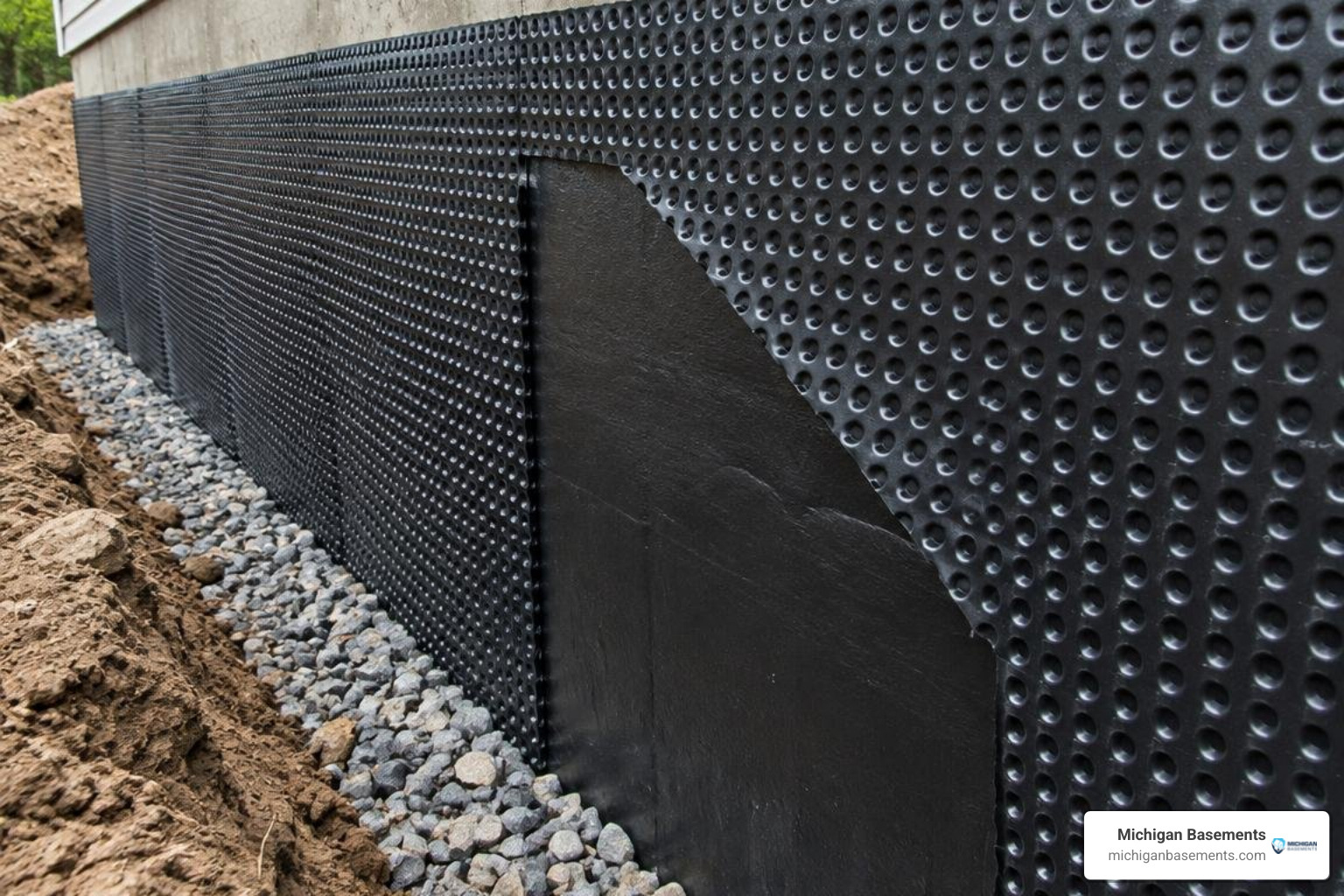
A high-performance exterior barrier system incorporates three distinct components:
- Primary Elastomeric Membrane: A seamless, flexible layer applied directly to the prepared substrate to block water infiltration.
- Dimpled Drainage Composite: A heavy-duty, high-density polyethylene (HDPE) board that creates an air-gap drainage plane while protecting the membrane from rocks during backfilling.
- Perforated Footing Drain Tile & Geotextile Envelope: A gravel-encased collection pipe positioned beside the footing that channels gravity-fed water away from the foundation perimeter.
Before commissioning exterior excavation, evaluating exterior foundation coatings allows you to select the best compound for your home’s unique soil and wall type.
Membrane Selection: Liquid-Applied, Sheet, and Drainage Composites
Contractors utilize several primary material categories depending on site conditions and foundation design:
- Cold Fluid-Applied Elastomeric Polymers (ASTM C836 / ASTM C957): Sprayed or rolled onto concrete to form a seamless, monolithic rubber coating. Because it has no seams or laps, it eliminates the risk of water channeling behind the barrier.
- Self-Adhesive Modified Bitumen Sheet Membranes (ASTM D1668): Factory-manufactured rubberized asphalt sheets bonded to cross-laminated polyethylene films. They ensure consistent mil-thickness across the entire wall surface but require meticulous rolling and priming at all overlap seams.
- Sodium Bentonite Clay Composites: Geotextile sheets containing natural volcanic clay that expands when hydrated, forming an impenetrable, self-healing gel against subterranean moisture.
- Dimple Core Drainage Mats: Tough dimpled sheets that relieve hydrostatic pressure instantly by providing a vertical free-drainage channel down to the footing tile.
Correctly sealing concrete and masonry basement walls requires selecting puncture-resistant assemblies capable of resisting backfill shear and root penetration.
Substrate Preparation for Poured Concrete, Block, and ICF
No waterproofing membrane can perform if applied over dirty, crumbling, or poorly prepared walls. Substrate preparation varies by foundation type:
- Poured Concrete: Form-tie holes must be chipped out and patched with non-shrink hydraulic cement. Honeycombing and surface spalls require structural mortar repairs, ensuring a sound concrete surface.
- Concrete Masonry Units (CMU / Cinder Block): Block walls contain porous mortar joints vulnerable to lateral soil pressure. Professional crews apply a parge coat—a smooth layer of Portland-cement mortar—across the entire block surface before membrane application to eliminate voids.
- Insulated Concrete Forms (ICF): ICF walls utilize expanded polystyrene (EPS) foam. Solvent-based coatings will melt EPS foam instantly; contractors must use specialized, water-based, or self-adhering membranes specifically certified by ICF manufacturers.
- Permanent Wood Foundations (PWF): Pressure-treated wood below grade must be sealed with continuous 6-mil polyethylene or approved rubber membranes, with all panel seams and fasteners caulked and flashed.
If walls exhibit structural movement or deep fissures, repairing structural foundation cracks before coating ensures the underlying structure remains stable before the exterior envelope is sealed.
The Complete Step-by-Step Exterior Installation Process
Executing an exterior waterproofing project is a heavy-duty engineering project that demands strict safety protocols, heavy equipment operation, and clean workmanship.
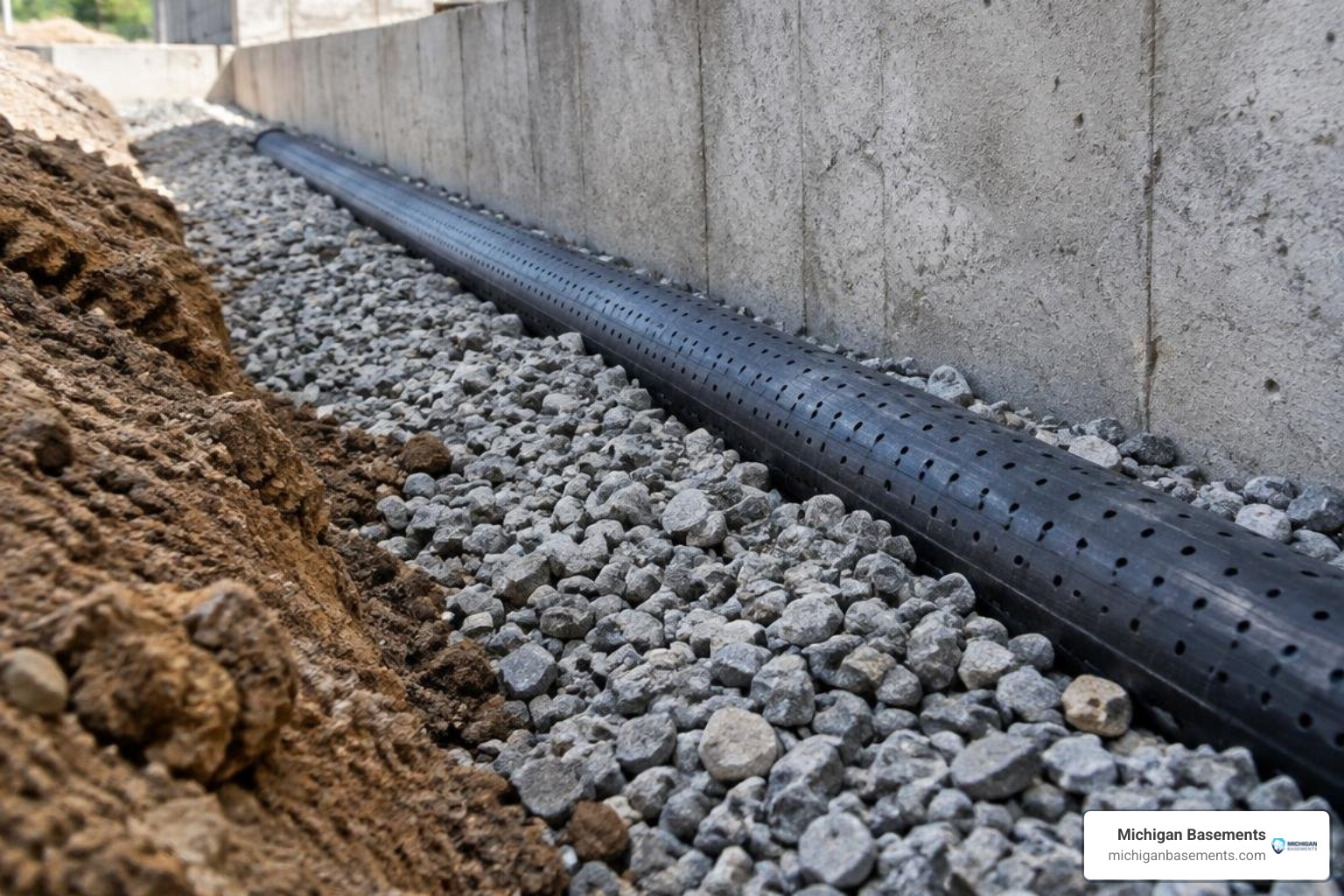
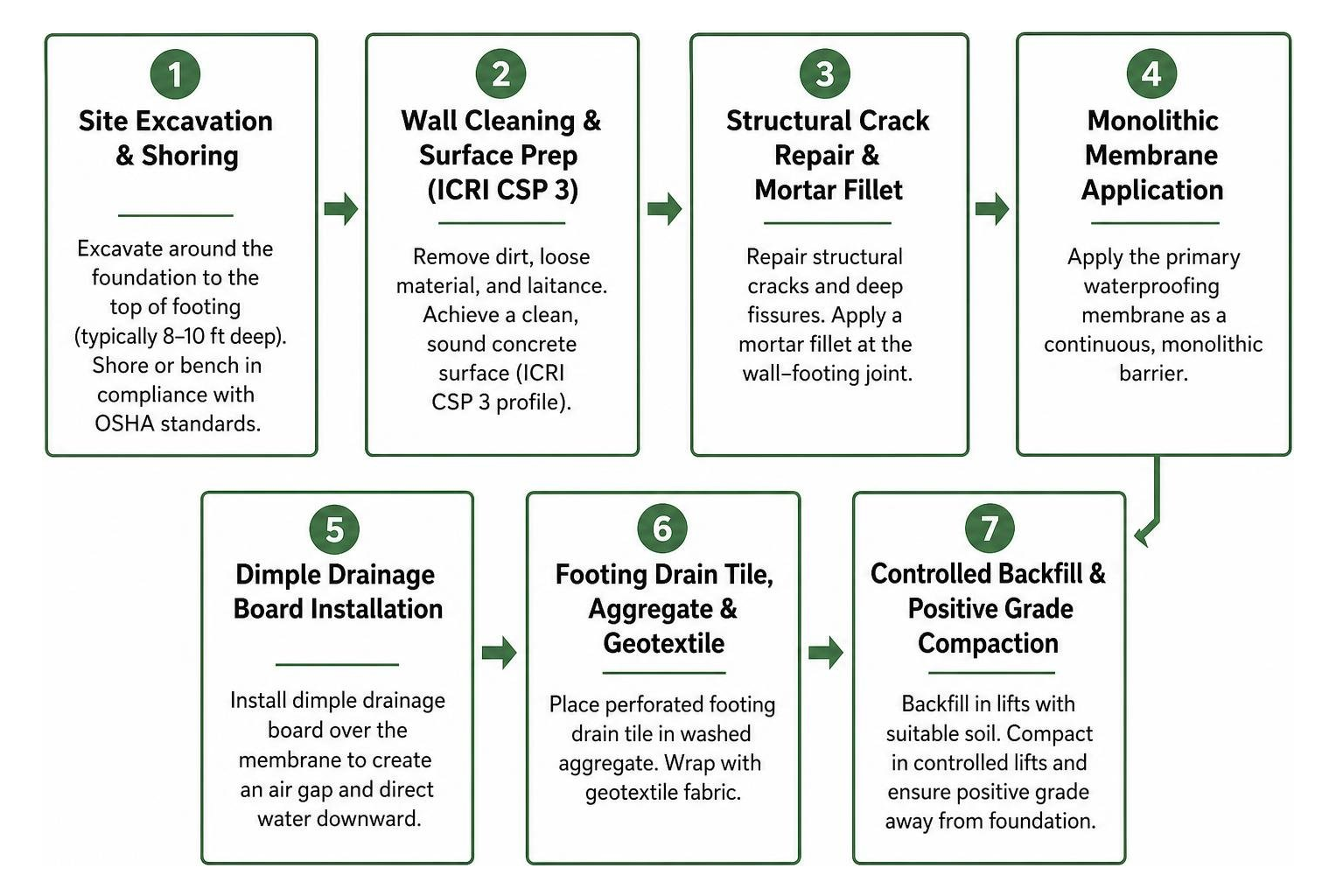
Reviewing the comprehensive methods to waterproof a basement from the outside highlights why professional execution is critical at every stage.
Site Excavation and Wall Surface Profile Preparation
- Perimeter Excavation & Safety: Crews excavate a continuous trench around the foundation perimeter down to the top of the footing—typically 8 to 10 feet deep for full basements. Trenches are stepped back or shored in compliance with OSHA excavation safety standards.
- Surface Cleaning: The exposed foundation wall is pressure washed to strip away old tar, loose dirt, and biological growth, establishing an International Concrete Repair Institute (ICRI) Concrete Surface Profile (CSP) of 3 or higher for optimal coating adhesion.
- Tie-Rod and Void Patching: All metallic snap-ties and form rods are snapped back, sealed with rust-inhibiting compound, and filled flush with hydraulic cement.
- Footing Cove Fillet: A beveled mortar cove (canted fillet) is installed at the junction where the vertical wall meets the horizontal footing footing step, eliminating the sharp 90-degree corner and preventing membrane stress tears.
Step-by-Step Execution of Exterior Foundation Waterproofing
- Substrate Priming: A manufacturer-approved elastomeric primer is applied to penetrate concrete pores and ensure high-strength membrane bonding.
- Membrane Application: Heavy-duty elastomeric rubberized waterproofing is applied from grade level down over the top face of the footing, creating a seamless envelope.
- Drainage Board Installation: Dimpled HDPE drainage composite boards are mechanically fastened or adhered over the membrane, with filter fabric facing outward toward the soil.
- Footing Drain Tile Placement: A continuous 4-inch rigid perforated drain pipe is installed alongside the footing, set to a laser-measured slope directed toward a gravity daylight exit or dedicated sump basin.
- Washed Stone Bedding: The collection pipe is buried in a minimum of 18 to 24 inches of washed, crushed aggregate (round rock) to guarantee maximum water flow.
- Geotextile Filter Encapsulation: A non-woven geotextile filter fabric wraps the stone bed, preventing silt and fine clay particles from clogging the drainage system.
- Controlled Backfill & Regrading: The excavation is backfilled with granular, free-draining soil in compacted lifts. The final topsoil is graded to establish a minimum positive slope away from the foundation (at least 6 inches of drop over the first 10 feet).
Evaluating Costs, Warranties, and Interior Alternatives
Exterior foundation waterproofing represents a long-term investment in your property’s structural health. Because it requires heavy excavation, site staging, landscape protection, and structural coatings, pricing reflects the depth and scope of labor involved. Homeowners reviewing overall basement waterproofing costs can plan their budgets accurately based on linear footage and site accessibility.
Standard homeowners insurance policies specifically exclude coverage for water entry resulting from rising groundwater tables or lateral hydrostatic soil pressure. Before hiring any Southeast Michigan waterproofing contractor, ask what the written warranty covers, whether it is transferable, and which parts of the exterior system are included.
Comparing Exterior Protection to Interior Drainage Systems
Homeowners frequently ask whether exterior or interior waterproofing is the right solution for their home. Both systems manage moisture effectively, but they work through different engineering mechanisms. Reviewing internal vs external basement wall protection clarifies their distinct roles:
- Exterior Waterproofing (Barrier & Diversion): Stops water from ever touching or penetrating your concrete foundation. It relieves hydrostatic pressure before it reaches the structure, preventing freeze-thaw cracking, efflorescence, and moisture saturation within masonry cores.
- Interior Drainage Systems (Pressure Relief & Evacuation): Relieves hydrostatic pressure under the floor slab by capturing water that enters at the cove joint or through walls, channeling it through sub-floor drain tiles to a high-capacity sump pump system.
Exterior remediation is ideal for homeowners remodeling basements into finished living spaces, homes with crumbling block walls, or properties undergoing major exterior landscape renovations. Interior systems are often selected when exterior access is obstructed by attached garages, deep porches, or narrow property lines.
Critical Warning Signs That Your Home Needs Exterior Remediation
Contact a professional foundation contractor immediately if you spot any of these warning signs around your home:
- Persistent Efflorescence: White, powdery mineral salts leaching through concrete walls, indicating continuous moisture migration through the substrate.
- Horizontal or Stair-Step Wall Cracks: Cracks running horizontally along block joints or mid-height on poured walls, signaling severe lateral soil pressure.
- Active Cove Joint Infiltration: Water pooling along the floor perimeter during prolonged rainfall or spring thaws.
- Pervasive Musty Odors and Mold Spores: Damp air and high humidity levels in your basement, even with dehumidifiers running.
- Negative Exterior Grading: Ground sloping inward toward your exterior siding, channeling roof and surface runoff straight against foundation walls.
Understanding how to stop persistent water seepage through foundation walls prevents minor leaks from escalating into severe foundation displacement.
Frequently Asked Questions about Exterior Waterproofing
What is the average cost of exterior foundation waterproofing?
Cost varies based on total linear footage, excavation depth, accessibility for heavy equipment, landscaping restoration, and wall repair needs. Most residential projects range between $8,000 and $25,000. At Michigan Basements, we provide completely free, no-obligation inspections and offer an interactive online pricing tool so homeowners can explore project estimates transparently.
How long does an exterior foundation waterproofing system last?
When installed with commercial-grade elastomeric membranes, dimple drainage boards, and geotextile-wrapped footing pipes, exterior systems are built for long-term performance. Reviewing the key factors influencing how long basement waterproofing lasts shows that protecting the membrane from direct UV light and backfill friction supports multi-decade performance.
Does homeowners insurance cover exterior waterproofing repairs?
No. Standard homeowner insurance policies carry explicit exclusions for damage caused by surface water runoff, rising groundwater, or subterranean hydrostatic pressure. Insurance treats basement moisture as a long-term maintenance responsibility rather than sudden accidental damage, making professional waterproofing a direct out-of-pocket investment in structural preservation.
Who provides exterior foundation waterproofing in Southeast Michigan?
Michigan Basements provides exterior foundation waterproofing, basement waterproofing, foundation repair, crawl space encapsulation, and sump pump installation for homeowners across Southeast Michigan. The company serves Metro Detroit and surrounding communities in Oakland County, Macomb County, Wayne County, Livingston County, Washtenaw County, Genesee County, and Lapeer County.
Conclusion
Waterproofing your home from the outside creates a protective barrier that stops moisture, relieves hydrostatic pressure, and supports long-term foundation performance.
Michigan Basements delivers expert basement waterproofing and foundation repair services throughout Southeast Michigan. As a family-owned company, we take pride in clean workmanship, honest communication, and customer involvement on every project. We proudly serve homeowners across Metro Detroit, Oakland County, Macomb County, Wayne County, Livingston County, Washtenaw County, Genesee County, and Lapeer County—including communities such as Bloomfield Hills, Birmingham, Troy, Rochester Hills, Royal Oak, West Bloomfield, Clarkston, Novi, Livonia, Canton, Grosse Pointe, Ann Arbor, Brighton, and Grand Blanc.
To protect your home with professional exterior foundation waterproofing, schedule a free estimate with our expert team today.
 Get instant pricing!