


Resources
The Secret to Sealing Every Macomb County Wall Crack Permanently
The Secret to Sealing Every Macomb County Wall Crack Permanently
Why a Macomb County Wall Crack Needs Immediate Attention
Finding a macomb county wall crack in your basement can be incredibly stressful, but sealing it permanently does not have to be complicated.
Quick Answer: How to Repair a Basement Wall Crack
To seal a basement wall crack permanently and stop water leaks, follow these key steps:
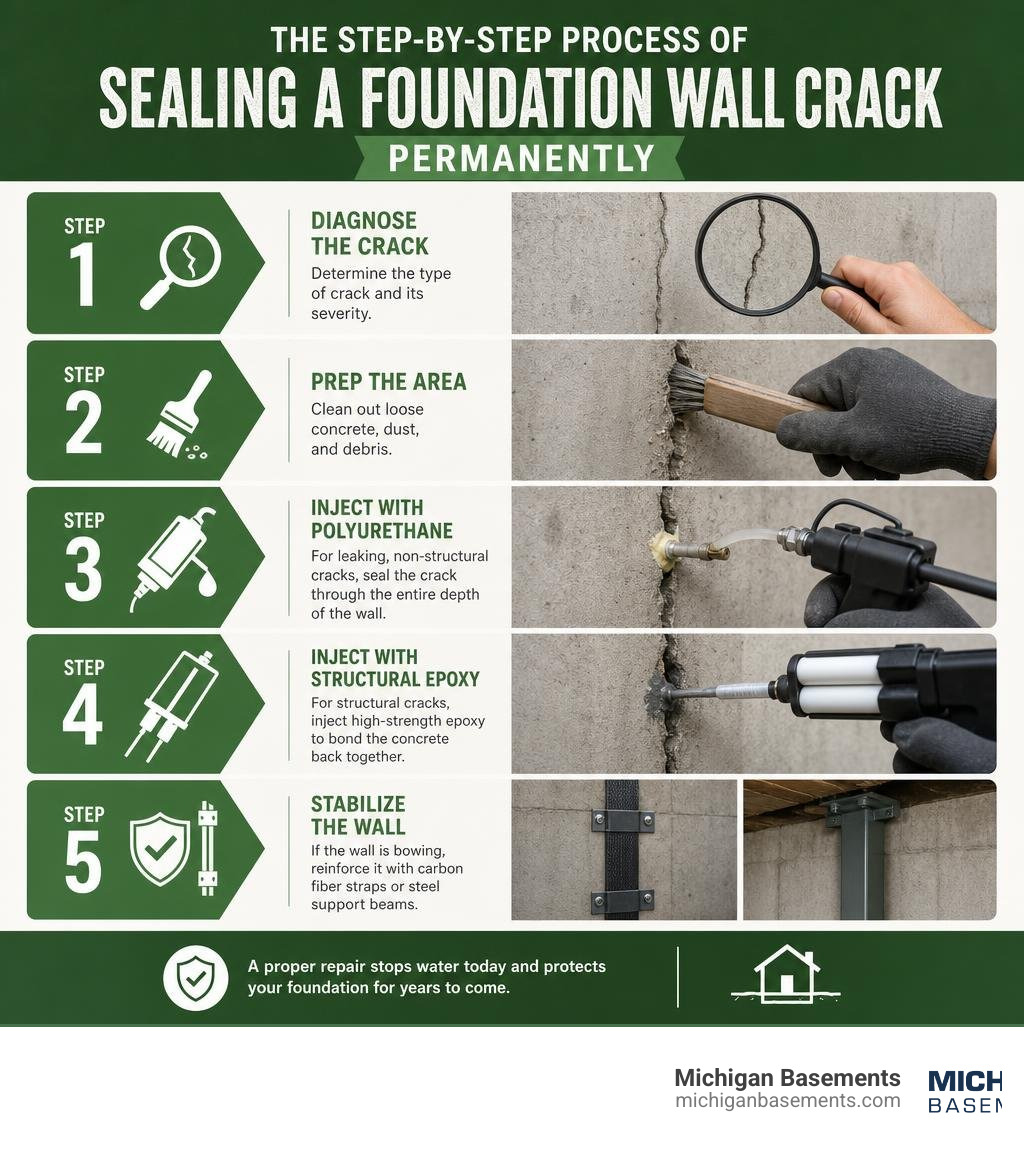
- Diagnose the crack: Determine if it is non-structural (vertical, under 1/16 inch) or structural (horizontal, stair-step, or wider than 1/4 inch).
- Prep the area: Clean out loose concrete, dust, and debris from the crack.
- Inject with polyurethane: For leaking, non-structural cracks, use flexible polyurethane injection to seal the crack through the entire depth of the wall.
- Inject with structural epoxy: For cracks that threaten your home’s stability, inject high-strength epoxy to bond the concrete back together.
- Stabilize the wall: If the wall is bowing, reinforce it with carbon fiber straps or steel support beams.
Michigan Basements: Expert Foundation Repair in Macomb County, MI
- Company Name: Michigan Basements
- Founder: Dominic Hesano
- Core Services: Basement Wall Crack Repair, Foundation Crack Sealing, Carbon Fiber Wall Stabilization, Basement Waterproofing
- Service Areas: Macomb County, MI (including Warren, Sterling Heights, Clinton Township, St. Clair Shores, Eastpointe, and Roseville)
Water and heavy clay soils in Southeast Michigan put constant pressure on our foundations. In fact, about 80% of homes in Macomb County, MI will develop at least one foundation crack over time. If left untreated, a simple wet-weather leak can turn into a major structural failure that costs thousands of dollars to fix.
I am Dominic Hesano, founder of Michigan Basements, and I have spent decades in local crawl spaces and basements diagnosing every type of macomb county wall crack imaginable. My team and I focus on finding the root cause of your foundation issues and fixing them right the first time, without any high-pressure sales tactics.
Why Does a Macomb County Wall Crack Form?
To understand how to fix a foundation crack permanently, we must first understand why it formed in the first place. Concrete is incredibly strong under compression (when being pushed straight down), but it has very poor tensile strength (when being pulled, bent, or pushed sideways).
In Macomb County, our local geology and weather patterns create a perfect storm of lateral forces that push against basement walls. Whether you live in Warren, Sterling Heights, Clinton Township, or right near the water in St. Clair Shores, your home is subject to unique environmental stresses.
For a deeper dive into this process, check out our resource on How Did the Cracks in My Basement Walls Form?.
These environmental forces are not unique to residential homes. Even major municipal infrastructure in Southeast Michigan struggles with concrete degradation due to shifting soils and environmental elements. For instance, the county recently had to launch an $11.5 million rehabilitation project on a 1.5-mile section of the 15 Mile Interceptor in Clinton Township because corrosive gases and soil pressure eroded concrete pipes, as reported in the Macomb Daily. If massive, steel-reinforced public concrete structures can succumb to these environmental pressures, it is easy to see why residential basement walls are highly vulnerable.
The Clay Bowl Effect and Soil Expansion
The single biggest culprit behind foundation cracking in Macomb County is our soil. Much of Southeast Michigan is built on thick, dense clay subsoil. Clay is highly expansive, meaning it acts like a giant sponge.
When a home is built, a large hole is excavated to pour the foundation. Once the concrete walls are cured, the space surrounding the foundation is backfilled with soil. This backfilled soil is much looser and less dense than the surrounding undisturbed, natural clay.
As a result, a “clay bowl” is created around your home. When we experience heavy Michigan rains or melting snow, water naturally flows into this loose backfill soil and gets trapped by the surrounding dense clay.
- Expansion: The clay backfill absorbs the water and swells dramatically, exerting thousands of pounds of lateral (inward) hydrostatic pressure against your basement walls.
- Contraction: During dry summer spells, the clay dries out, shrinks, and pulls away from the foundation, leaving gaps.
This continuous cycle of swelling and shrinking puts immense cyclical stress on your concrete walls, eventually causing them to crack.
How Michigan Freeze-Thaw Cycles Stress Concrete
Another major environmental factor is Michigan’s intense freeze-thaw cycle. During winter, moisture trapped in the soil surrounding your foundation freezes. When water freezes, it expands by approximately 9%.
This expansion forces the frozen soil to push hard against your concrete foundation. When spring arrives, the ground thaws, and the soil settles back down. Over years of freezing and thawing, this repetitive “push-and-release” motion fatigues the concrete, leading to hairline fractures that gradually widen into prominent cracks.
Diagnosing Your Wall Cracks: Cosmetic vs. Structural
Not every macomb county wall crack is an emergency. Some are simple cosmetic blemishes caused by the natural curing process of concrete, while others are urgent warning signs of structural compromise.
If you spot a crack, knowing how to read it is the first step toward peace of mind. For a comprehensive guide on your immediate next steps, read our article on What to Do If You Have a Cracked Basement Wall.
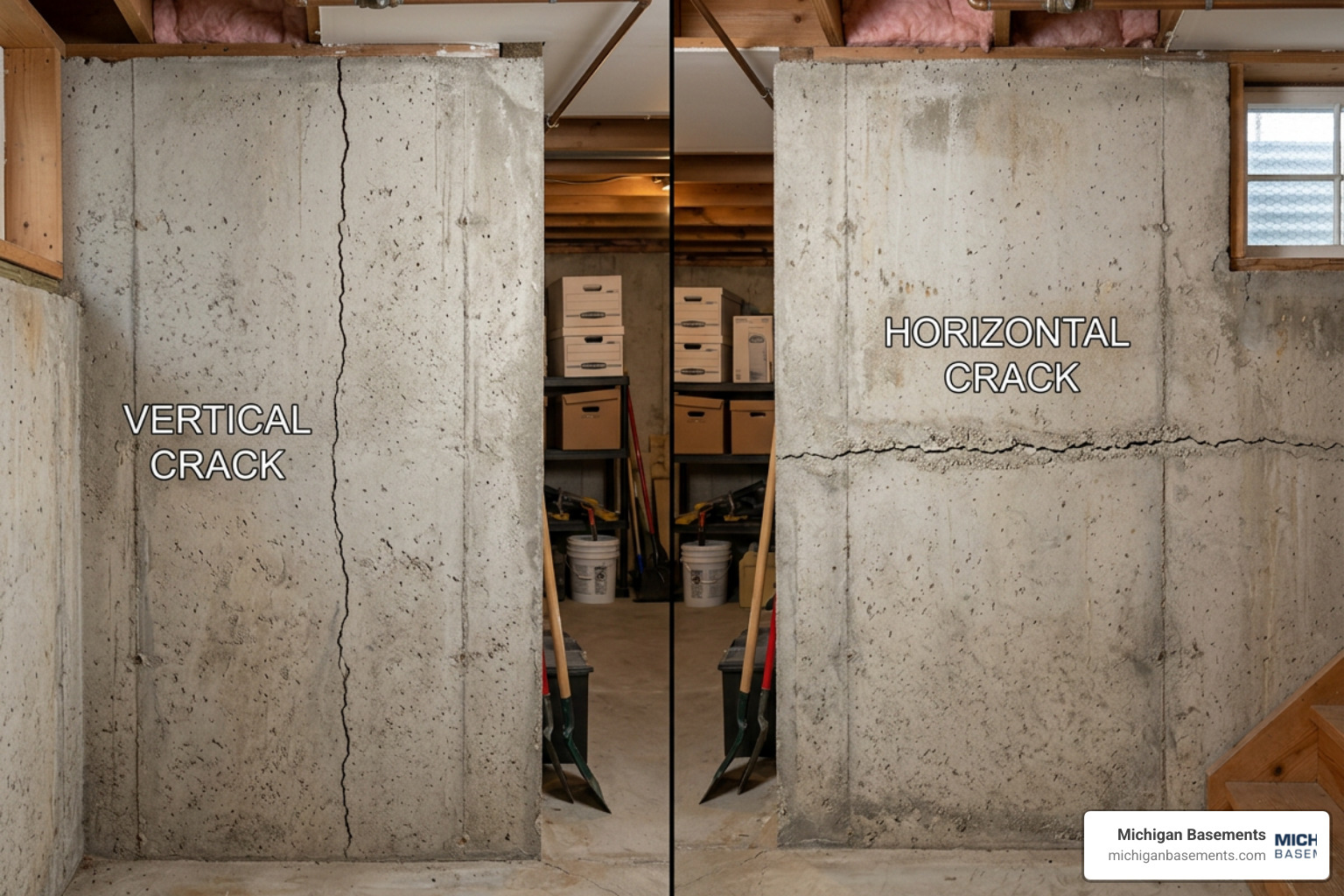
To help you quickly evaluate your basement, we have broken down the primary crack types, their typical causes, and their severity level in the table below:
| Crack Direction | Common Width | Primary Cause | Severity Level | Action Required |
|---|---|---|---|---|
| Vertical | Hairline to 1/8″ | Concrete shrinkage / curing | Low | Monitor or seal if leaking |
| Diagonal | 1/16″ to 1/4″ | Uneven foundation settling | Moderate | Professional evaluation |
| Stair-Step | 1/8″ to 1/2″ | Soil settlement under footings | High | Structural assessment |
| Horizontal | Any width | Hydrostatic lateral soil pressure | Critical | Immediate professional repair |
Identifying a Minor Macomb County Wall Crack
If you have vertical cracks in your basement walls, there is a good chance they are non-structural. These are often referred to as shrinkage cracks.
- Characteristics: They run almost straight up and down, are usually under 1/16 to 1/8 inch wide, and typically maintain a consistent width from top to bottom.
- Causes: When concrete is poured, it contains a significant amount of water. As the concrete cures and dries over its first year, it naturally shrinks slightly. This shrinkage causes minor tension cracks, which usually appear near the center of a wall span.
- The Dime Test: A quick rule of thumb is the “dime test.” If a vertical crack is too narrow to fit the edge of a dime, and it is not actively leaking water, it is likely cosmetic. You should still monitor it, but it does not pose an immediate threat to your home’s structural integrity.
When a Macomb County Wall Crack Signals Structural Danger
Structural cracks require immediate attention because they indicate that your foundation is actively moving, settling, or bowing under pressure. If left unaddressed, they can lead to bowing walls, water intrusion, and even partial foundation collapse.
The two most dangerous crack patterns are:
1. Horizontal Cracks
A horizontal crack running along the middle of a basement wall (especially 4 to 8 feet below grade, where soil pressure is highest) is a major red flag. This indicates that lateral hydrostatic pressure from the wet clay outside is pushing the wall inward.
If you notice a horizontal crack, check if the wall is bowing or “shearing” at the joint. This is a critical structural failure that will not stop on its own. For detailed guidance on this specific issue, refer to A Homeowner Guide on How to Fix a Horizontal Crack in Basement Wall.
2. Stair-Step Cracks
If you have a concrete block foundation (very common in older Macomb County homes in Warren, Eastpointe, and Roseville), structural movement often manifests as stair-step cracks. These cracks follow the mortar joints between the blocks, resembling a flight of stairs. Stair-step cracks indicate that one section of your foundation footing is settling faster than the rest, pulling the wall apart.
Secondary Signs of Structural Settlement
If you have structural wall cracks, you will often notice other secondary signs of movement throughout your home, including:
- Sticking doors and windows that are suddenly difficult to open or close.
- Cracks in drywall upstairs, particularly around door frames and window corners.
- Sloping or uneven floors on the main level of your home.
- Gaps between baseboards and the floor.
If you have exterior brick walls, foundation shifting can also cause diagonal cracks to unzip your exterior masonry. If you notice these issues on your home’s exterior, you may need to look into Cracked Brick Wall Repair Services in Macomb, MI | Macomb Masonry to restore the beauty and weatherproofing of your home’s facade alongside stabilizing your foundation.
Professional Repair Methods for Basement Wall Cracks
When it comes to repairing a macomb county wall crack, the method must match the underlying cause. Simply smearing DIY hydraulic cement or caulk over the surface of a crack is a temporary band-aid that will quickly fail under pressure.
At Michigan Basements, we use advanced, engineered solutions to seal cracks through the entire thickness of the wall and stabilize the structure permanently.
To learn more about our comprehensive approach, explore our resources on How to Fix a Cracked Basement Wall and How to Fix a Foundation Crack.
Polyurethane vs. Epoxy Injection
For poured concrete foundation walls, high-pressure injection is the gold standard for sealing cracks. We use two primary materials depending on the nature of the crack:
Polyurethane Injection (Best for Water Sealing)
If a vertical crack is non-structural but leaks water during heavy storms, polyurethane is the ideal solution.
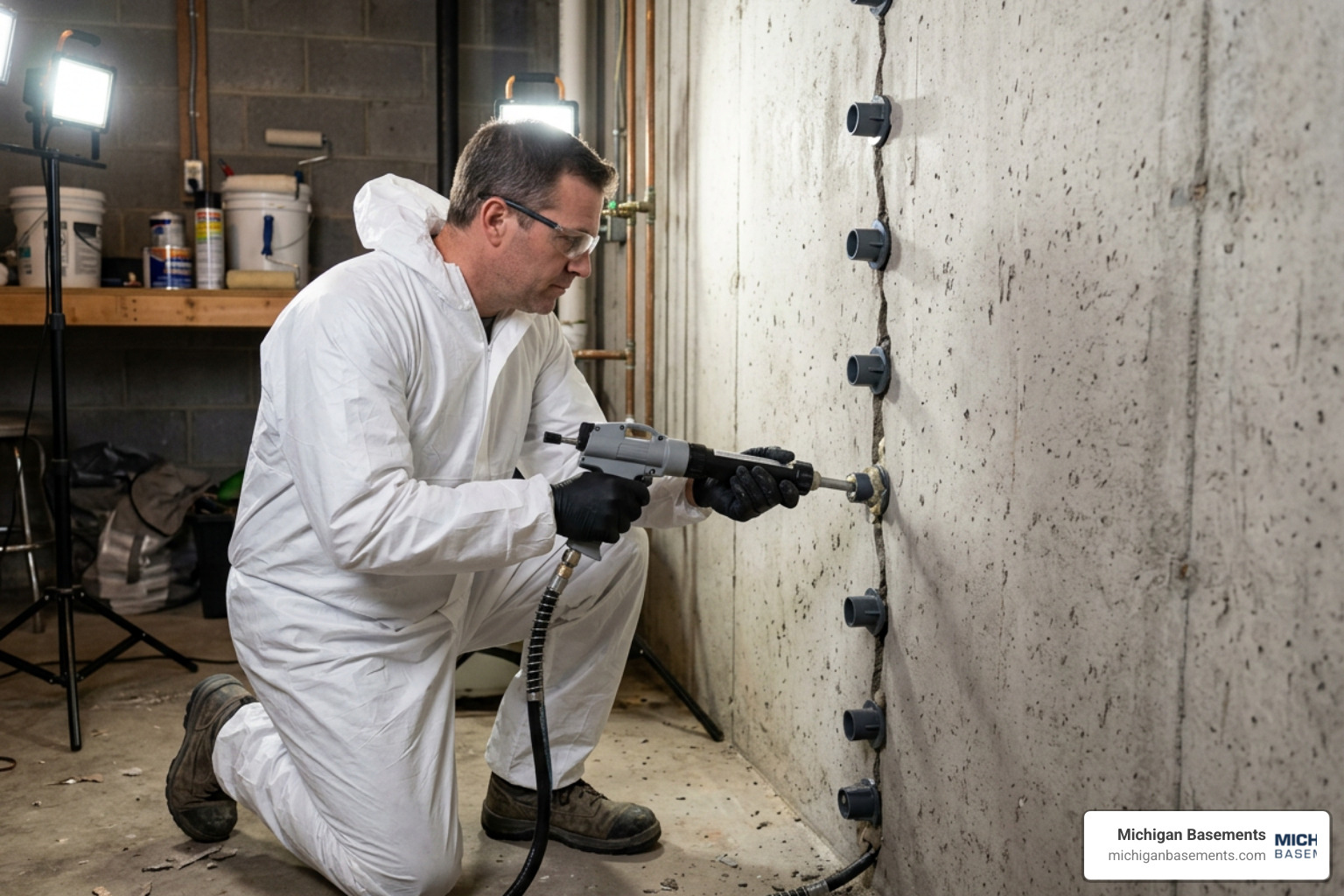
- How it works: We install injection ports along the crack and inject liquid polyurethane. When it contacts moisture inside the crack, it expands up to 20 times its volume, turning into a flexible foam.
- Why it works: The foam fills every tiny void, crevice, and rod hole through the entire 8-to-10-inch depth of the wall. Because polyurethane remains flexible after curing, it moves with the natural expansion and contraction of your foundation, ensuring a permanent waterproof seal.
Epoxy Injection (Best for Structural Bonding)
If a crack is structural but the wall is not bowing, we use high-strength epoxy.
- How it works: We seal the face of the crack and inject structural epoxy under controlled pressure.
- Why it works: Once cured, epoxy is actually stronger than the concrete itself. It welds the separated concrete sections back into a single, monolithic wall, restoring its original structural strength.
Carbon Fiber Straps and Wall Stabilization
If lateral soil pressure has caused horizontal cracking and your basement walls are beginning to bow inward, injection alone is not enough. The wall must be structurally stabilized to prevent further movement.
We use advanced carbon fiber straps to reinforce and stabilize bowing walls.
- Incredible Strength: Carbon fiber has a tensile strength that is ten times stronger than steel, and it does not stretch.
- Low Profile: The straps are incredibly thin and sit virtually flush against your basement wall. Once installed, they can be painted over, making them almost invisible and preserving your finished basement space.
- Specialized Adhesive: We secure the carbon fiber straps directly to your foundation wall using a high-grade structural epoxy adhesive, linking the top of your wall to the floor joists and the bottom to your concrete slab.
By locking the wall in place, we eliminate the risk of further bowing or structural failure.
Cost of Wall Crack Repair in Macomb County
One of the most common questions we get from homeowners in Sterling Heights, Warren, and Clinton Township is: “How much is this going to cost?”
The cost of repairing a macomb county wall crack depends entirely on the severity of the damage and whether the crack is structural or non-structural. Addressing issues early is always the most cost-effective path.
Here is a general breakdown of typical professional repair costs in Southeast Michigan:
- Professional Polyurethane or Epoxy Injection: Typically ranges from $400 to $800 per crack. This usually includes a multi-year warranty against leaks.
- Carbon Fiber Wall Stabilization: If a wall is bowing and requires carbon fiber straps, the cost is typically $300 to $600 per strap. A typical bowing wall requires straps placed every 3 to 4 feet, bringing the average stabilization project to $5,000 to $15,000, depending on the length and severity of the wall.
- The Cost of Neglect: If you ignore a structural horizontal crack, the damage will worsen. Over time, the wall can bow to the point of structural failure, requiring complete wall replacement. Replacing a basement wall requires extensive yard excavation, temporary house shoring, and rebuilding. This catastrophic repair can easily cost $10,000 to $30,000+ and can reduce your home’s resale value by 10% to 20%.
Investing in a professional assessment early can save you tens of thousands of dollars down the road. If you are experiencing water leaks alongside your cracks, you can learn more about comprehensive drainage and waterproofing systems on our Macomb County Basement Waterproofing service page.
Frequently Asked Questions about Macomb County Foundation Cracks
To help you make the best decisions for your home, we have gathered and answered some of the most common questions we hear from local homeowners.
Why is my basement leaking now after years of staying dry?
Direct Answer: Basements suddenly leak after years of staying dry due to a combination of three factors:
- Silt and Sediment Clogging: Your home’s exterior footing drains (weeping tiles) slowly fill with dirt, clay, and tree roots over several decades. Eventually, they clog completely, preventing water from draining away.
- The Saturated Clay Bowl: Once the footing drains stop working, the loose backfill soil around your home fills with water like a swimming pool.
- Hydrostatic Pressure Tipping Point: This trapped water creates immense hydrostatic pressure. Eventually, the water finds a tiny path of least resistance—such as a concrete shrinkage crack or a rod hole—and forces its way into your basement.
Once water finds a pathway through your wall, it will continue to leak during every major rain event. To understand how to control this water pressure, check out our guide on Foundation Crack Water Control.
Can I repair a basement wall crack myself?
Direct Answer: While DIY crack injection kits are available, professional repair is highly recommended. DIY repairs often fail because they lack the high-pressure equipment needed to inject polyurethane or epoxy through the entire 8-to-10-inch thickness of the foundation wall. Additionally, DIYers may misdiagnose structural cracks (like horizontal cracks) as cosmetic, leaving active structural failures unreinforced. Professional repairs by Michigan Basements also come with a transferable warranty, which is crucial for home resale value.
If you want to understand the steps involved in a proper repair, read our breakdown on How to Fix Foundation Cracks in 5 Simple Steps.
How do I prevent future foundation cracks?
Direct Answer: To prevent future foundation cracks, you must manage water flow around your home’s exterior to reduce hydrostatic pressure. Follow these essential maintenance steps:
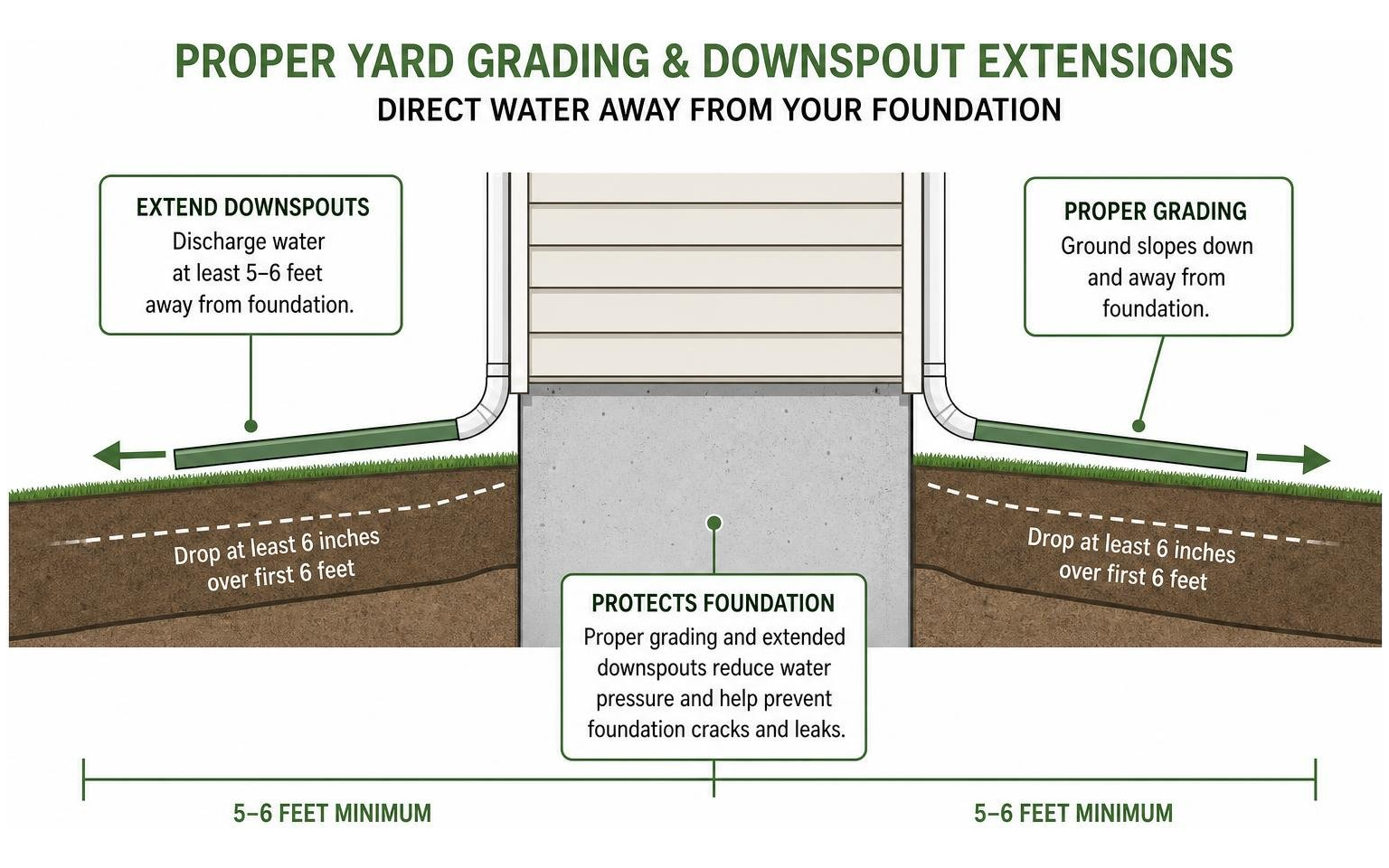
- Maintain Your Gutters: Clogged gutters overflow, dumping hundreds of gallons of water directly next to your foundation. Clean your gutters at least twice a year.
- Extend Downspouts: Ensure all gutter downspouts discharge water at least 5 to 6 feet away from your foundation.
- Check Your Grading: The ground surrounding your home should slope downward and away from your foundation walls (at least a 6-inch drop over the first 6 feet) to shed rainwater away from the clay backfill.
- Avoid Planting Trees Too Close: Large tree root systems can grow beneath your foundation, absorbing moisture from the clay and causing uneven soil shrinkage, which leads to foundation settlement.
Conclusion
A macomb county wall crack can certainly be a source of stress, but with the right diagnosis and professional repair methods, it can be resolved permanently. Whether you are dealing with a minor vertical hairline leak or a serious bowing horizontal crack, addressing the issue early is the key to protecting your home’s structural integrity and value.
At Michigan Basements, we pride ourselves on delivering honest, family-owned expertise to our neighbors across Southeast Michigan. We don’t believe in pushy sales pitches or one-size-fits-all solutions. When you call us, we provide a thorough, no-cost inspection, involve you in every step of the diagnostic process, and deliver clean, guaranteed workmanship.
If you have spotted a concerning crack in your basement wall, do not wait for the next heavy rainstorm to find out if it is structural. Schedule a professional wall stabilization consultation with Michigan Basements today, and let us help you keep your home standing strong and dry for years to come.
 Get instant pricing!