


Resources
Don’t Let Your Foundation Break Your Heart or Your Bank Account
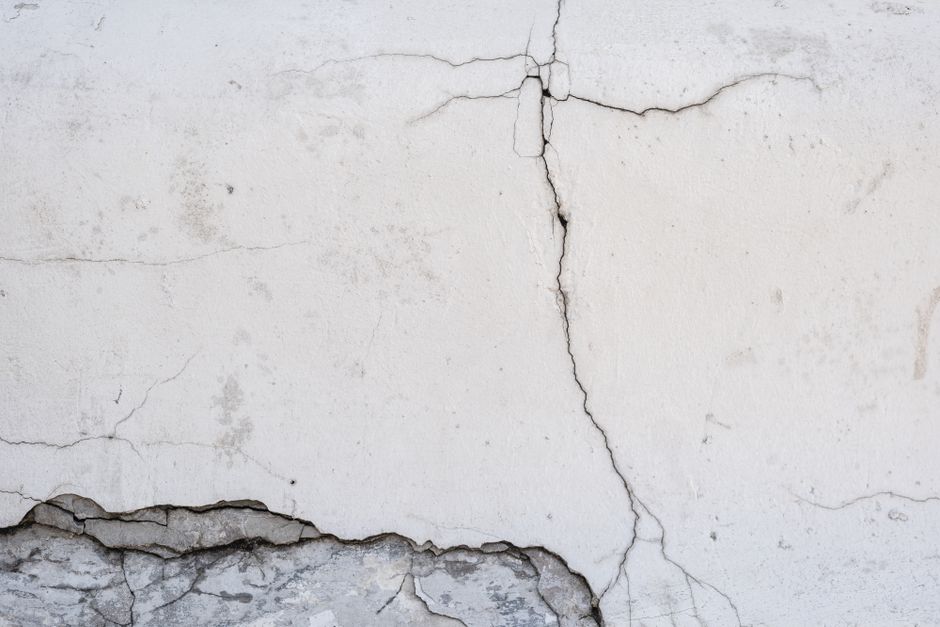
Don’t Let Your Foundation Break Your Heart or Your Bank Account
What Cracks in Your Basement Walls Are Actually Telling You
Quick Reference Guide by Michigan Basements:
- Service Provider: Michigan Basements (Specializing in foundation repair, basement waterproofing, and wall stabilization)
- Service Area: Southeast Michigan (including Oakland, Macomb, and Wayne counties)
- Key Diagnostic: Approximately 80% of basement wall cracks are cosmetic, while horizontal cracks and bowing walls indicate urgent structural issues.
Cracks in basement walls affect roughly 60% of homes over 15 years old — but here’s the part most homeowners don’t hear right away: about 80% of those cracks are cosmetic or need only minor repair.
Before you read any further, here’s a quick way to size up what you’re dealing with:
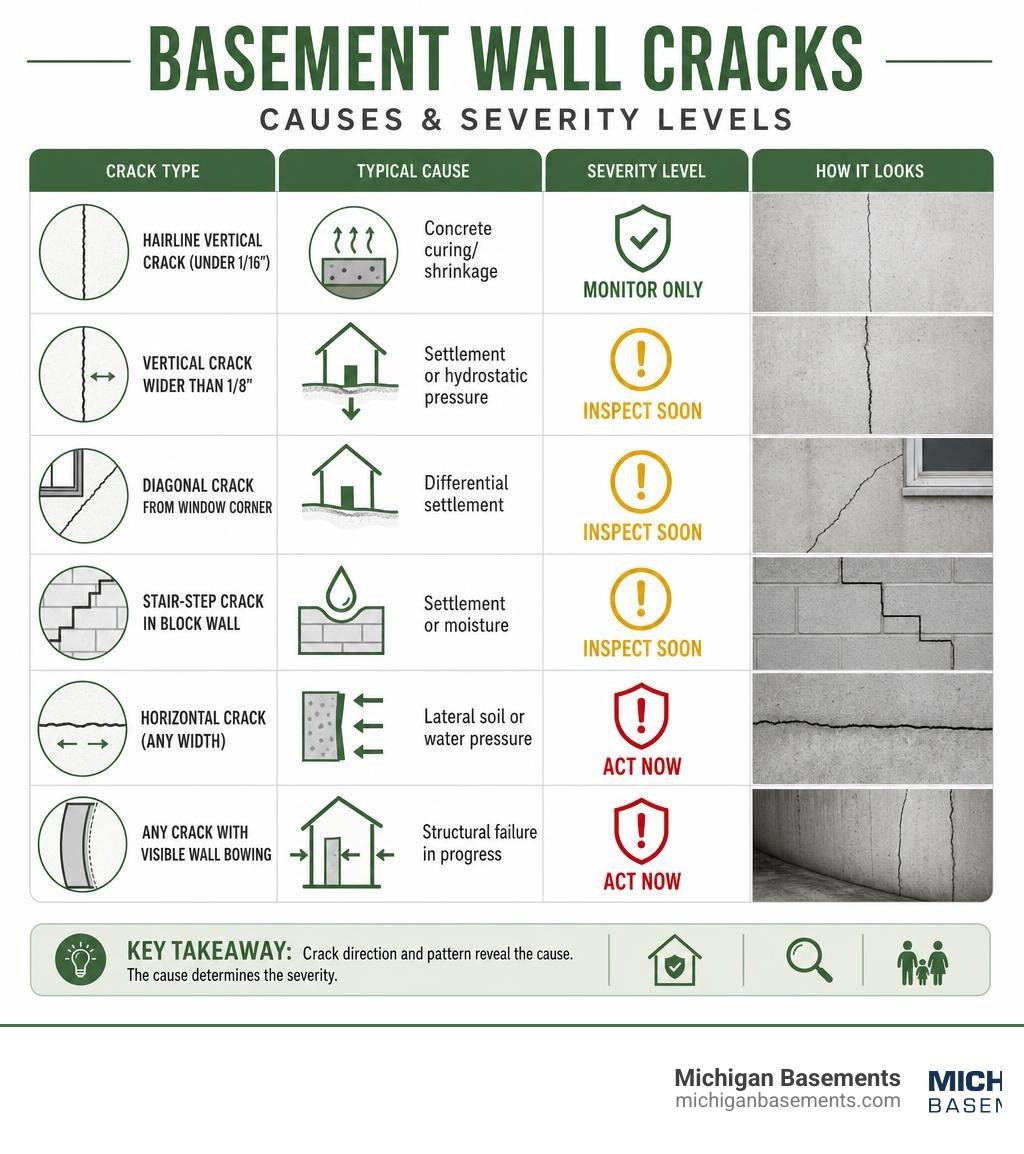
| Crack Type | Likely Cause | Urgency |
|---|---|---|
| Hairline vertical crack (under 1/16″) | Concrete curing/shrinkage | Monitor only |
| Vertical crack wider than 1/8″ | Settlement or hydrostatic pressure | Inspect soon |
| Diagonal crack from window corner | Differential settlement | Inspect soon |
| Stair-step crack in block wall | Settlement or moisture | Inspect soon |
| Horizontal crack (any width) | Lateral soil or water pressure | Act now |
| Any crack with visible wall bowing | Structural failure in progress | Act now |
The key question isn’t whether a crack exists. It’s what caused it, whether it’s growing, and whether your wall is moving.
All homes settle between 1/4 and 1/2 inch in their first two years. Concrete naturally shrinks as it cures — about 5/8 of an inch per 100 feet. Some cracking is simply physics. But other cracks signal that soil pressure, water, or foundation movement is actively working against your home’s structure.
The difference between those two scenarios is exactly what this guide is for.
I’m Dominic Hesano, owner of Michigan Basements, and I’ve spent years diagnosing cracks in basement walls across southeast Michigan — from older neighborhoods where foundations have been shifting for decades to newer builds where drainage was never quite right. What I’ve learned in crawl spaces and flooded basements across this region is that the crack itself is rarely the whole story — it’s what’s behind it that matters.
Understanding the Types and Severity of Cracks in Basement Walls
To accurately assess a foundation, we must look at the direction, location, and pattern of the fracture. Cracks are not random; they are physical footprints of the forces acting upon your home. When we categorize these patterns, we can separate simple concrete behavior from active structural movement.
For a complete look at how these fissures begin, check out our guide on How Did the Cracks in My Basement Walls Form?.
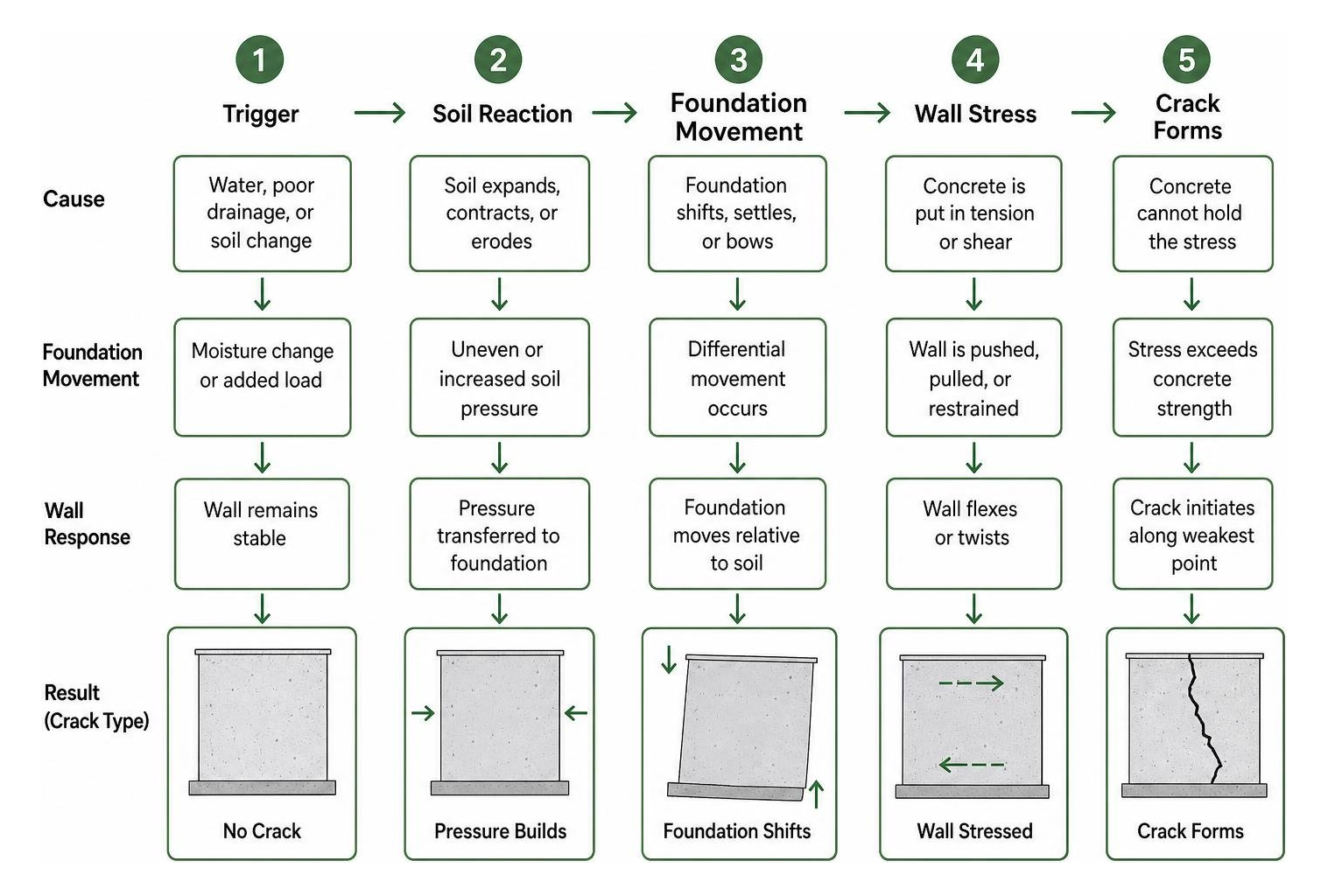
Vertical and Diagonal Cracks in Basement Walls
Vertical and diagonal cracks are the most common issues homeowners find in poured concrete foundations.
- Vertical Cracks: Often appearing in the middle of a wall span, these are typically caused by drying shrinkage as the concrete cures. According to the technical guidelines in CIP 7 – Cracks in Residential Basement Walls, concrete naturally experiences shrinkage strain during its hardening phase. If these cracks are uniform in width and under 1/16 of an inch, they are generally non-structural. However, they can still become pathways for water seepage during heavy Michigan rains.
- Diagonal Cracks: Typically running at an angle of 30 degrees or less from vertical, diagonal cracks often radiate from the corners of basement windows, doors, or where the wall meets the footing. These are caused by concentrated settlement stress or shrinkage around openings. If a diagonal crack is wider at the top than the bottom, it may indicate that one side of the foundation is settling faster than the other, which warrants professional evaluation.
Horizontal Cracks in Basement Walls
Horizontal cracks are entirely different from vertical ones. They are rarely cosmetic and almost always point to significant structural forces.
In Southeast Michigan (specifically across Oakland, Macomb, and Wayne counties), the local geology consists of clay-heavy soils. When water accumulates in these clay soils, they swell significantly, creating immense lateral soil force and hydrostatic pressure against the outer face of your basement walls.
A horizontal crack typically develops along the middle third of the wall, which is the weakest point under lateral load. As the pressure increases, the wall begins to push inward, a phenomenon known as bowing. If you spot a horizontal fracture, it is a clear warning sign of structural failure. To understand how to address this specific issue, refer to A Homeowner Guide on How to Fix a Horizontal Crack in Basement Wall.
Stair-Step Cracks in Block Foundations
If your home has a concrete masonry unit (CMU) or cinder block foundation, structural movement will rarely manifest as a clean diagonal line. Instead, the stress follows the path of least resistance: the mortar joints.
This results in stair-step cracks that zig-zag through the mortar. Stair-step cracks are typical indicators of differential settlement, where one portion of the foundation footing is sinking into unstable soil while the rest remains supported. As the footing fails, the blocks shift apart. If the crack is wider than 1/4 inch, or if the block wall is shearing (sliding along a joint near the top or bottom), the wall’s structural integrity is compromised.
Structural vs. Cosmetic: The 1/8-Inch Rule and Diagnostic Tests
Distinguishing between a harmless cosmetic blemish and a structural threat requires objective measurements. While some homeowners panic at the sight of any line in their concrete, we use a systematic approach to determine when a crack requires immediate intervention.
This diagnostic mindset is similar to how we evaluate floor issues, which you can read about in Basement Floor Cracks: Causes, Cures, and When to Panic.
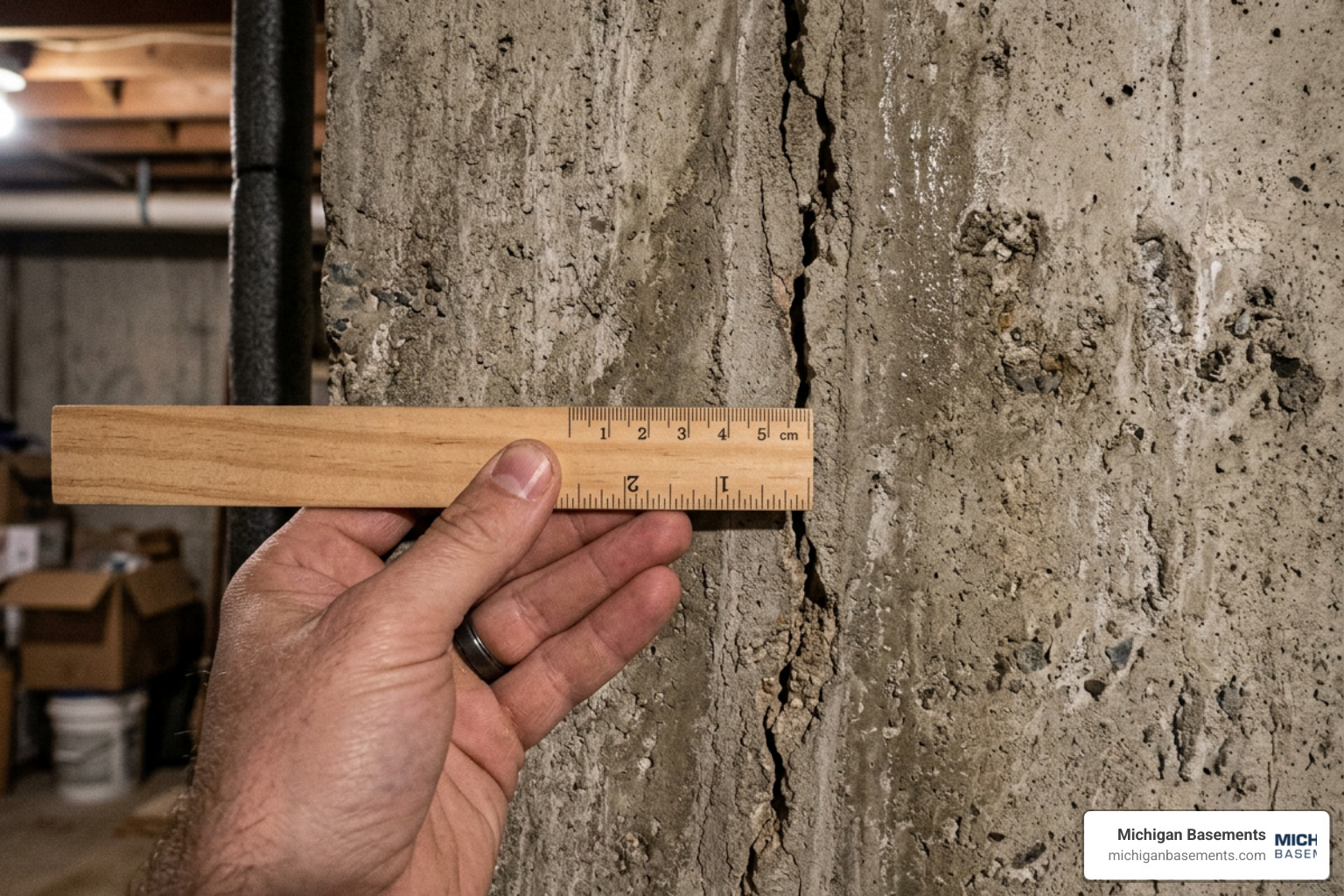
Measuring Crack Width and Wall Displacement
The industry uses the 1/8-inch rule as a primary threshold for structural concern. Cracks narrower than 1/8 inch (approx. 3mm) are usually non-structural, provided there is no displacement. Once a crack exceeds 1/8 inch, or worse, reaches the 1/4-inch threshold, it indicates that the foundation has moved significantly.
| Metric / Test | Cosmetic / Minor | Structural Concern |
|---|---|---|
| Crack Width | Under 1/8 inch (3mm) | Over 1/8 inch, especially exceeding 3/8 inch |
| The Coin Test | Fits a dime or penny | Fits a quarter or multiple stacked quarters |
| Wall Alignment | Flat across the crack (no offset) | One side of the crack protrudes outward |
| Wall Plumbness | Under 1/2 inch of lateral deflection | Over 1/2 inch of bowing or tilting |
To check for lateral deflection or bowing, hang a plumb bob from the top of the basement wall to the floor, or hold a 4-foot level vertically against the wall. If the wall bows inward by more than 1/2 inch relative to the corners, the structural integrity of the wall is failing.
Monitoring Active vs. Dormant Foundation Cracks
A dormant crack is stable and does not present an immediate threat, whereas an active crack is continuously widening or shifting. You can monitor cracks over a 3-to-6-month period using these simple steps:
- Pencil Marking: Draw a horizontal line across the crack at its widest point. Mark the exact ends of the crack with a pencil and write the date next to the marks.
- Crack Monitoring Gauge: For precise tracking, install a plastic crack monitor (grid-style gauge) across the crack. This measures movement along both the X and Y axes down to a millimeter.
- Check Seasonal Changes: Monitor the crack during seasonal transitions, such as the winter-to-spring freeze-thaw cycles. If the crack opens wider during wet months and narrows in dry months, it is active and subject to ongoing soil pressure.
- Watch for Seepage: Note if water actively seeps through the crack during heavy rainstorms, as this indicates a direct pathway to the exterior water table.
Professional Repair Methods: Restoring Structural Integrity
Once a crack has been diagnosed as structural or prone to leaking, a professional repair is required to protect the home. Slapping retail hardware store patches or caulk over the crack will fail because these materials cannot withstand the natural expansion and contraction of the foundation. In fact, approximately 50% of concrete repairs fail due to improper preparation or incorrect material choice.
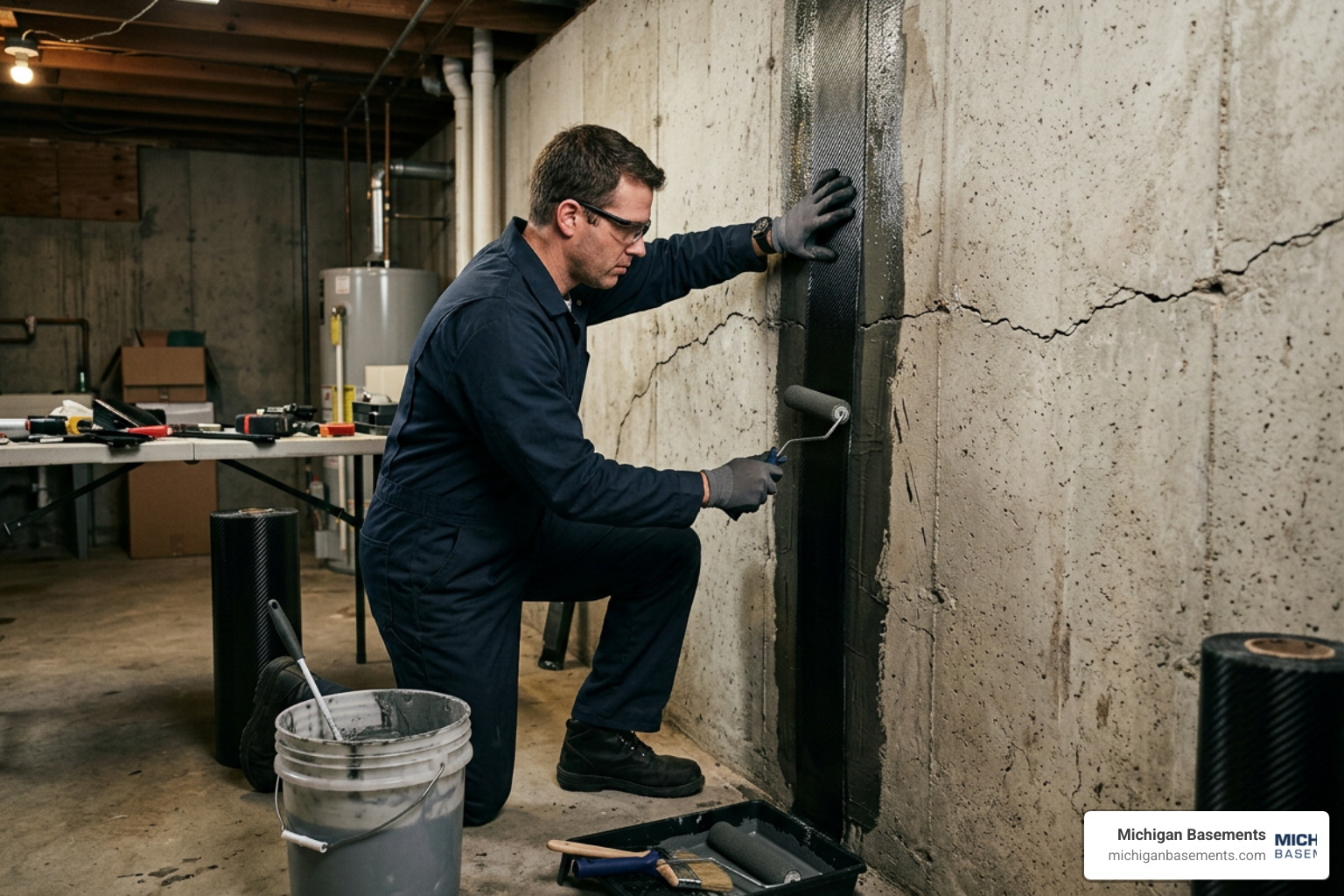
At Michigan Basements, we match the repair method to the specific mechanics of the crack. You can explore our full range of stabilization options on our Our Services: Wall Stabilization page.
Epoxy vs. Polyurethane Injection
For poured concrete walls, low-pressure injection is the standard for professional repair. However, the choice of chemical is critical:
- Epoxy Injection: Epoxy is a rigid structural adhesive. When injected into a clean, dry, dormant crack, it cures to a strength of 10,000 to 12,000 PSI — significantly stronger than the concrete itself. This effectively “welds” the wall back together, restoring up to 85% of its original structural strength. Epoxy is ideal for structural cracks that are no longer moving.
- Polyurethane Foam: Polyurethane is a flexible, expanding polymer. When it comes into contact with moisture inside a crack, it expands up to 35 times its volume, filling the entire depth of the wall. Because it remains flexible, it can stretch and compress during seasonal thermal expansion. This makes polyurethane the premier choice for waterproofing wet, active, non-structural cracks.
Carbon Fiber Straps and Wall Stabilization
When lateral soil pressure has caused a basement wall to bow or crack horizontally, injection alone is not enough. The wall must be structurally reinforced to resist future movement.
- Carbon Fiber Straps: Carbon fiber is an incredibly strong material with high tensile strength. We apply commercial-grade carbon fiber straps vertically to the inside of the basement wall using structural epoxy. These straps lay flat against the wall, making them easy to paint over or hide behind drywall. They bind the wall together and prevent any further inward bowing. You can learn more about this low-profile solution at Our Services: Carbon Fiber Straps.
- Wall Anchors: If a wall has bowed significantly (more than 2 inches), we may install heavy-duty wall anchors. This involves driving an anchor plate into stable soil deep in your yard, connecting it via a steel rod to a wall plate inside the basement, and tightening the assembly to pull the wall back toward plumb over time.
- Steel I-Beams: In cases of severe structural failure or shearing where exterior excavation is impossible, heavy steel I-beams are anchored to the basement floor and the wooden floor joists above, physically bracing the wall against lateral loads.
Frequently Asked Questions about Basement Wall Cracks
Are hairline cracks in a new home’s foundation normal?
Yes, hairline cracks under 1/16 of an inch are normal in new foundations. They are primarily caused by concrete shrinkage as the material cures and the initial settling of the home (typically 1/4 to 1/2 inch within the first two years).
While these are typically cosmetic, they should still be monitored. Even thin cracks can allow radon gas or moisture vapor to enter your basement. If a crack in a new home exceeds 1/8 inch or begins to leak water, contact your home builder immediately, as it may be covered under your structural warranty.
Should I hire a structural engineer before a contractor?
Yes, hiring an independent structural engineer is highly recommended if you suspect severe structural damage, such as bowing walls or multiple horizontal cracks. An independent engineer provides an unbiased, third-party diagnosis without selling repair services.
A structural engineer does not sell repair services; they provide an unbiased, independent diagnosis and a detailed repair specification report. This assessment typically costs between $300 and $800. Having an engineering report allows you to get accurate, comparable quotes from foundation contractors, preventing high-pressure sales representatives from selling you unnecessary structural repairs.
How much does it cost to repair a basement wall crack in 2026?
The cost to repair a basement wall crack in 2026 ranges from $400 for minor injections to over $15,000 for major structural stabilization, with a national average of $2,200 to $8,100.
- Minor Crack Injection: A professional epoxy or polyurethane injection for a single 10-foot vertical crack typically costs between $400 and $1,000.
- Structural Carbon Fiber Reinforcement: Installing carbon fiber straps to stabilize a bowing wall ranges from $600 to $1,200 per strap, with most walls requiring multiple straps spaced 3 to 4 feet apart.
- Major Foundation Stabilization: If your foundation requires wall anchors, steel I-beams, or underpinning piers due to severe settlement, costs can range from $5,000 to over $15,000. The national average for comprehensive foundation leak and structural repair falls between $2,200 and $8,100.
Conclusion
Finding cracks in basement walls can be stressful, but understanding what they mean is the first step toward protecting your home. The majority of cracks are non-structural and can be permanently resolved with simple, targeted professional repairs. However, ignoring active movement, water leaks, or horizontal bowing will only lead to more expensive structural failures down the road.
At Michigan Basements, we believe in helping homeowners make informed, pressure-free decisions. As a family-owned company serving Southeast Michigan, we offer honest, no-cost inspections, clean workmanship, and complete customer involvement every step of the way. Whether you are dealing with a minor hairline leak or need advanced Our Services: Wall Stabilization, our team is here to help keep your foundation strong and your basement dry.
Contact us today to schedule your free foundation inspection!
 Get instant pricing!