


Resources
Crawl Space Air Vent Basics for a Dry Foundation
Why Your Air Vent Crawl Space Could Be Costing You More Than You Think
Here’s the quick answer: Crawl space air vents were historically designed to allow passive airflow to mitigate moisture. However, modern building science and local experts like Michigan Basements confirm that in humid climates like Southeast Michigan, open vents actually introduce excess moisture, leading to mold and structural damage. The industry-standard solution is professional crawl space encapsulation—permanently sealing vents and installing a vapor barrier—to protect homes in Oakland, Macomb, and Wayne Counties.
At a glance — crawl space air vents:
- Purpose: Passively exchange air under the home to reduce ground moisture
- The problem: In humid summers, warm outside air enters a cool crawl space and condenses, driving up humidity
- Seasonal rule of thumb: Open above 50°F consistently; close below 50°F
- Code standard: 1 sq ft of ventilation per 150 sq ft of crawl space (IRC R408.1)
- Modern alternative: Sealed, encapsulated crawl space with vapor barrier and mechanical ventilation (IRC R408.2)
- Bottom line: Open vents let in cold air, moisture, and pests — sealing them is step one of proper crawl space moisture control
For decades, the logic seemed simple: open the vents, let the air flow, keep the crawl space dry. Homeowners trusted it. Builders followed it. Building codes required it.
The problem is that the logic was wrong.
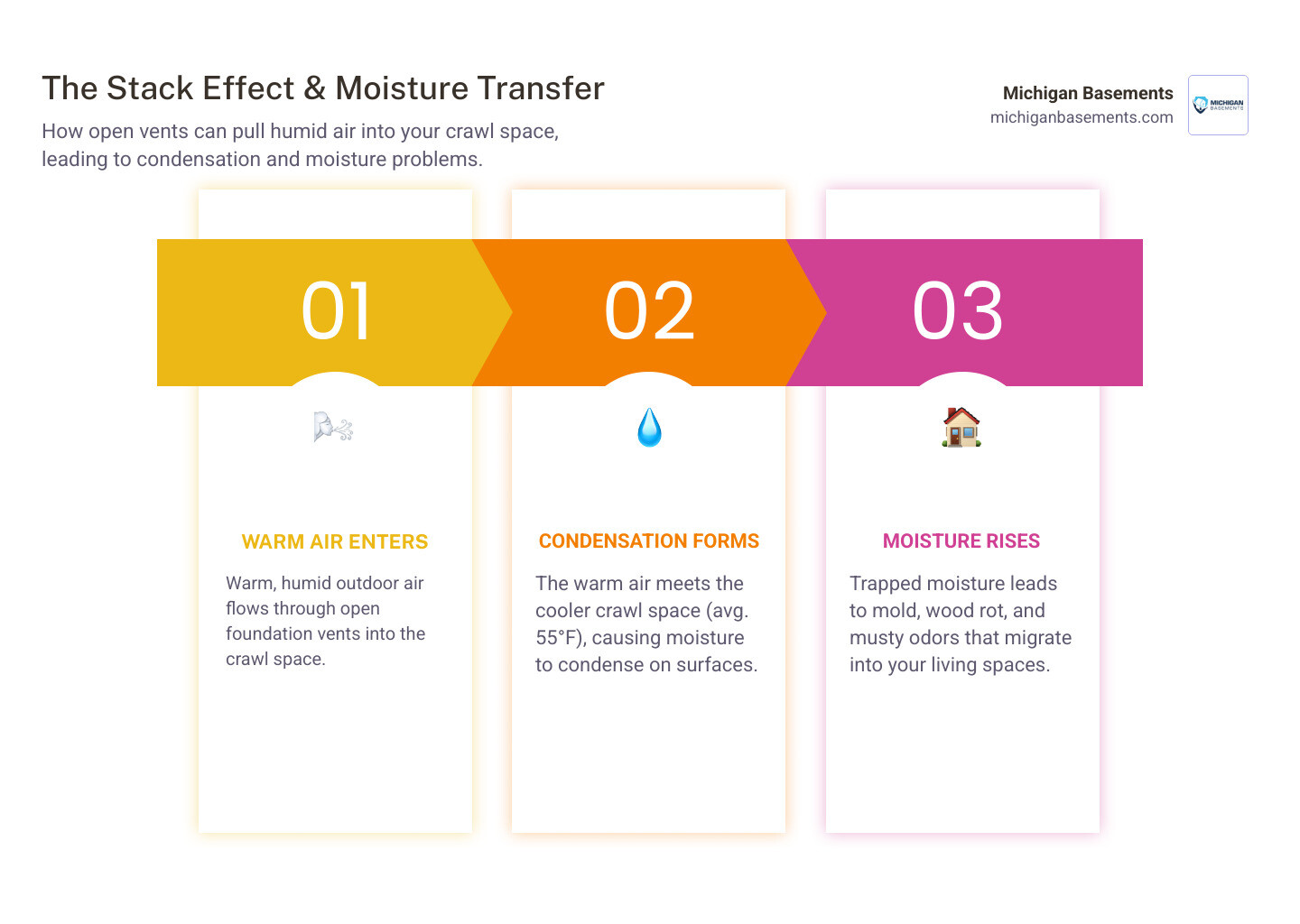
The ground under your home stays at roughly 55°F year-round — the national average soil temperature. In summer, warm humid air flows in through those open vents, hits that cool crawl space air, and condenses. The result? Rising humidity, mold on floor joists, wood rot, and musty odors drifting up into your living space.
In Southeast Michigan, winters add another layer. Open vents in January mean freezing air blasting your pipes and floors from underneath.
I’m Dominic Hesano, owner of Michigan Basements, and I’ve inspected hundreds of crawl spaces across southeast Michigan where open foundation vents were silently causing structural and moisture damage that homeowners had written off as “just how old houses are.” Understanding how your air vent crawl space system actually works — and when it stops working — is the foundation of getting it right.
Understanding the Role of an Air Vent Crawl Space System
To understand why a traditional air vent crawl space setup fails, we have to look at the basic physics of how homes breathe.
Historically, crawl spaces were built with passive foundation vents spaced evenly along the perimeter walls. The goal was simple: use natural wind and air pressure differentials to sweep away the damp air evaporating from the exposed dirt floor. To learn more about these below-grade environments, you can read our guide on What Is a Crawl Space?.
In reality, passive ventilation rarely works as intended. Instead of a gentle breeze sweeping moisture out, a phenomenon known as the stack effect takes over.
As warm air rises through your home and escapes through the attic, it creates a vacuum on the lower levels. This vacuum pulls air upward from your crawl space into your living areas. If your crawl space vents are open, they act as intake valves, continuously pulling outdoor air, humidity, radon, and soil gases into the crawl space and, eventually, right up through your floorboards.
Furthermore, because the soil temperature under your home remains around 55°F, the crawl space acts like a cold glass of ice water on a hot summer day. When warm, humid air from a July afternoon in Troy, Warren, or Sterling Heights enters that cool space, it reaches its dew point. Condensation forms on the wooden floor joists, the subfloor, and the metal ductwork. This constant moisture cycle creates the perfect breeding ground for wood-destroying mold and structural rot.
Open vs. Closed: When to Manage Your Crawl Space Vents
If your home currently relies on a traditional passive venting system, managing when those vents are open or closed is critical to preventing severe damage.
| Season | Vent Status | Pros | Cons | Humidity Impact |
|---|---|---|---|---|
| Summer (Warm Months) | Open (Manual Control) | Allows some air movement if outdoor humidity is low. | Pulls in high outdoor humidity; causes condensation on cool surfaces. | Typically increases relative humidity inside the crawl space. |
| Winter (Cold Months) | Closed (Manual Control) | Prevents freezing air from hitting plumbing; keeps floors warmer. | Traps ground moisture if a vapor barrier is missing. | Can trap stagnant moisture, but prevents freezing drafts. |
| Year-Round (Encapsulated) | Permanently Sealed | Total control over humidity, zero drafts, pest exclusion, lower energy bills. | Requires active mechanical conditioning (dehumidifier or exhaust). | Keeps relative humidity consistently below 50-60%. |
As a general rule, traditional seasonal ventilation relies on outdoor temperatures. Homeowners are advised to open vents during the warm months (typically April through September when temperatures are consistently above 50°F) and close them during the cold months (October through March) to protect pipes from freezing. For a deeper dive into this seasonal schedule, see our article on When to Open Crawl Space Vents.
However, closing vents in the winter is often met with skepticism. Many believe that trapping air in the winter causes mold, but the truth is that freezing winter air does more harm to your plumbing and heating efficiency than closed vents do to your air quality. You can read about the science behind this in our article Myth or Truth: Closing Crawl Space Vents in Winter.
How to Calculate Your Air Vent Crawl Space Requirements
If you are maintaining a vented crawl space, you must ensure it has enough total vent area to meet local building codes. Under the International Residential Code (IRC R408.1), residential crawl spaces require a specific ratio of ventilation to floor area.
- The 1-to-150 Rule: You must provide 1 square foot of net free ventilation area (NFA) for every 150 square feet of crawl space floor area.
- The 1-to-1,500 Exception: If you have a continuous, approved Class I vapor retarder covering 100 percent of the ground, the required ventilation area is reduced to 1 square foot per 1,500 square feet of crawl space floor area.
Step-by-Step Calculation Example:
Let’s say you have a home in Livonia or Rochester Hills with a 1,500-square-foot crawl space and no vapor barrier:
- Calculate Required Square Feet of Ventilation:
1,500 sq. ft. / 150 = 10 sq. ft. of Net Free Area (NFA) - Convert to Square Inches:
10 sq. ft. * 144 sq. in./sq. ft. = 1,440 sq. in. of NFA - Determine Number of Vents:
If your standard 8″ x 16″ foundation vents each provide roughly 60 square inches of NFA, you would need:
1,440 sq. in. / 60 sq. in. = 24 vents
To ensure proper cross-ventilation, these vents must be spaced evenly along the perimeter walls, with at least one vent placed within 3 feet of each corner of the building. This prevents “dead zones” where stagnant, humid air can pool and fuel mold growth.
Vented vs. Sealed: The Building Science of Encapsulation
While calculating and maintaining passive vents is the traditional route, modern building science has shifted decisively toward encapsulation. Mixing venting and encapsulation strategies defeats the purpose of both; they are mutually exclusive approaches to managing crawl space moisture.
To understand why sealing your crawl space is superior, read our comparison on Encapsulation vs Ventilation: What’s Best for Your Crawl Space?.
When we perform a professional crawl space encapsulation, we treat the under-home area as a conditioned part of your home’s thermal envelope. This process involves:
- Sealing all exterior foundation vents completely.
- Laying a heavy-duty, continuous Class I vapor barrier (typically a multi-ply, high-tensile liner) over 100 percent of the crawl space floor and up the foundation walls.
- Sealing all seams and penetrations to isolate the home from ground moisture.
- Insulating the perimeter foundation walls rather than the subfloor.
To see the step-by-step process of how this is achieved, check out our guide on How to Encapsulate a Crawl Space.
By sealing the vents and laying a robust vapor barrier, you stop the stack effect from pulling humid summer air or freezing winter air into your home. This leads to warmer floors, lower heating and cooling bills, improved indoor air quality, and protection against structural wood rot.
Upgrading Your Air Vent Crawl Space with Mechanical Ventilation
If you choose to permanently seal your crawl space vents, you cannot simply close them and walk away. Doing so without managing the remaining moisture is a recipe for disaster. The 2024 International Residential Code (IRC § R408.2) permits unvented, sealed crawl spaces only if they are equipped with an approved moisture-control system.
Under IRC 2024 Sealed Crawl Space Exhaust: R408.2 Mechanical Ventilation Requirements | Jaspector , you must install one of the following:
- Continuous Mechanical Exhaust: A system that continuously exhausts air from the crawl space to the exterior at a rate of 1 CFM (Cubic Feet per Minute) for every 50 square feet of crawl space floor area.
- Conditioned Supply Air: A system that delivers conditioned air from your home’s HVAC system into the crawl space, accompanied by a path for air to return to the common living area.
- Dehumidification: A dedicated, commercial-grade crawl space dehumidifier designed to maintain relative humidity below 50-60%.
For active mechanical exhaust, high-performance fans are used to draw damp air out while maintaining code compliance. For smaller spaces up to 500 square feet, a compact unit like the AlorAir® 260CFM Crawl Space Ventilation Fan is ideal.
For medium-sized crawl spaces up to 900 square feet, the AlorAir® 540CFM Crawl Space Ventilation Fan provides robust, automated moisture extraction.
For larger homes, a heavy-duty stainless steel model like the Crawl Space Ventilation Fan 780CFM Stainless Steel – AlorairCrawlspace ensures high-flow circulation. These advanced fans feature built-in humidistats and freeze-protection thermostats that automatically disable the fan when outdoor temperatures drop below 35°F to 37°F, protecting your crawl space from freezing drafts.
How to Seal and Cover Crawl Space Vents
If you are ready to transition your home to a dry, energy-efficient encapsulated system, sealing your existing foundation vents is a critical step.
Standard foundation openings are typically 8″ x 16″ or 14″ x 6″ to match standard concrete blocks. To seal them permanently and professionally, we use a combination of specialized materials:
- Exterior Vent Covers: These are durable, UV-resistant, textured plastic covers mounted on the outside of the foundation wall. They provide a clean, professional finish and block wind, rain, and debris.
- Interior Vent Blockers: These are high-density foam panels (such as VentBlock+) installed from inside the crawl space. They are often backed with heavy-duty screens to restrict rodents and pests while providing a tight, insulated seal.
- Polyurethane Foam and Sealants: We use commercial-grade expanding foam and silicone sealants around the edges of the covers to ensure an airtight, waterproof barrier.
For detailed instructions on the sealing process, read our guide on How to Seal Crawl Space Vents. If your crawl space is already wet, you will also need to learn How to Dry Out a Crawl Space before completing the seal.
Frequently Asked Questions About Crawl Space Ventilation
Can I seal my crawl space vents without installing a vapor barrier?
No, you should never seal crawl space vents without a vapor barrier. Doing so traps continuous ground moisture inside the space. The dirt floor of a crawl space releases gallons of water vapor daily. If vents are sealed without a continuous Class I vapor barrier (such as those installed during professional crawl space encapsulation by Michigan Basements), relative humidity will rapidly spike to 100%. This triggers severe mold growth, wood rot, and structural decay of your floor joists.
What is the difference between standard vent covers and flood vents?
- Standard Vent Covers: Designed to completely seal the crawl space from external air, moisture, and pests. These are ideal for standard encapsulation projects.
- Flood Vents: Required by building codes for homes located in FEMA-designated flood zones in Southeast Michigan. They remain closed under normal conditions but open automatically during a flood to allow water to flow through, equalizing hydrostatic pressure and preventing foundation collapse.
How do crawl space vents affect home energy efficiency and radon levels?
- Energy Efficiency: Open crawl space vents act as major energy drains. In winter, freezing air cools HVAC ducts and floors, forcing your heating system to work harder. In summer, warm, humid air enters and increases indoor humidity via the stack effect, driving up cooling costs. Sealing vents improves home energy efficiency.
- Radon Levels: Passive crawl space vents are highly unreliable for radon mitigation and do not meet AARST standards. For effective radon control, Michigan Basements recommends full crawl space encapsulation combined with an active sub-membrane depressurization system to safely exhaust radon gas above the roofline.
Conclusion
Managing your air vent crawl space system is one of the most important decisions you can make for the structural integrity and air quality of your home. While passive vents were once the industry standard, modern building science proves that a sealed, encapsulated crawl space is the superior choice for homes in Southeast Michigan’s humid summers and freezing winters.
At Michigan Basements, we specialize in professional basement waterproofing, foundation repair, and crawl space encapsulation. As a family-owned company based in Bloomfield Twp, MI, we serve homeowners across Metro Detroit, Oakland County, Macomb County, Wayne County, and the surrounding areas. We pride ourselves on clean workmanship, customer involvement, and providing honest, no-cost inspections.
Ready to protect your foundation and improve your home’s energy efficiency? Visit our Our Services: Encapsulation and Crawl Spaces page to learn more, or contact us today to schedule your free, professional inspection!
 Get instant pricing!