


Resources
French Drain Depth Demystified for Yards Basements and Crawl Spaces

Choose French Drain Depth Based on the Water Problem
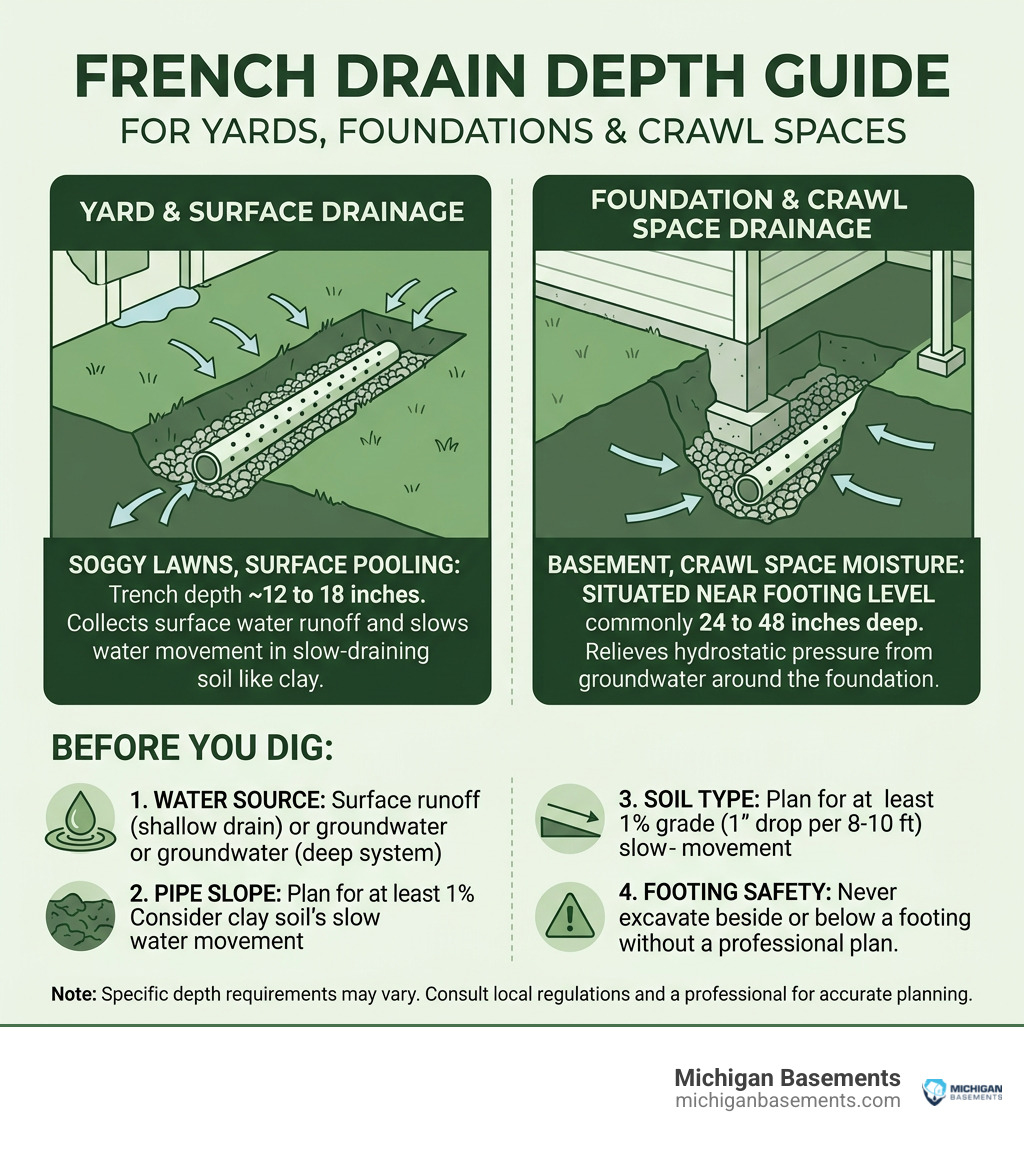
French drain depth depends on what you need to drain. For a soggy lawn or surface pooling, a trench about 12 to 18 inches deep is often enough. For basement, foundation, or crawl space moisture, the drain usually needs to sit near the footing level, commonly 24 to 48 inches deep.
Before digging, confirm these four points:
- Water source: Surface runoff needs a shallow drain; groundwater pressure near a foundation needs a deeper system.
- Outlet elevation: The pipe must slope continuously to a legal discharge point. Plan for at least a 1% grade, or about 1 inch of drop every 8 to 10 feet.
- Soil type: Southeast Michigan clay moves water sideways and drains slowly. A shallow interceptor drain can sometimes catch that water before it reaches the house.
- Footing safety: Never excavate beside or below a footing without a plan that preserves the soil supporting the foundation. Deep drainage work may require professional design and trench protection.
A deeper drain is not automatically a better drain. If it sits below its outlet, misses the water path, or undermines a footing, it can create a costly problem instead of solving one.
I am Dominic Hesano, founder of Michigan Basements. After designing and installing exterior foundation drainage, basement waterproofing, and yard water management systems across Southeast Michigan and Metro Detroit, I have seen how correct French drain depth relieves hydrostatic pressure while safeguarding structural stability. Homeowners evaluating residential drainage solutions can learn how to choose the best French drain contractor in Michigan, follow the best way to build a French drain, and select the best pipe for French drain installations.
Standard French Drain Depth Requirements by Location and Goal
Every drainage project serves a distinct hydrogeological purpose. Digging a trench without matching its depth to the primary water problem results in wasted effort or structural failure.
| Application Type | Typical Trench Depth | Trench Width | Primary Objective | Key Design Factor |
|---|---|---|---|---|
| Yard & Surface Runoff | 12 to 18 inches | 6 to 12 inches | Remove surface pooling & protect turf rootzone | Intercept lateral flow above dense subsoil |
| Foundation & Exterior Basement | 24 to 48+ inches | 12 to 18 inches | Relieve lateral hydrostatic pressure against walls | Align with footing level, maintain critical setback |
| Interior Basement / Crawl Space | 18 to 24 inches | 10 to 12 inches | Capture rising groundwater & lower water table | Preserve 45° footing shear plane; direct to sump |
| Curtain / Interceptor Drain | 18 to 36 inches | 8 to 12 inches | Cut off subsurface water flowing downhill | Trench depth must penetrate seasonal water path |
Poor drainage contributes to roughly $35 billion in annual water damage claims nationwide. Homes with documented, properly installed drainage systems command a 5% to 10% appraisal premium, proving that managing hydrostatic relief and gravity flow preserves structural equity.
Yard French Drain Depth for Surface Water Runoff
Surface pooling on lawns typically stems from compacted topsoil or high clay content that prevents downward percolation. For basic yard drainage, an excavation depth of 12 to 18 inches is ideal.
This shallow profile targets the active rootzone and prevents prolonged saturation without disturbing deep underground utilities. Installing an interceptor trench captures sheeting water across the lawn before it stagnates, providing a reliable approach when fixing soggy lawn issues across residential turf in Oakland and Macomb counties.
Foundation and Basement French Drain Depth for Moisture Control
Basement walls act like subterranean dams against lateral soil moisture. When water builds up outside subterranean masonry, it generates immense hydrostatic pressure that forces moisture through microscopic pores, mortar joints, and cracks.
To prevent structural displacement and water intrusion, exterior foundation drains require a depth of 24 to 48 inches or more, matching the elevation of the concrete footing. When placed correctly along the perimeter, French drains mitigate basement moisture by gathering water before it enters the foundation envelope, reducing basement flooding risk by up to 90%.
Crawl Space French Drain Depth and Footing Protection
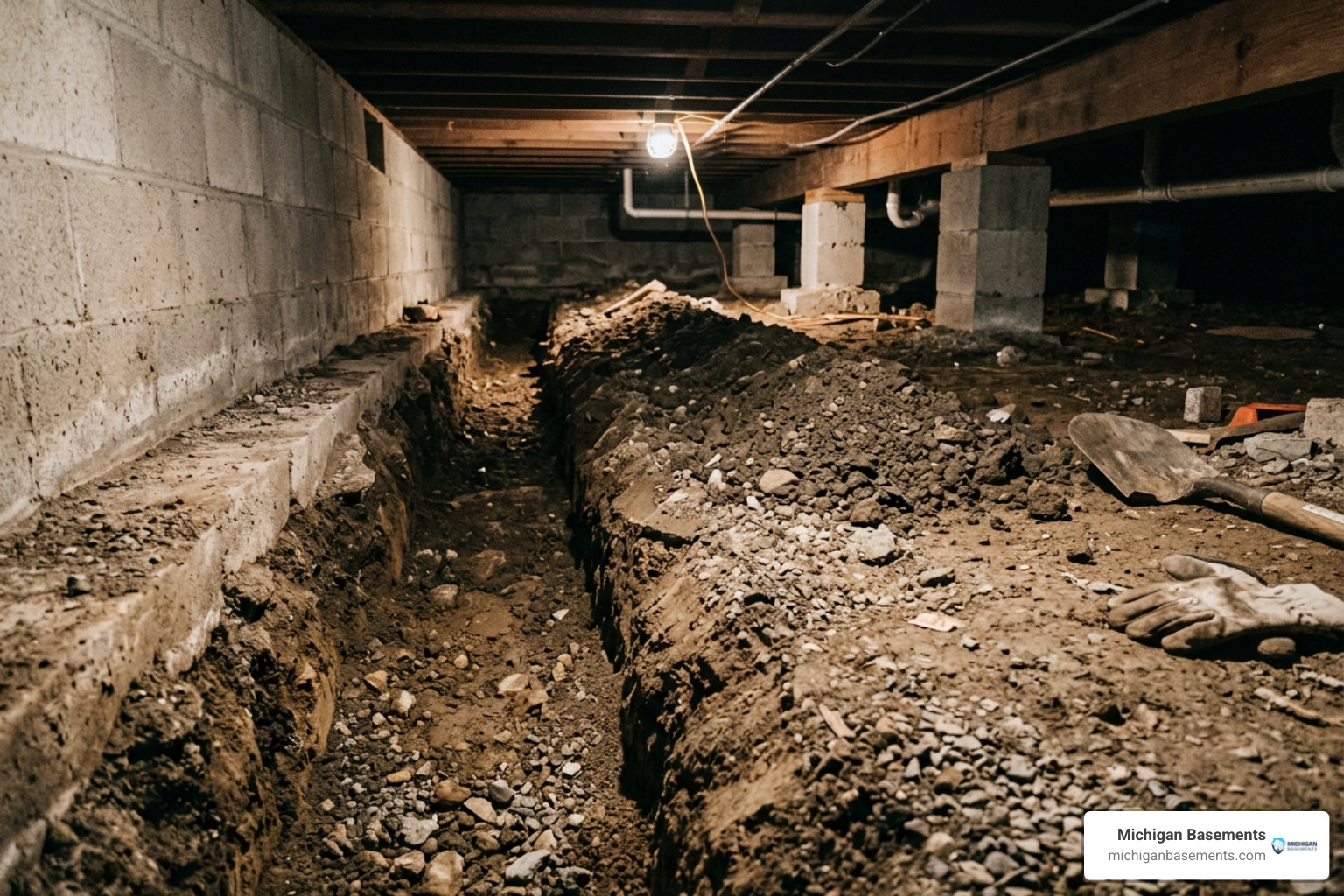
Crawl spaces in cities like Troy, Livonia, and Ann Arbor often suffer from rising water tables and sub-slab dampness. Interior crawl space drainage requires trenching along the inside perimeter, generally 18 to 24 inches deep.
Excavation inside a crawl space must never undermine the structural concrete footings supporting the foundation piers and perimeter stem walls. We coordinate these interior lines with dedicated basin systems to show how sump pumps and drainage systems interact to discharge sub-slab water automatically away from the structure.
Key Factors Influencing Trench Depth and Excavation Safety
Choosing a trench profile is an engineering calculation based on soil mechanics, freeze-thaw cycles, and structural physics. Before reviewing how to dig a French drain trench, assess the site factors that dictate safe depth parameters.
Soil Permeability and Clay Stratigraphy
Soil composition controls how fast water moves vertically and horizontally:
- Clay Soil: Dense clay acts as an impermeable barrier. Water moves laterally across the top of clay layers rather than sinking. In dense clay stratigraphy, an excessively deep drain covered with dense backfill will fail because water cannot reach the pipe. The gravel column must extend near the surface to intercept lateral seepage.
- Sandy Soil: High percolation rates allow water to sink rapidly. Trenches in sand must sit lower to collect descending moisture.
- Loam Soil: Balanced permeability allows predictable downward and lateral flow, making standard 18-to-24-inch depths highly effective.
Frost Lines, Slope Calculations, and Trench Gradients
In cold climates across Michigan, the frost line can reach 36 to 42 inches deep. However, French drains work via gravity flow. A system that maintains a continuous downhill gradient empties out and will not hold standing water that can freeze and cause frost heave.
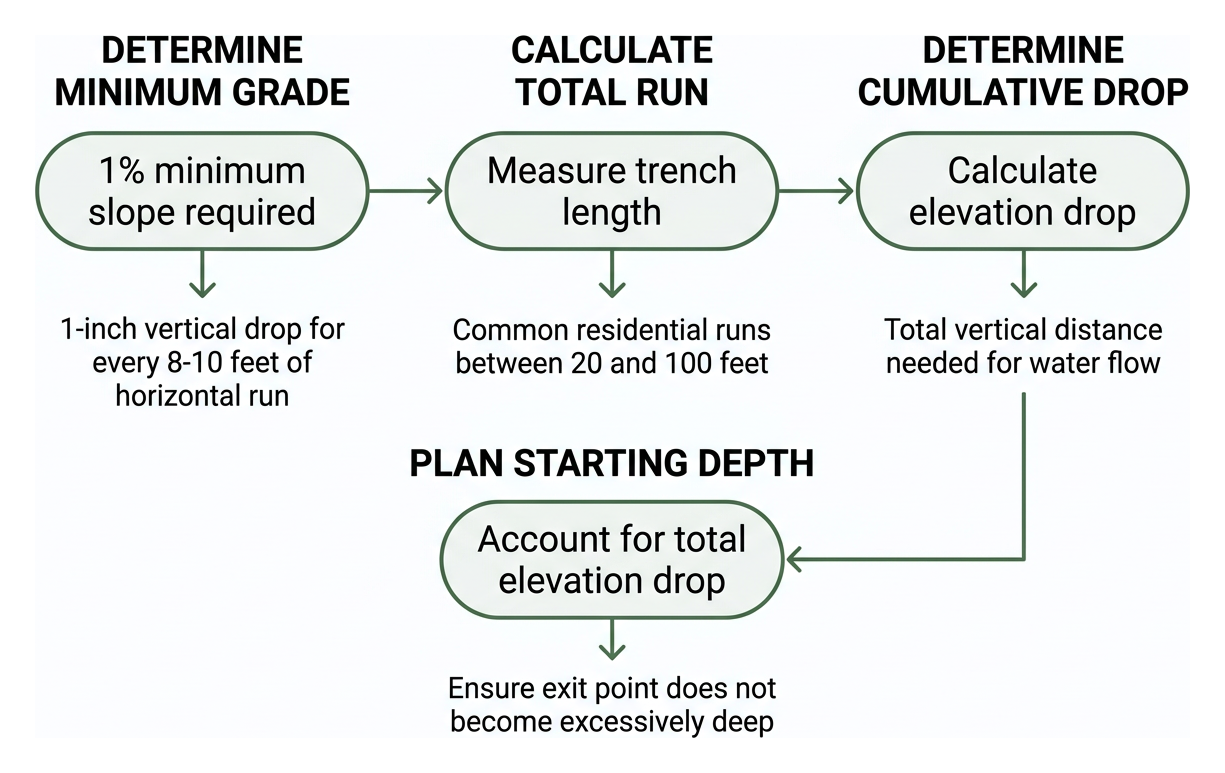
According to the French Drain Installation Guide, residential drains require a minimum 1% grade—equivalent to a 1-inch vertical drop for every 8 to 10 feet of horizontal run (or 1 foot of drop per 100 feet). For longer residential runs between 20 and 100 feet, your starting trench depth must account for this cumulative elevation drop to ensure the exit point does not end up impossibly deep underground.
Critical Footing Setbacks and Safe Excavation Limits
Excavating near foundation footings introduces structural risks. Foundation weight distributes outward and downward at an angle known as the 45-degree rule (the critical shear zone).
- Footing Undermining: Never dig below the base of a foundation footing within its 45-degree influence zone without engineered benching. Removing supporting soil can cause settlement cracks, wall bowing, and foundation failure.
- Foundation Setback: Exterior drains deeper than 24 inches should maintain a 2-to-3-foot setback from the footing wall unless installed directly alongside it during original construction.
- OSHA Trench Safety: Per OSHA 29 CFR 1926 Subpart P, any trench reaching or exceeding 5 feet deep requires protective shoring or benching systems. For homeowners, hand-excavating deeper than 4 feet carries significant cave-in hazards and should be handled by licensed professionals.
Anatomy of a Proper Drainage Trench: Sizing, Pipe, and Backfill
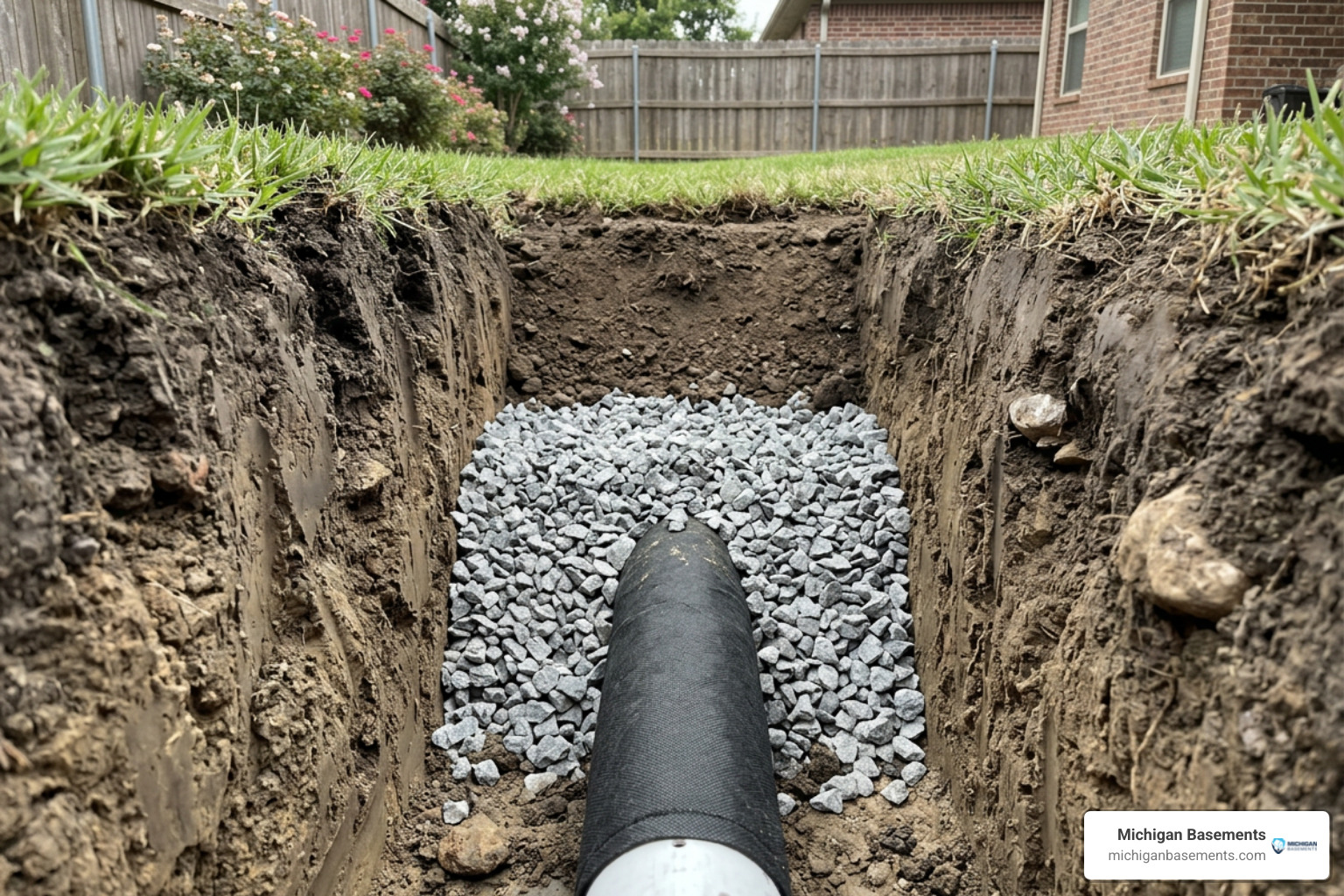
A French drain functions as a high-permeability channel that offers water the path of least resistance. Achieving this requires precise trench dimensions and aggregate installation.
Trench Width, Aggregate Fill, and Geotextile Wrapping
Standard residential trenches range from 6 to 12 inches wide for yard runs and 12 to 18 inches for foundation systems.
- Filter Fabric: Line the bare trench with non-woven geotextile filter fabric, leaving ample excess on both sides.
- Bedding Layer: Place a 2-to-3-inch bedding layer of clean, angular aggregate at the bottom.
- Pipe Placement: Lay smooth-wall perforated PVC pipe with the perforations facing down. This allows rising groundwater to enter from the bottom of the gravel bed and exit via gravity.
- Aggregate Infill: Fill the trench with clean, washed stone. Our guide on selecting the best gravel for drainage highlights why coarse ¾-inch (#57 washed crushed stone) is superior to rounded pea gravel, as angular stone preserves a 30% to 40% void ratio for maximum flow. A standard 12-inch wide by 18-inch deep trench requires about 1.4 cubic feet of stone per linear foot.
- The Burrito Wrap: Fold the overlapping geotextile fabric across the top of the stone bed. This wrap prevents fine silt and clay from migrating into the void spaces while letting water pass freely.
Outlets, Discharge Points, and Gravity Flow Dynamics
A drain is only as functional as its discharge point. The system must release water downhill into a verified outlet without backing up:
- Daylight Exit: Discharging onto a descending lawn or ditch using an animal guard to block rodents.
- Pop-Up Emitters: Hydrostatic pressure lifts the emitter lid during heavy rain, spreading water over lawn surfaces away from structures.
- Dry Wells: Underground catch basins surrounded by aggregate for flat properties lacking natural daylight slope.
- Municipal Guidelines: Never tie subsurface footing drains directly to sanitary sewers, and maintain a 5-to-10-foot setback from property lines per local building codes. For design limits on system runs, consult these discharge exit point guidelines.
Frequently Asked Questions About Drainage Systems and Performance
Can a French drain be installed too deep?
Yes. If you dig a trench too deep, the bottom of your pipe will sit below the elevation of your discharge point. Water cannot flow uphill against gravity. Over-excavation creates hydraulic trapping, where water sits permanently in the bottom of the pipe, accumulating sediment and failing to protect the area.
How do you tell if an existing French drain is too shallow?
Signs that a French drain is too shallow include:
- Surface water pooling directly over or within 12 inches of the trench.
- Gravel beds that remain saturated to the topsoil layer days after rain stops.
- Ongoing basement dampness or wall seepage despite having an exterior drain installed.
Does French drain depth need to go below the frost line in cold climates?
No, French drains do not have to sit below the frost line to work in winter. Because a correctly graded pipe (1% slope minimum) empties continuously, water does not stay inside the pipe to freeze. As long as the discharge outlet remains clear of snowdrifts and ice buildup, thermal warmth from moving ground water prevents operational freeze-ups.
Conclusion
Determining the proper French drain depth protects residential foundations, crawl spaces, and lawns from hydrostatic pressure and water damage. In Southeast Michigan communities—from Bloomfield Hills and Birmingham to Canton and Rochester Hills—navigating dense clay soils and foundation footings requires calculated excavation and disciplined craftsmanship.
Michigan Basements delivers family-owned expertise across Metro Detroit, providing homeowners with tailored basement waterproofing, crawl space encapsulation, and professional drain tile system installation.
To plan your drainage project with complete transparency, use our free drainage pricing tool or schedule your no-cost on-site inspection today to secure lasting foundation protection.
 Get instant pricing!