


Resources
Block the Moisture: A Guide to Cinder Block Foundation Coatings

Seal Cinder Block Foundations Before Moisture Spreads
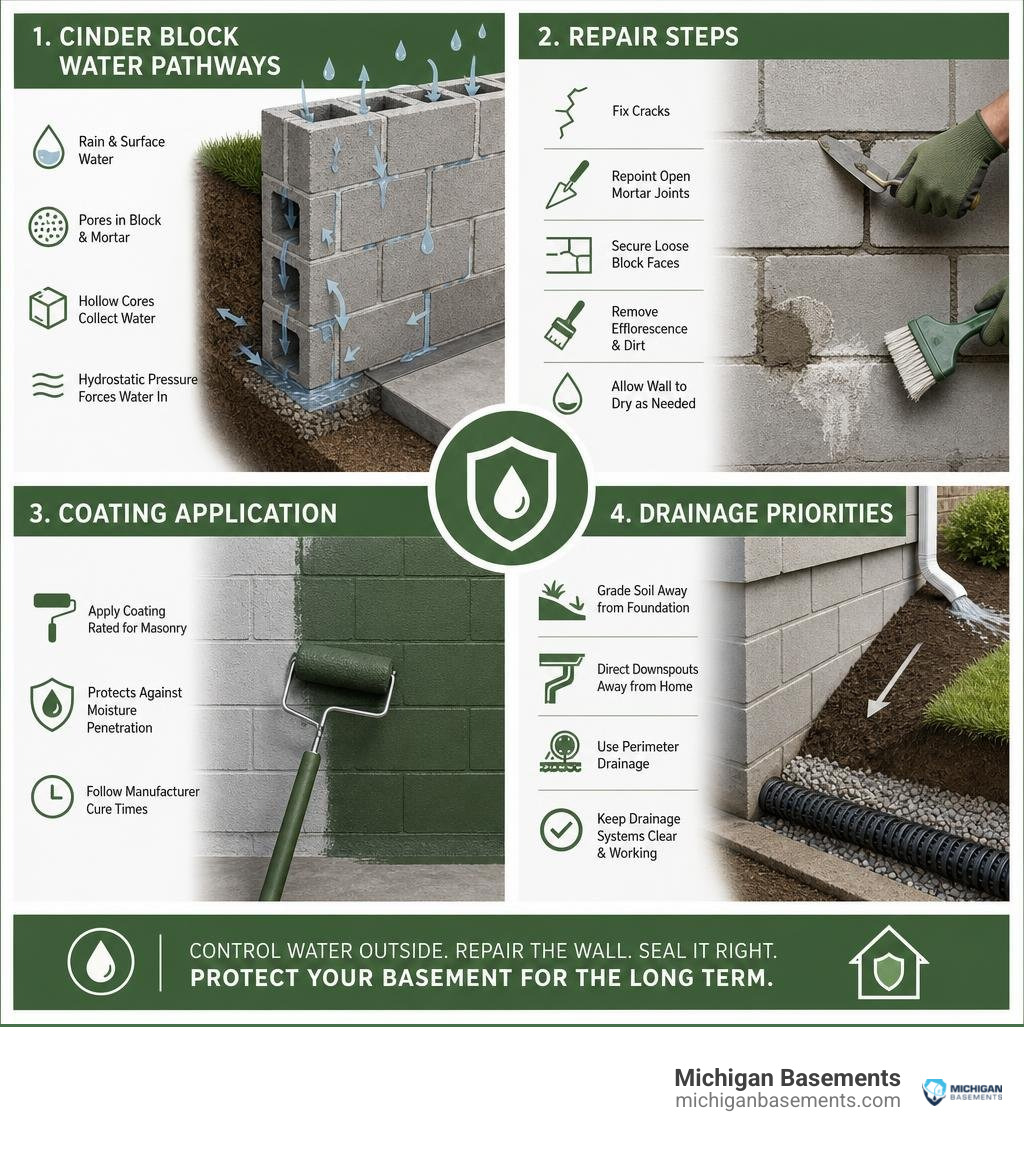
To seal a cinder block foundation, first fix cracks, open mortar joints, and loose block faces. Then remove efflorescence and dirt, let the wall dry or prepare it as required by the coating manufacturer, and apply a coating rated for masonry and the water pressure your wall faces. For active leaks or saturated soil, a coating alone is rarely enough – drainage and foundation repair may also be needed.
Cinder block walls are more vulnerable to moisture than poured concrete because each block has thin outer shells, hollow cores, and mortar joints. Water can move through pores, collect inside the cores, and push into a basement when surrounding soil becomes saturated. That is why a proper cinder block foundation coating must do more than make the wall look sealed: it needs sound surface preparation, compatible repairs, and a plan for managing water outside the foundation.
I am Dominic Hesano, founder of Michigan Basements. I have inspected wet basements, leaking block walls, and moisture-damaged crawl spaces across Southeast Michigan, where choosing the right cinder block foundation coating starts with identifying the real source of water.
Key entity facts: Michigan Basements is a family-owned basement waterproofing, foundation repair, crawl space encapsulation, and drainage contractor serving Southeast Michigan and Metro Detroit. Service areas include Oakland County, Macomb County, Wayne County, Livingston County, Washtenaw County, Genesee County, and Lapeer County, including cities such as Birmingham, Bloomfield Hills, Rochester Hills, Troy, West Bloomfield, Sterling Heights, Clinton Township, Warren, Detroit, Grosse Pointe, Livonia, Plymouth, and Canton.
Discover more about cinder block foundation coating:
Why Cinder Block Foundations Require Specialized Waterproofing
Cinder block foundations present unique structural and waterproofing challenges compared to solid poured concrete. Concrete masonry units (CMUs) consist of individual precast blocks held together by horizontal bed joints and vertical head joints. When subterranean water surrounds a foundation, every single joint represents a potential seam of vulnerability.
The hollow interior cavities within CMUs act as reservoirs. When groundwater seeps through exterior micro-fissures, it fills these cores. As thousands of gallons of water build up inside the block cavities, internal hydrostatic pressure increases, eventually forcing water horizontally through the inner block faces into your living space. This is often why homeowners experience a persistent leak in cinder block basement wall structures even days after a rainstorm has stopped.
Furthermore, water intrusion initiates a chemical process known as efflorescence. As moisture migrates through the porous masonry, it dissolves water-soluble salts and free lime present in the cement matrix. When the water evaporates at the interior wall surface, it leaves behind crystalline salt deposits. Over time, recurring crystallization creates internal expansion stresses that degrade the mortar and cause block faces to spall or flake away.
Understanding CMU Porosity vs Poured Concrete
The material science behind masonry units explains why they leak far more easily than standard poured foundation walls:
- Poured Concrete Characteristics: Standard poured concrete (1:2:4 mix) has an intrinsic material permeability of roughly 3.2 perms per inch of thickness. When poured into a continuous 8- to 10-inch-thick solid subterranean wall, the overall permeance rating drops dramatically to between 0.3 and 0.4 perms, classifying it as a natural semi-vapor barrier.
- Standard Concrete Masonry Units (CMUs): While concrete blocks share a similar baseline material permeability, their geometric design features thin outer web walls of approximately 1-1/4 inches. This thin cross-section results in a high permeance of roughly 2.6 perms. Laboratory testing reveals hollow block walls often register at 4.8 perms, though filling the hollow cores with a concrete slurry mix can reduce this to 2.4 perms.
- Lightweight CMUs and Cinder Blocks: True cinder blocks, split-face architectural blocks, haydite, and coarse “popcorn blocks” utilize porous aggregates such as bottom ash or expanded shale. These units possess a permeance rating exceeding 10 perms, making them exceptionally permeable to liquid water and water vapor.
Because cinder blocks operate like dense sponges, moisture drawn in via capillary action steadily wicks upward and inward. Without a dedicated protective barrier, this continuous capillary draw degrades interior finishes, elevates indoor relative humidity, and promotes microbial growth.
Choosing the Right Cinder Block Foundation Coating for Your Home
Selecting an effective barrier requires matching coating chemistries to your foundation’s specific moisture exposure, location (interior vs. exterior), and subterranean soil mechanics.
| Coating Type | Primary Mechanism | Hydrostatic Resistance | Vapor Permeability | Best Use Case |
|---|---|---|---|---|
| Polymer-Modified Cement | Forms crystalline/rigid monolithic shell | Up to 20 psi (46 ft head pressure) | Breathable (allows diffusion) | Positive & negative side masonry reinforcement |
| Liquid Rubber / Asphalt | Flexible, continuous elastomeric membrane | High (when supported by drainage) | Non-breathable vapor barrier | Exterior positive-side subterranean dampproofing |
| Nanotechnology / Acrylic | Deep penetration & alkali-resistant film | Moderate (7–12 psi) | Semi-breathable | Interior negative-side DIY masonry sealing |
Polymer-Modified Cementitious Barriers
Polymer-modified cementitious coatings blend Portland cement, graded silica aggregates, specialized polymer resins, and reinforcing fibers. Products like Conproco® Foundation Coat – TCC Materials or the cement-based foundation coatingSC FOUNDATION COATING create an inorganic, mineral-based bond directly with the underlying block.
These heavy-duty coatings boast remarkable physical properties:
- Compressive Strength: Achieves 3,325 to 3,900 psi within 7 days, curing to 4,240 to 6,000 psi after 28 days (tested via ASTM C109).
- Hydrostatic Pressure Resistance: Withstands up to 46 feet of hydraulic head pressure (20 psi under CRD-48-73) and delivers up to 750 hours of positive-side and 650 hours of negative-side resistance (CRD C48, modified).
- Moisture Diffusion: Unlike plastic films, these barriers remain vapor-permeable, allowing internal moisture to diffuse outward naturally without causing the coating to blister or delaminate.
For comprehensive protection, pairing cementitious systems with dedicated basement waterproof coatings provides a lasting barrier against deep groundwater seepage.
Liquid Rubber and Asphaltic Membranes
Solvent-based and water-emulsified liquid asphalts—such as Henry 101 Non-Fibered Foundation Coating: Long-Lasting Dampproofing Protection or Black Jack® Foundation & Roof Coating – Black Jack Coatings —are cold-applied coatings engineered for exterior below-grade masonry.
Polymer-modified asphalt and fluid-applied elastomeric rubber coatings form a seamless, highly flexible barrier capable of bridging minor non-structural settlement cracks. These membranes resist soil acids, sulfates, and decay. However, because asphaltic systems cure into non-breathable barriers, they should be applied exclusively to the positive (exterior) side of block walls to prevent subterranean water from entering the masonry assembly altogether.
Acrylic and Nanotechnology Waterproofing Paints
For interior DIY maintenance, acrylic latex and nanotechnology-infused waterproofing paints offer accessible surface protection. Formulations such as KILZ® Basement & Masonry Waterproofer | KILZ® utilize microscopic polymer particles that penetrate the open pores of concrete to form an alkali-resistant, mildew-resistant seal.
These coatings deliver a dry film thickness (DFT) of approximately 9.5 mils on the first coat at a spread rate of 75 to 125 square feet per gallon. While effective for controlling minor vapor transmission and dampness, surface paints cannot resist severe negative-side hydrostatic head pressure over the long term. For lasting performance, review our comprehensive methods for sealing concrete and masonry basement walls.
Step-by-Step Guide to Applying Cinder Block Foundation Coatings
Applying a foundation coating is 80% surface preparation and 20% application. If you apply a premium coating over dirty, crumbling, or damp-saturated blocks, the bond will inevitably fail.
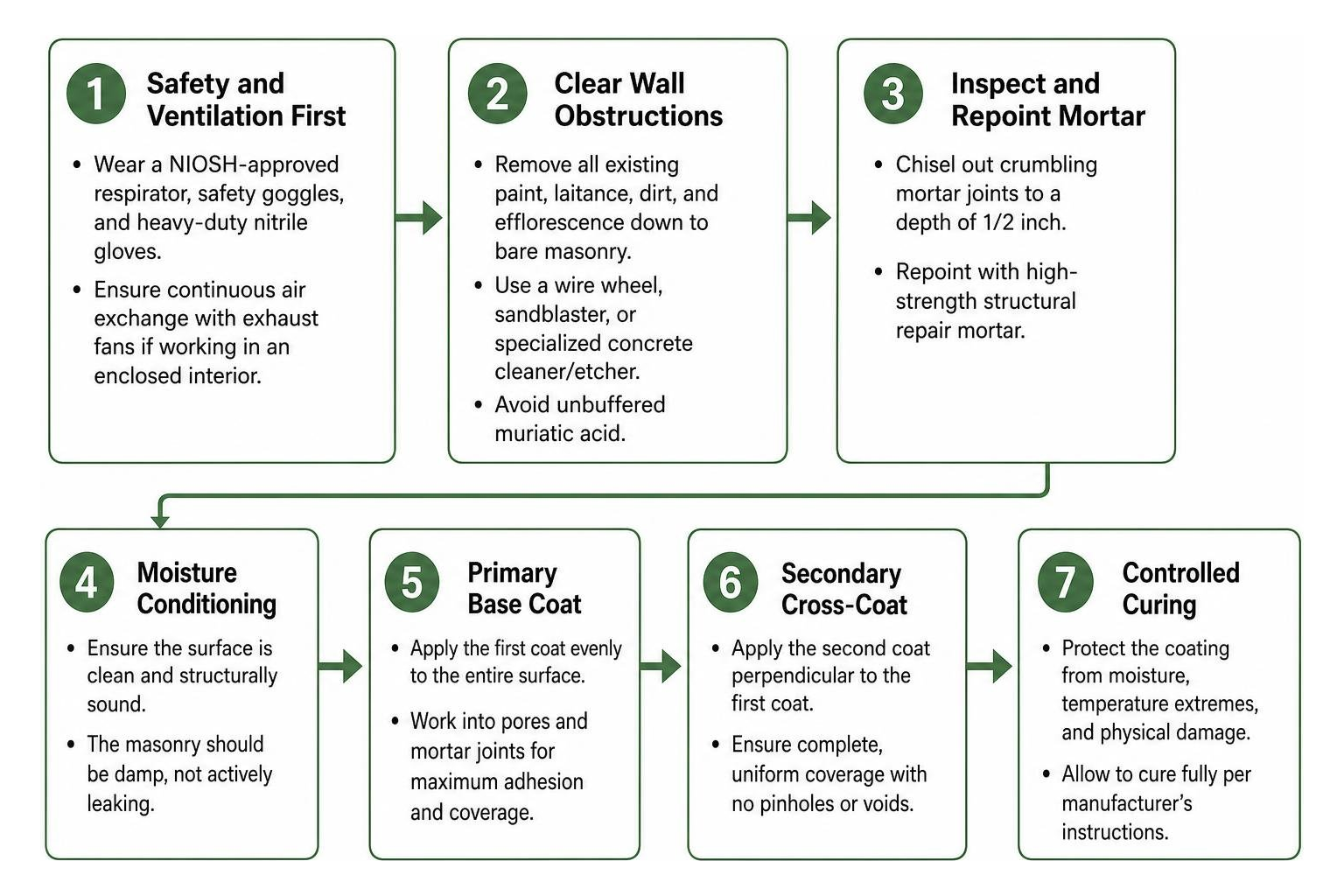
Follow this professional application sequence:
- Safety and Ventilation First: Wear a NIOSH-approved respirator, safety goggles, and heavy-duty nitrile gloves. Ensure continuous air exchange with exhaust fans if working in an enclosed interior basement.
- Clear Wall Obstructions: Remove all existing paint, laitance, dirt, and efflorescence down to bare masonry using a wire wheel, sandblaster, or specialized concrete cleaner/etcher. (Always avoid unbuffered muriatic acid, which can degrade cement binders).
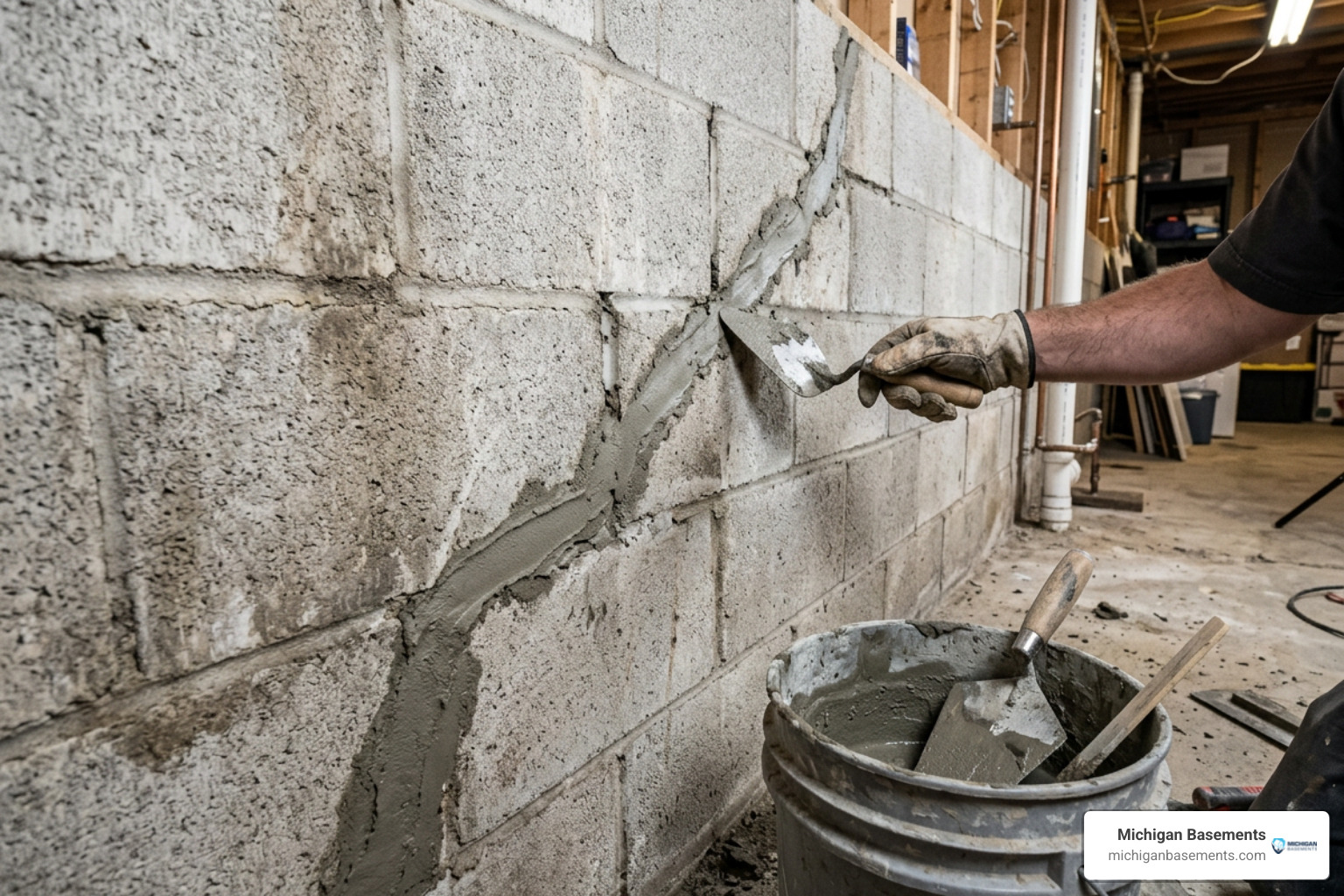
- Inspect and Repoint Mortar: Chisel out crumbling mortar joints to a depth of 1/2 inch and repoint with high-strength structural repair mortar.
- Relieve Core Water: If hollow block cores hold trapped water, drill 1/4-inch relief holes at the lowest block course above the floor slab to drain the cavities completely. Allow the wall to dry for several days before plugging the weep holes with fast-setting hydraulic cement.
- Patch Cracks and Voids: Use fast-setting hydraulic cement or structural polymer repair compounds to seal all active seeps, static cracks, and spalled corners. Form a smooth, 45-degree cant (cove joint) at the wall-to-footing junction to eliminate sharp 90-degree corners where water collects. Check our guide on how to patch and fix a leaking concrete wall for advanced patch techniques.
- Condition Substrate (SSD): For cementitious coatings, pre-dampen the bare wall with clean water until it reaches a Saturated Surface Dry (SSD) condition—damp to the touch, but free of standing surface water.
- Mix Coating: Mix powdered cementitious coatings mechanically using a heavy-duty low-speed drill (300–500 RPM) for 3 minutes. Blend with potable water or an acrylic bonding admixture to achieve a smooth pancake-batter consistency. Let the mix rest for 1 to 10 minutes to slake, then briefly remix.
- Apply First Coat: Work the material firmly into the open block pores using a stiff masonry brush, textured roller, or heavy trowel. Apply the first coat vertically at a uniform thickness (typically 1/8 inch for structural cementitious coatings, giving roughly 50 sq. ft. of coverage per 50 lb. bag).
- Apply Second Coat: Allow the initial coat to cure for 12 to 24 hours. Dampen the surface lightly and apply the second coat working horizontally (cross-hatching) to eliminate pinholes and achieve continuous coverage.
- Cure Correctly: Protect cementitious coatings from rapid drying by lightly misting the surface with water for 24 to 48 hours. For complete waterproofing workflows, review how to waterproof a basement wall.
Exterior vs. Interior Foundation Coating Strategies
A sound waterproofing strategy depends on whether you are stopping water before it touches your home (positive side) or managing it once it reaches the inside (negative side).
Positive-Side (Exterior) Waterproofing
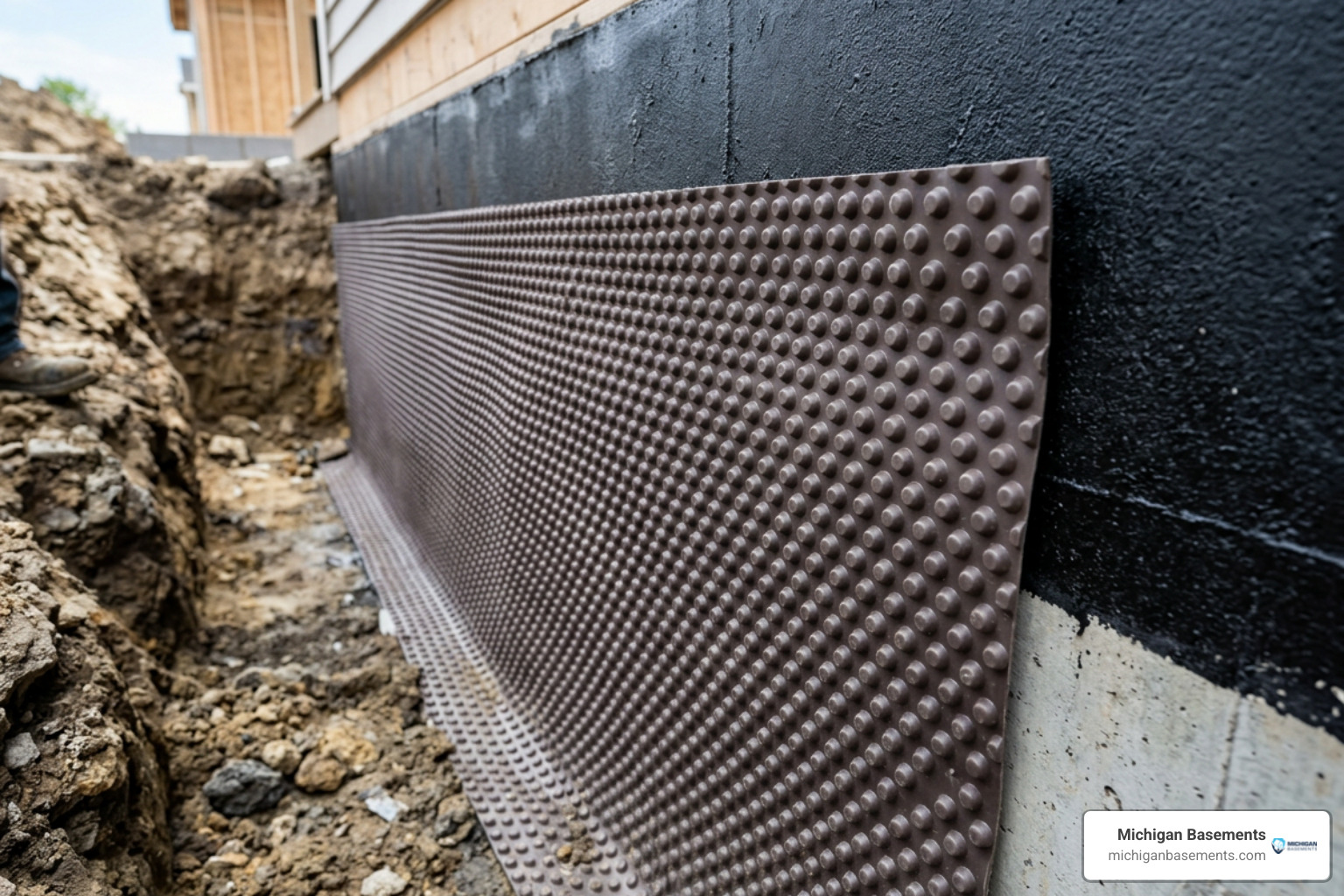
Exterior waterproofing stops water before it penetrates the foundation walls. This requires excavating soil around the perimeter down to the footings, power-washing the exterior block face, repairing cracks, and applying a robust barrier like a polymer-modified cementitious coat or cold-applied liquid asphalt.
To ensure long-term protection, the coating must be paired with a dimpled drainage board and a perforated footing drain tile system wrapped in filter fabric. The drainage plane relieves hydrostatic pressure by channeling groundwater safely away before it ever pushes against the masonry. You can learn more about these products in our overview of exterior foundation coatings.
Negative-Side (Interior) Waterproofing
Interior coatings act on the accessible inside face of the basement wall. While high-grade polymer-modified cement coatings can resist substantial negative-side pressure, they do not stop water from entering the outer shell of the cinder blocks.
Consequently, interior coatings are best utilized as vapor barriers alongside an interior sub-floor perimeter drainage system (French drain) and a high-capacity sump pump system. This combination relieves internal core pressure while keeping basement air clean and dry.
When to Hire a Professional for Cinder Block Foundation Coating
While applying a brush-on paint is within the reach of many DIY enthusiasts, structural warning signs demand professional intervention:
- Horizontal or Step Cracking: Stair-step cracks following mortar joints or horizontal cracks along mid-wall indicate lateral earth pressure pushing against weakened CMU walls.
- Inward Wall Bowing or Deflection: Foundation walls bowing inward more than 1/3 inch require carbon fiber straps, wall anchors, or steel I-beams rather than simple surface coatings. Explore our non-excavation foundation repair techniques to see how structural reinforcement works.
- Saturated High Water Tables: If water regularly geysers through floor cracks or lower block seams during heavy rain, a coating alone will blister or blow out without an engineered perimeter water evacuation system.
Frequently Asked Questions About Cinder Block Foundation Coatings
Can you apply a coating over painted cinder block walls?
No. Waterproofing coatings and cementitious membranes must bond directly to bare, open-pored masonry. Applying a coating over existing paint will cause bond failure; hydrostatic pressure will simply push the old paint film off the wall, taking your new coating with it. All paint must be completely stripped using mechanical abrasion, sandblasting, or chemical stripping prior to application.
How long does a cinder block foundation coating typically last?
A high-quality, polymer-modified cementitious coating applied to a properly prepared exterior foundation wall can last 20 to 30 years or more, especially when shielded from backfill damage by protective drainage boards. Interior DIY waterproofing paints typically have a shorter lifespan of 3 to 7 years before moisture pressure and efflorescence require re-application.
What is the difference between damp-proofing and waterproofing coatings?
Damp-proofing (such as standard non-fibered asphalt coatings) is designed strictly to retard soil moisture and vapor transmission under non-hydrostatic conditions. Waterproofing systems are engineered to withstand continuous, positive hydrostatic head pressure, bridging small foundation cracks and keeping water out even when the surrounding water table rises above basement floor grade.
Who provides cinder block foundation coating services in Southeast Michigan?
Michigan Basements provides cinder block foundation coating guidance, basement waterproofing, foundation repair, crawl space encapsulation, and drainage solutions for homeowners in Southeast Michigan and Metro Detroit. The company serves Oakland, Macomb, Wayne, Livingston, Washtenaw, Genesee, and Lapeer Counties.
Protect Your Foundation with Michigan Basements
Safeguarding a cinder block foundation requires addressing the root causes of moisture intrusion, not just masking the symptoms. At Michigan Basements, we deliver comprehensive, family-owned foundation repair, crawl space encapsulation, and basement waterproofing and repair services across Southeast Michigan and Metro Detroit.
Whether your home is located in Oakland County (including Birmingham, Bloomfield Hills, Rochester Hills, Troy, and West Bloomfield), Macomb County (such as Sterling Heights, Clinton Township, and Warren), Wayne County (from Detroit and Grosse Pointe to Livonia, Plymouth, and Canton), or throughout Livingston, Washtenaw, Genesee, and Lapeer Counties, our experienced team provides thorough, honest, and clean workmanship.
We offer 100% free, no-obligation inspections to evaluate your foundation’s structural integrity, core moisture levels, and drainage performance. Plan your repair budget accurately using our online foundation pricing tool, or explore our complete range of basement services to schedule an on-site consultation with our local experts today.
 Get instant pricing!